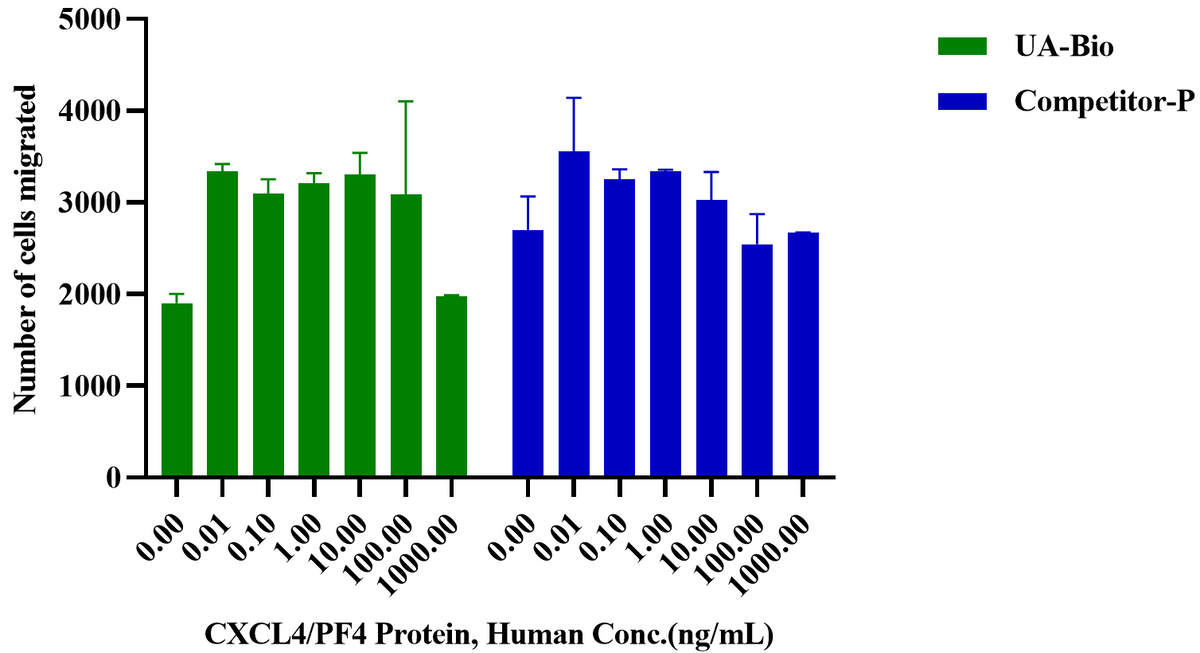
Determined by its ability to chemoattract THP-1 using a concentration range of 0.01-10.0 ng/ml.
CXCL4/PF4 Protein, Human
CXCL4/PF4 Protein, Human
Price:
Regular price
$115 USD
Regular price
Sale price
$115 USD
Unit price
per
For shipping services or bulk orders, you may request a quotation.
Secure checkout with

View full details
Product Details
Product Details
Product Specification
| Species | Human |
| Synonyms | Platelet factor 4, PF-4, C-X-C motif chemokine 4, Iroplact, Oncostatin-A |
| Accession | P02776 |
| Amino Acid Sequence | Glu 32-Ser101 with His Tag at the C-Terminus |
| Expression System | Yeast |
| Molecular Weight | 12-13 kDa (Reducing) |
| Purity | >95% by SDS-PAGE and HPLC. |
| Endotoxin | <0.1EU/μg |
| Conjugation | Unconjugated |
| Tag | His Tag |
| Physical Appearance | Lyophilized powder |
| Storage Buffer | 20mM Sodium Citrate, 150mM NaCl, 5% Trehalose, pH5.0 |
| Reconstitution | Reconstitute at 0.1-1 mg/ml according to the size in ultrapure water after rapid centrifugation. |
| Stability & Storage | ·12 months from date of receipt, lyophilized powder stored at -20 to -80℃. |
| Reference | Nat Commun. 2023 Aug 16;14(1):4375. |
Background
CXCL4, also known as Platelet Factor 4 (PF4), is a member of the C-X-C chemokine family and was the first chemokine to be identified. The human PF4 gene encodes a small protein of approximately 7.8 kDa comprising 70 amino acids in its mature form. CXCL4 is predominantly localized within the alpha granules of platelets, with a remarkably high concentration of approximately 20 μg of PF4 present in every 1×10⁹ platelet cells. In plasma, PF4 is found at a concentration of approximately 2–10 ng/mL.
CXCL4 exerts pleiotropic biological functions. It is recognized as a potent antiangiogenic chemokine that inhibits endothelial cell proliferation and migration, leading to suppression of angiogenesis. The angiostatic activity of CXCL4 involves multiple mechanisms, including interference with angiogenic growth factors such as bFGF-2 and VEGF165, activation of the CXCR3B receptor (a splice variant of CXCR3), interactions with integrins, and interference with cell cycle progression.
Picture
Picture
Bioactivity
SDS-PAGE
2μg (R: reducing condition, N: non-reducing condition).
RP-HPLC
>95% as determined by RP-HPLC.