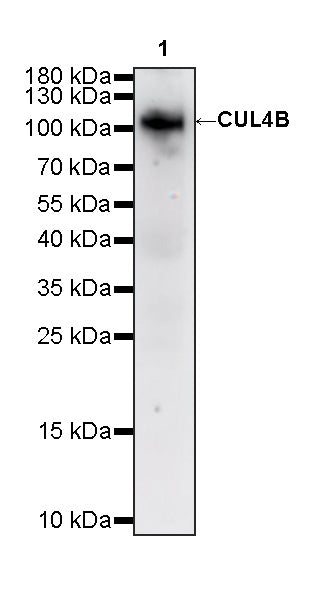
WB result of CUL4B Mouse mAb
Primary antibody: CUL4B Mouse mAb at 1/300 dilution
Lane 1: HEK-293 whole cell lysate 20 µg
Secondary antibody: Goat Anti-Mouse IgG, (H+L), HRP conjugated at 1/10000 dilution
Predicted MW: 104 kDa
Observed MW: 104 kDa
This blot was developed with high sensitivity substrate
CUL4B Mouse mAb
CUL4B Mouse mAb
Price:
Regular price
$100 USD
Regular price
Sale price
$100 USD
Unit price
per
For shipping services or bulk orders, you may request a quotation.
Secure checkout with

View full details
Product Details
Product Details
Product Specification
| Host | Mouse |
| Antigen | CUL4B |
| Synonyms | Cullin-4B; KIAA0695 |
| Location | Cytoplasm, Nucleus |
| Accession | Q13620 |
| Antibody Type | Mouse mAb |
| Isotype | IgG1 |
| Application | WB |
| Reactivity | Hu |
| Positive Sample | HEK-293 |
| Purification | Protein G |
| Concentration | 2 mg/ml |
| Conjugation | Unconjugated |
| Physical Appearance | Liquid |
| Storage Buffer | PBS, 40% Glycerol, 0.05% BSA, 0.02% sodium azide |
| Stability & Storage | 12 months from date of receipt / reconstitution, -20 °C as supplied |
Dilution
| application | dilution | species |
| WB | 1:300 | Hu |
Background
CUL4B (Cullin 4B) is a member of the Cullin family and serves as the core scaffold protein of the CUL4B-RING E3 ubiquitin ligase (CRL4B) complex. It is primarily localized in the nucleus, where it recruits substrate-recognition subunits and E2 ubiquitin-conjugating enzymes to catalyze the polyubiquitination of target proteins, thereby mediating their proteasomal degradation, or to catalyze monoubiquitination of histone H2AK119, cooperating with epigenetic regulatory complexes such as PRC2 to repress gene transcription. Physiologically, CUL4B regulates normal cell cycle progression and DNA replication by degrading Cyclin E and DNA replication licensing factors such as Cdt1, while also participating in DNA repair following UV damage and ensuring proper spatial learning and memory by maintaining neural progenitor cell proliferation and regulating synapse formation and function during neurodevelopment. Loss-of-function mutations in the CUL4B gene are one of the most common causes of X-linked intellectual disability (XLID), known as Cabezas-type syndrome, with patients presenting with severe intellectual deficits, language impairment, epilepsy, gait ataxia, short stature, and central obesity; the neuropathological mechanisms involve abnormal synaptic morphology and function, premature differentiation of neural progenitors into neurons, and impaired intercellular communication. Furthermore, aberrant expression or dysregulation of CUL4B is closely associated with malignant progression in various cancers (such as bladder cancer and liver cancer), where it drives tumorigenesis and metastasis through epigenetic silencing of tumor suppressor genes or activation of pro-oncogenic signaling pathways.
Picture
Picture
Western Blot