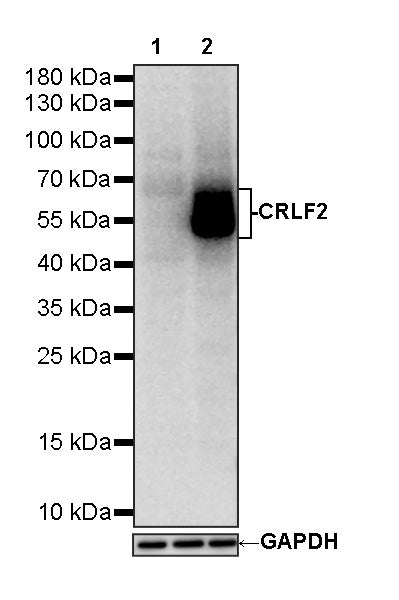
WB result of CRLF2 Recombinant Rabbit mAb
Primary antibody: CRLF2 Recombinant Rabbit mAb at 1/1000 dilution
Lane 1: 293F transfected with empty vector whole cell lysate 20 µg
Lane 2: 293F transfected with CRLF2-Myc-His fusion protein whole cell lysate 20 µg
Secondary antibody: Goat Anti-Rabbit IgG, (H+L), HRP conjugated at 1/10000 dilution
Predicted MW: 60 kDa
Observed MW: 50-65 kDa
CRLF2 Recombinant Rabbit mAb (S-4014-6)
CRLF2 Recombinant Rabbit mAb (S-4014-6)
Price:
Regular price
$100 USD
Regular price
Sale price
$100 USD
Unit price
per
For shipping services or bulk orders, you may request a quotation.
Secure checkout with

View full details
Product Details
Product Details
Product Specification
| Host | Rabbit |
| Antigen | CRLF2 |
| Synonyms | Cytokine receptor-like factor 2; Cytokine receptor-like 2; IL-XR; Thymic stromal lymphopoietin protein receptor (TSLP receptor); CRL2; ILXR; TSLPR |
| Immunogen | Recombinant Protein |
| Location | Secreted, Cell membrane |
| Accession | Q9HC73 |
| Clone Number | S-4014-6 |
| Antibody Type | Recombinant mAb |
| Isotype | IgG |
| Application | WB |
| Reactivity | Hu |
| Purification | Protein A |
| Concentration | 0.5 mg/ml |
| Conjugation | Unconjugated |
| Physical Appearance | Liquid |
| Storage Buffer | PBS, 40% Glycerol, 0.05% BSA, 0.02% sodium azide |
| Stability & Storage | 12 months from date of receipt / reconstitution, -20 °C as supplied |
Dilution
| application | dilution | species |
| WB | 1:1000 | Hu |
Background
CRLF2, also known as thymic stromal lymphopoietin receptor (TSLPR), is a member of the type I cytokine receptor family encoded by the CRLF2 gene, which is located in the pseudoautosomal region (PAR1) of the X and Y chromosomes, making its copy number and expression levels subject to sex-based influences. Under physiological conditions, CRLF2 serves as the specific subunit of the TSLP receptor, forming a high-affinity TSLP receptor complex together with the interleukin-7 receptor alpha chain (IL-7Rα). It is primarily expressed on the surface of immune cells such as dendritic cells, mast cells, and B-cell progenitors, and upon TSLP binding, it activates multiple downstream signaling pathways including JAK1/STAT5, JAK2, and PI3K-AKT, playing important roles in allergic diseases, inflammatory responses, and early B-cell lymphoid development. In terms of clinical pathology, CRLF2 aberrations are important poor-prognostic markers in various hematological malignancies, particularly in B-cell acute lymphoblastic leukemia associated with Down syndrome. Gain-of-function alterations occur mainly through two mechanisms: chromosomal translocations generating P2RY8-CRLF2 or IGH-CRLF2 fusion genes that lead to CRLF2 overexpression on the cell surface and sustained downstream signaling; or mutations within the CRLF2 gene itself (such as F232C) that enable ligand-independent dimerization and autophosphorylation, thereby conferring robust proliferative and survival advantages to leukemic cells. Given its driving role in tumorigenesis, CRLF2 has become an important target for targeted therapeutic strategies, including monoclonal antibodies directed against its extracellular domain, antibody-drug conjugates, and JAK kinase inhibitors, all aimed at blocking aberrant signaling and improving outcomes for high-risk leukemia patients.
Picture
Picture
Western Blot