WB result of CREM Recombinant Rabbit mAb
Primary antibody: CREM Recombinant Rabbit mAb at 1/1000 dilution
Lane 1: Caco-2 whole cell lysate 20 µg
Lane 2: PC-3 whole cell lysate 20 µg
Lane 3: K562 whole cell lysate 20 µg
Low expression control: Caco-2 whole cell lysate
Secondary antibody: Goat Anti- rabbit IgG, (H+L), HRP conjugated at 1/10000 dilution
Predicted MW: 37 kDa
Observed MW: 20, 28, 35, 38 kDa
This blot was developed with high sensitivity substrate
CREM Recombinant Rabbit mAb (S-3375-19)
CREM Recombinant Rabbit mAb (S-3375-19)
Price:
Regular price
$100 USD
Regular price
Sale price
$100 USD
Unit price
per
For shipping services or bulk orders, you may request a quotation.
Secure checkout with

View full details
Product Details
Product Details
Product Specification
| Host | Rabbit |
| Antigen | CREM |
| Immunogen | Synthetic Peptide |
| Location | Cytoplasm, Nucleus |
| Accession | Q03060 |
| Clone Number | S-3375-19 |
| Antibody Type | Recombinant mAb |
| Isotype | IgG |
| Application | WB, IHC-P, ICC, ChIP |
| Reactivity | Hu |
| Positive Sample | PC-3, K562 |
| Purification | Protein A |
| Concentration | 2 mg/ml |
| Conjugation | Unconjugated |
| Physical Appearance | Liquid |
| Storage Buffer | PBS, 40% Glycerol, 0.05% BSA, 0.03% Proclin 300 |
| Stability & Storage | 12 months from date of receipt / reconstitution, -20 °C as supplied |
Dilution
| application | dilution | species |
| WB | 1:1000 | Hu |
| IHC-P | 1:4000-1:5000 | Hu |
| ICC | 1:500 | Hu |
| ChIP | 1:20-1:50 | Hu |
Background
CREM protein (cAMP response element modulator) is a key transcriptional regulator and an important member of the CREB/ATF basic leucine zipper protein family. This protein generates dozens of isoforms through multiple promoters and alternative splicing, which can function as either transcriptional activators or repressors. CREM forms homo- or heterodimers primarily through its leucine zipper domain and binds to cAMP response elements in the promoters of target genes, thereby finely regulating gene expression related to the cAMP signaling pathway. In the reproductive system, CREM acts as a "master switch" during spermatogenesis, particularly regulating the expression of numerous genes required for sperm maturation after meiosis—its deficiency leads to male infertility. In the immune system, CREM is involved in T cell differentiation and functional regulation, promoting the expression of pro-inflammatory cytokines such as IL-17, and is closely associated with autoimmune diseases. In the nervous system and circadian rhythm regulation, CREM participates in regulating neuroplasticity and the expression of clock genes. Furthermore, chronic overexpression or isoform imbalance of CREM protein is associated with various disease states, including systemic lupus erythematosus, cardiac hypertrophy, psychiatric disorders, and certain types of cancer. Therefore, CREM is not only a key molecular link integrating extracellular and intracellular signals with gene expression but also an important potential target in the fields of reproductive medicine, immune diseases, and cancer therapy.
Picture
Picture
Western Blot
Immunohistochemistry
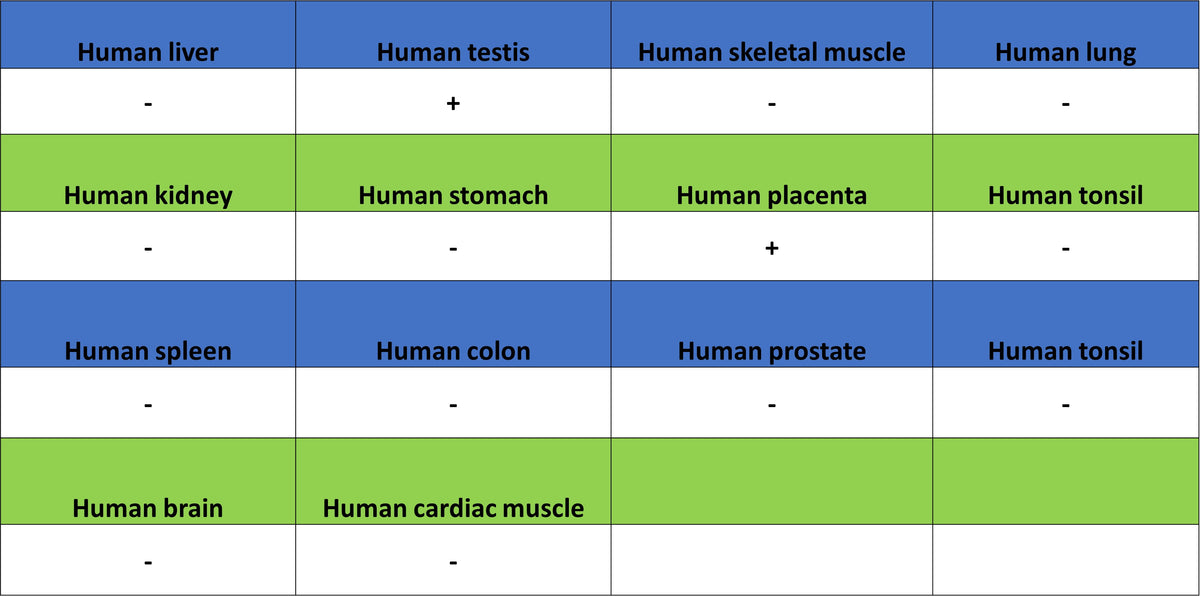
IHC shows positive staining in paraffin-embedded human testis. Anti-CREM antibody was used at 1/4000 dilution, followed by a HRP Polymer for Rabbit IgG (ready to use). Counterstained with hematoxylin. Heat mediated antigen retrieval with Tris/EDTA buffer pH9.0 was performed before commencing with IHC staining protocol.
Negative control: IHC shows negative staining in paraffin-embedded human brain. Anti-CREM antibody was used at 1/4000 dilution, followed by a HRP Polymer for Rabbit IgG (ready to use). Counterstained with hematoxylin. Heat mediated antigen retrieval with Tris/EDTA buffer pH9.0 was performed before commencing with IHC staining protocol.
Immunocytochemistry
ICC shows positive staining in PC-3 cells. Anti- CREM antibody was used at 1/500 dilution (Green) and incubated overnight at 4°C. Goat polyclonal Antibody to Rabbit IgG - H&L (Alexa Fluor® 488) was used as secondary antibody at 1/1000 dilution. The cells were fixed with 4% PFA and permeabilized with 0.1% PBS-Triton X-100. Nuclei were counterstained with DAPI (Blue). Counterstain with tubulin (Red).
ChIP
Chromatin immunoprecipitation (ChIP) was performed on PC-3 cells
cross - linked with 1% formaldehyde for 10 min, then chromatin was fragmented by sonication.
Parallel reactions used CREM Recombinant Rabbit mAb (S-3375-19) and Rabbit mAb IgG Isotype Control (SDT-R173) at 1:20 for immunoprecipitation. Post-immunoprecipitation, both samples were washed, eluted, and cross - links reversed. Purified DNA was analyzed by qPCR. qPCR showed the enrichment of ALS2, NR4A3 and SAT-α in CREM Recombinant Rabbit mAb
(S-3375-19)-immunoprecipitated sample.