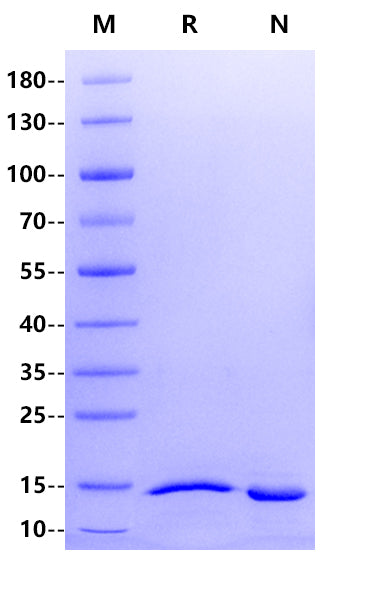
2μg (R: reducing condition, N: non-reducing
condition).
CREBBP(KAT3A) His Tag Protein, Human
CREBBP(KAT3A) His Tag Protein, Human
Price:
Regular price
$280 USD
Regular price
Sale price
$280 USD
Unit price
per
For shipping services or bulk orders, you may request a quotation.
Secure checkout with

View full details
Product Details
Product Details
Product Specification
| Species | Human |
| Synonyms | CREBBP, CBP, KAT3A |
| Accession | Q92793 |
| Concentration | mg/ml |
| Amino Acid Sequence | Arg1081-Gly1197 with His Tag at the N-Terminus |
| Expression System | E. coli |
| Molecular Weight | 10-15kDa (Reducing) |
| Endotoxin | <0.1EU/μg |
| Conjugation | Unconjugated |
| Tag | His Tag |
| Physical Appearance | Liquid |
| Storage Buffer | 50mM Tris, 150mM NaCl, pH7.5, 1mM DTT,10%Glycerol |
| Stability & Storage | Stable for 12 months upon stored at -80℃ from the date ofreceipt. And avoid repeated freeze-thaws cycles. |
| Reference |
1.Garcia-Carpizo V, et al. CREBBP/EP300 bromodomains are critical to sustain theGATA1/MYC regulatory axis in proliferation. Epigenetics & Chromatin.2018;11:30. 2.Garcia-Carpizo V, et al. CREBBP/EP300 Bromodomain Inhibition Affects theProliferation of AR-Positive Breast Cancer Cell Lines. Molecular CancerResearch. 2019;17(3):720-730. 3. Taylor AM, et al. Controlling IntramolecularInteractions in the Design of Selective, High-Affinity Ligands for the CREBBPBromodomain. Journal of Medicinal Chemistry. 2021;64(14):10102-10123. |
Background
CREBBP (CREB-binding protein, also known asCBP/KAT3A) is a lysine acetyltransferase whose bromodomain functions as anacetyl-lysine reader, specifically recognizing acetylated marks on histones andnon-histone proteins to couple chromatin modification with transcriptionalregulation. The CREBBP bromodomain binds sites such as p53 K382ac, and itsbinding activity is modulated by adjacent phosphorylation. CREBBP and itsparalog EP300 share high sequence similarity in their bromodomains but arefunctionally non-redundant. In recent years, the CREBBP bromodomain has emergedas a prominent epigenetic drug target, with selective small-molecule ligands(e.g., (-)-OXFBD05) providing tool compounds for probe development. High-impactstudies demonstrate that CREBBP/EP300 bromodomain inhibitors interfere withGATA1/MYC-driven transcriptional programs to suppress leukemia and lymphomacell proliferation, and downregulate super-enhancer-associated gene expressionin AR-positive breast cancer.
Picture
Picture
SDS-PAGE