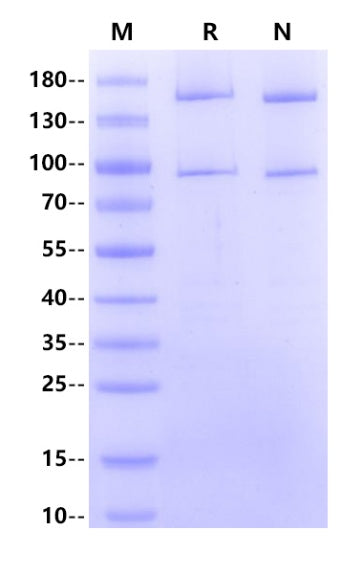
2μg (R: reducing condition, N: non-reducing condition).
CRBN/DDB1 Complex GST Tag Protein, Human
CRBN/DDB1 Complex GST Tag Protein, Human
Price:
Regular price
$335 USD
Regular price
Sale price
$335 USD
Unit price
per
For shipping services or bulk orders, you may request a quotation.
Secure checkout with

View full details
Product Details
Product Details
Product Specification
| Species | Human |
| Synonyms | CRBN/DDB1 |
| Accession | Q96SW2、Q16531 |
| Amino Acid Sequence | Met1-Leu442(CRBN) with GST Tag at the N-Terminus |
| Expression System | Baculovirus-InsectCells |
| Molecular Weight | CRBN,70-100kDa (Reducing); DDB1,130-180kDa (Reducing) |
| Purity | >95% by SDS-PAGE |
| Conjugation | Unconjugated |
| Tag | GST Tag |
| Physical Appearance | Liquid |
| Storage Buffer | 50mM Tris, 150mM NaCl, PH7.5, 1mM DTT, 10%Glycerol |
| Stability & Storage | Stable for 12 months upon stored at -80℃ from the date of receipt. And avoid repeated freeze-thaws cycles. |
| Reference | 1. Fischer, E.S., et al. (2014). Structure of the DDB1-CRBN E3 ubiquitin ligase in complex with thalidomide. Nature, 512(7512), 49-53. |
Background
CRBN is the substrate recognition component (DCAF) of the CUL4-RBX1-DDB1-CRBN (CRL4ᴰᴮᴮ¹⁻ᴿⁱⁿᵍ) E3 ubiquitin ligase complex, while DDB1 acts as an adaptor protein that links CRBN to the core CUL4-RBX1 catalytic unit. The CRBN gene is located on human chromosome 3q26.2 and encodes an approximately 50 kDa protein broadly expressed in the central nervous system, kidney, liver, and retina.
Structure and Mechanism: Within the CRL4ᴰᴮᴮ¹⁻ᴿⁱⁿᵍ complex, DDB1 bridges the ligase core to the substrate receptor. CRBN is anchored to the ligase via interaction of its C-terminal domain with the BPC domain of DDB1. The C-terminal region of CRBN forms an aromatic cage (Trp380/386/400) that constitutes the binding pocket for immunomodulatory drugs (IMiDs). In its basal state, CRBN recognizes and mediates the ubiquitination and degradation of endogenous substrates, such as the transcription factor MEIS2. Upon binding of thalidomide or its analogues, CRBN creates a neo-substrate interaction interface, leading to the recruitment and degradation of “neosubstrates” like the transcription factors IKZF1/IKZF3 and the kinase CK1α that are normally not recognized.
Picture
Picture
SDS-PAGE