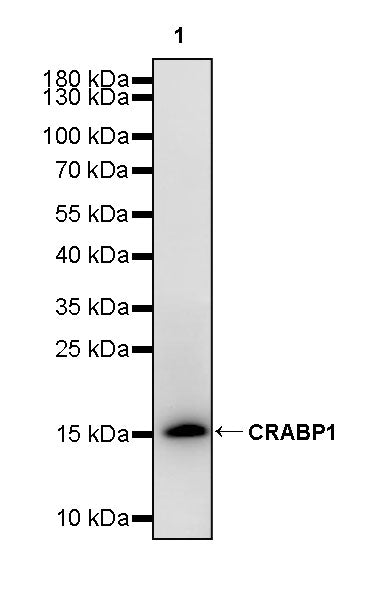
WB result of CRABP1 Recombinant Rabbit mAb
Primary antibody: CRABP1 Recombinant Rabbit mAb at 1/1000 dilution
Lane 1: HL-60 whole cell lysate 20 µg
Lane 2: SH-SY5Y whole cell lysate 20 µg
Lane 3: Molt-4 whole cell lysate 20 µg
Negative control: HL-60 whole cell lysate
Secondary antibody: Goat Anti- rabbit IgG, (H+L), HRP conjugated at 1/10000 dilution
Predicted MW: 15 kDa
Observed MW: 15 kDa
CRABP1 Recombinant Rabbit mAb (S-4212-76)
CRABP1 Recombinant Rabbit mAb (S-4212-76)
Price:
Regular price
$100 USD
Regular price
Sale price
$100 USD
Unit price
per
For shipping services or bulk orders, you may request a quotation.
Secure checkout with

View full details
Product Details
Product Details
Product Specification
| Host | Rabbit |
| Antigen | CRABP1 |
| Synonyms | Cellular retinoic acid-binding protein 1; RBP5 |
| Immunogen | Synthetic Peptide |
| Location | Cytoplasm |
| Accession | P29762 |
| Clone Number | S-4212-76 |
| Antibody Type | Recombinant mAb |
| Isotype | IgG |
| Application | WB |
| Reactivity | Hu, Ms, Rt |
| Positive Sample | SH-SY5Y, Molt-4, NIH/3T3, rat retina |
| Purification | Protein A |
| Concentration | 2 mg/ml |
| Conjugation | Unconjugated |
| Physical Appearance | Liquid |
| Storage Buffer | PBS, 40% Glycerol, 0.05% BSA, 0.02% sodium azide |
| Stability & Storage | 12 months from date of receipt / reconstitution, -20 °C as supplied |
Dilution
| application | dilution | species |
| WB | 1:1000 | Hu, Ms, Rt |
Background
CRABP1 (Cellular Retinoic Acid Binding Protein 1) is a member of the fatty acid-binding protein family, whose primary known function is to bind retinoic acid—the active derivative of vitamin A—with high affinity, and is believed to play an important role in retinoic acid-mediated cell differentiation and proliferation. This protein is widely distributed in the cytoplasm, and its three-dimensional structure forms a β-barrel fold that creates an internal cavity capable of accommodating hydrophobic ligands such as retinoic acid. Although binding retinoic acid is its primary known function, the role of CRABP1 in tumor biology is exceptionally complex and exhibits duality: in some epithelial tumors (such as papillary thyroid carcinoma and esophageal squamous cell carcinoma), its gene promoter is silenced by hypermethylation and expression is downregulated, suggesting that it may act as a tumor suppressor; however, in mesenchymal-derived tumors (such as synovial sarcoma) and pancreatic neuroendocrine tumors, CRABP1 displays clear pro-tumor and pro-metastatic activity, with its high expression closely associated with lymph node metastasis and poor differentiation/high-grade malignancy. Moreover, this pro-tumorigenic effect does not depend on its ability to bind retinoic acid, implying that the protein may possess other unknown pro-tumor molecular mechanisms. Overall, the role of CRABP1 in tumorigenesis and progression is highly tissue-dependent—it serves as a potential tumor suppressor in some cancers while acting as a key driver of malignant progression and a candidate prognostic biomarker of poor outcome in others, making its functional diversity an intriguing and complex target in cancer research.
Picture
Picture
Western Blot
WB result of CRABP1 Recombinant Rabbit mAb
Primary antibody: CRABP1 Recombinant Rabbit mAb at 1/1000 dilution
Lane 1: NIH/3T3 whole cell lysate 20 µg
Secondary antibody: Goat Anti- rabbit IgG, (H+L), HRP conjugated at 1/10000 dilution
Predicted MW: 15 kDa
Observed MW: 15 kDa
WB result of CRABP1 Recombinant Rabbit mAb
Primary antibody: CRABP1 Recombinant Rabbit mAb at 1/1000 dilution
Lane 1: rat retina lysate 20 µg
Secondary antibody: Goat Anti- rabbit IgG, (H+L), HRP conjugated at 1/10000 dilution
Predicted MW: 15 kDa
Observed MW: 15 kDa