WB result of COPZ1 Recombinant Rabbit mAb
Primary antibody: COPZ1 Recombinant Rabbit mAb at 1/1000 dilution
Lane 1: K-562 whole cell lysate 20 µg
Lane 2: HeLa whole cell lysate 20 µg
Secondary antibody: Goat Anti-Rabbit IgG, (H+L), HRP conjugated at 1/10000 dilution
Predicted MW: 20 kDa
Observed MW: 21 kDa
COPZ1 Recombinant Rabbit mAb (S-4445-53)
COPZ1 Recombinant Rabbit mAb (S-4445-53)
Price:
Regular price
$100 USD
Regular price
Sale price
$100 USD
Unit price
per
For shipping services or bulk orders, you may request a quotation.
Secure checkout with

View full details
Product Details
Product Details
Product Specification
| Host | Rabbit |
| Antigen | COPZ1 |
| Synonyms | Coatomer subunit zeta-1; COPZ |
| Immunogen | Synthetic Peptide |
| Location | Cytoplasm |
| Accession | P61923 |
| Clone Number | S-4445-53 |
| Antibody Type | Recombinant mAb |
| Isotype | IgG |
| Application | WB, ICC, IHC-P |
| Reactivity | Hu, Ms, Rt, Mk |
| Positive Sample | K-562, HeLa, NIH/3T3, RAW264.7, mouse liver, COS-7 |
| Purification | Protein A |
| Concentration | 2 mg/ml |
| Conjugation | Unconjugated |
| Physical Appearance | Liquid |
| Storage Buffer | PBS, 40% Glycerol, 0.05% BSA, 0.02% sodium azide |
| Stability & Storage | 12 months from date of receipt / reconstitution, -20 °C as supplied |
Dilution
| application | dilution | species |
| WB | 1:1000 | Hu, Ms, Mk |
| IHC-P | 1:1000-1:2000 | Hu, Ms, Rt |
| ICC | 1:400 | Ms |
Background
COPZ1 is one of the seven core subunits constituting the COPI coatomer complex. As a soluble protein localized in the cytoplasm, its primary function is to serve as a "molecular coat" involved in retrograde vesicular transport from the Golgi apparatus to the endoplasmic reticulum, as well as intracellular protein trafficking. It mediates vesicle budding and cargo loading by recognizing and binding specific sorting signals (such as dilysine motifs), thereby maintaining the homeostasis of the endomembrane system. Beyond its physiological functions, COPZ1 has garnered considerable attention in cancer biology and genetic diseases: it is pharmacologically targetable and exhibits differential expression compared to COPZ2, as normal cells express both isoforms while various tumor cells rely exclusively on COPZ1 for growth and survival—therefore, targeting COPZ1 has been proposed as an anticancer strategy that specifically eliminates tumor cells, including dormant ones, with the potential to overcome tumor relapse caused by conventional antiproliferative drugs. Concurrently, autosomal recessive mutations in the COPZ1 gene (such as nonsense and missense mutations) have been found to cause a novel severe congenital neutropenia syndrome; the mutant proteins, due to weakened interactions with other subunits of the COPI complex, impair retrograde Golgi-to-ER transport, consequently disrupting key signaling pathways such as JAK/STAT and myeloid differentiation, ultimately leading to hematopoietic dysfunction characterized by neutropenia.
Picture
Picture
Western Blot
WB result of COPZ1 Recombinant Rabbit mAb
Primary antibody: COPZ1 Recombinant Rabbit mAb at 1/1000 dilution
Lane 1: NIH/3T3 whole cell lysate 20 µg
Lane 2: RAW 264.7 whole cell lysate 20 µg
Lane 3: mouse liver lysate 20 µg
Secondary antibody: Goat Anti-Rabbit IgG, (H+L), HRP conjugated at 1/10000 dilution
Predicted MW: 20 kDa
Observed MW: 21 kDa
WB result of COPZ1 Recombinant Rabbit mAb
Primary antibody: COPZ1 Recombinant Rabbit mAb at 1/1000 dilution
Lane 1: COS-7 whole cell lysate 20 µg
Secondary antibody: Goat Anti-Rabbit IgG, (H+L), HRP conjugated at 1/10000 dilution
Predicted MW: 20 kDa
Observed MW: 21 kDa
Immunohistochemistry
IHC shows positive staining in paraffin-embedded human kidney. Anti-COPZ1 antibody was used at 1/2000 dilution, followed by a HRP Polymer for Rabbit IgG (ready to use). Counterstained with hematoxylin. Heat mediated antigen retrieval with Tris/EDTA buffer pH9.0 was performed before commencing with IHC staining protocol.
IHC shows positive staining in paraffin-embedded human breast cancer. Anti-COPZ1 antibody was used at 1/2000 dilution, followed by a HRP Polymer for Rabbit IgG (ready to use). Counterstained with hematoxylin. Heat mediated antigen retrieval with Tris/EDTA buffer pH9.0 was performed before commencing with IHC staining protocol.
IHC shows positive staining in paraffin-embedded human pancreatic cancer. Anti-COPZ1 antibody was used at 1/2000 dilution, followed by a HRP Polymer for Rabbit IgG (ready to use). Counterstained with hematoxylin. Heat mediated antigen retrieval with Tris/EDTA buffer pH9.0 was performed before commencing with IHC staining protocol.
IHC shows positive staining in paraffin-embedded mouse cerebral cortex. Anti-COPZ1 antibody was used at 1/2000 dilution, followed by a HRP Polymer for Rabbit IgG (ready to use). Counterstained with hematoxylin. Heat mediated antigen retrieval with Tris/EDTA buffer pH9.0 was performed before commencing with IHC staining protocol.
IHC shows positive staining in paraffin-embedded rat kidney. Anti-COPZ1 antibody was used at 1/2000 dilution, followed by a HRP Polymer for Rabbit IgG (ready to use). Counterstained with hematoxylin. Heat mediated antigen retrieval with Tris/EDTA buffer pH9.0 was performed before commencing with IHC staining protocol.
Immunocytochemistry
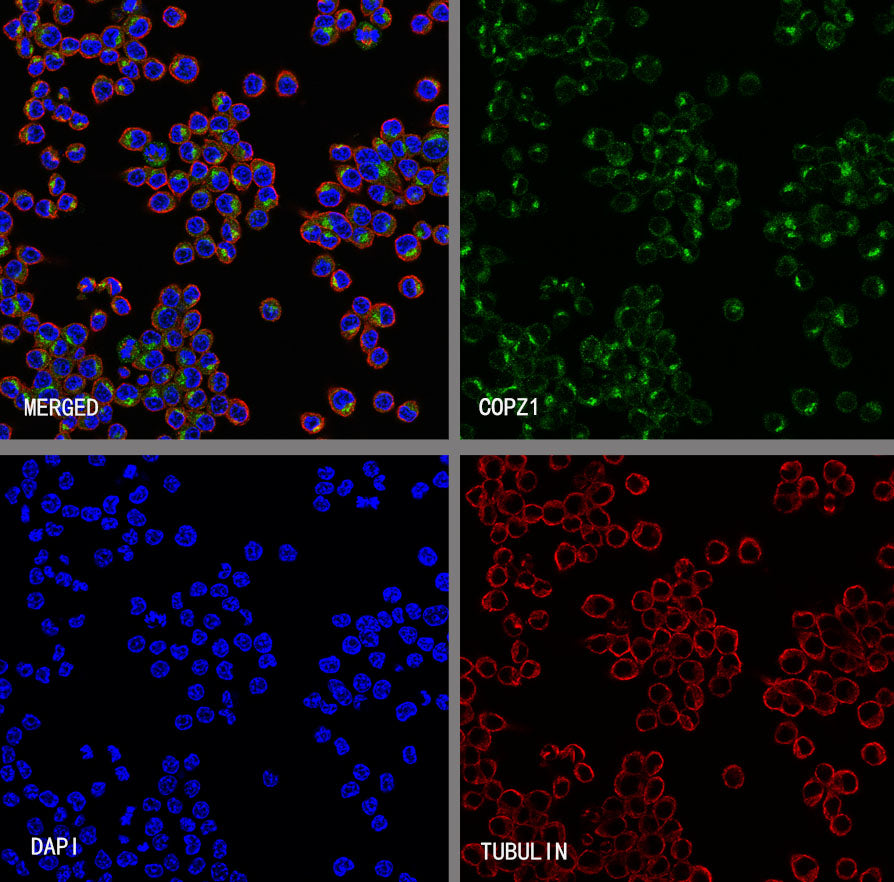
ICC shows positive staining in RAW264.7 cells. Anti-COPZ1 antibody was used at 1/400 dilution (Green) and incubated overnight at 4°C. Goat polyclonal Antibody to Rabbit IgG - H&L (Alexa Fluor® 488) was used as secondary antibody at 1/1000 dilution. The cells were fixed with 4% PFA and permeabilized with 0.1% PBS-Triton X-100. Nuclei were counterstained with DAPI (Blue). Counterstain with tubulin (Red).