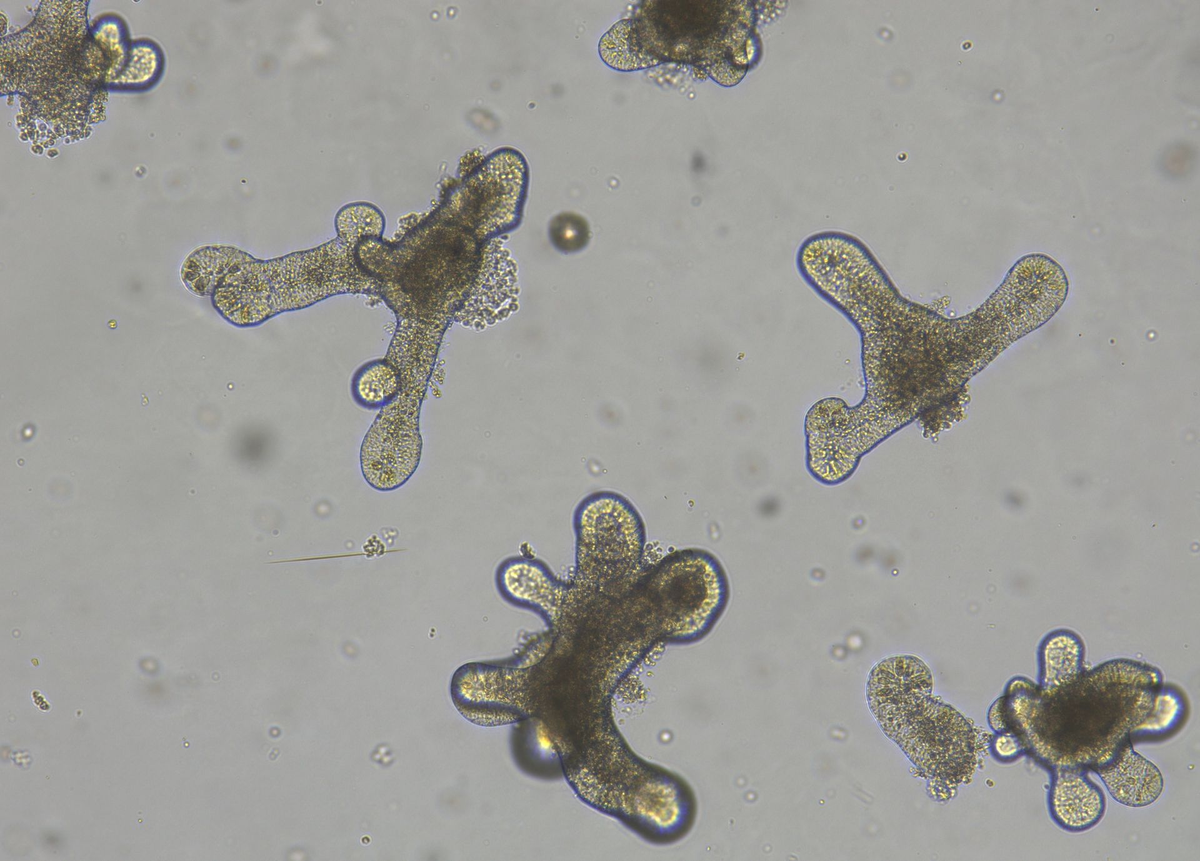
P4 D1
Mouse Intestinal Organoid Culture Medium
Mouse Intestinal Organoid Culture Medium
Price:
Regular price
$500 USD
Regular price
Sale price
$500 USD
Unit price
per
For shipping services or bulk orders, you may request a quotation.
Secure checkout with

View full details
Product Details
Product Details
Product Specification
| Species | Human |
| Stability & Storage | Store at -20°C; shelf life is 12 months. |
Background
Specifically for normal miceSmall intestineOrganoid design—this serum-free medium relies on the extracellular matrix environment, where its unique core components, in synergy with a rich array of cytokines, promote rapid cell growth and stable differentiation.classOrgans, while maintaining good cellular characteristics and viability, are essential for conductingSmall intestineAn ideal choice for organoid physiological function studies, disease research, and precision medicine.
Protocol
1. Primary culture
(1) In a laminar flow hood, carefully remove the mouse small intestine and place it in pre-cooled PBS (containing penicillin, streptomycin, and primary culture antibiotics). Using sterilized scissors, make a longitudinal cut along the intestinal segment, then unfold it with the lumen facing upward. Gently scrape off any impurities and residues from the intestinal surface with a coverslip, repeating this motion two or three times. Rinse the small intestine with pre-cooled PBS.
(2) Hold one end of the small intestine with forceps, cut it into small segments about 3–5 mm long, collect them, and transfer them to a sterile 50 ml centrifuge tube. Wash the segments two or three times with pre-cooled PBS.
(3) Add 30 ml of 5 mM EDTA/PBS solution (30 ml PBS + 300 µl of 0.5 M EDTA) to the centrifuge tube, place the small intestine tissue into the tube for digestion, and incubate on a shaker at 4°C for 20–30 minutes. Frequently observe under a microscope during this period; the detachment of crypts indicates that digestion should be stopped. The total digestion time should not exceed 40 minutes.
(4) Discard the digestion solution, add pre-cooled PBS, and gently shake to remove the EDTA.
(5) Add 30 ml of pre-cooled PBS containing 0.1% BSA, and vortex to detach the crypts from the small intestine.
(6) Retain the supernatant, pass it through a 70 µm cell strainer, evenly distribute the filtered cell suspension into two 15 ml centrifuge tubes, centrifuge at 1000 rpm for 5 minutes, and discard the supernatant after centrifugation.
(7) Repeat steps 5–6 twice to increase the number of crypts obtained.
(8) Resuspend the precipitate with an appropriate amount of basal medium or PBS.
(9) Mix the Matrigel with the crypts at a suitable ratio. For example, in a 24-well cell culture plate, dispense 25–30 µL of the Matrigel-crypt mixture per well for plating (perform this step at 4°C).
(10) Place the plated culture plate in a 37°C incubator for 20–30 minutes to allow gelation, then add an appropriate volume of complete mouse small intestine organoid culture medium (returned to room temperature) for culture.
2. Organoid passaging and culture
(1) Use a pipette to remove the culture medium, then add 1–2 mL of 4°C PBS to each well and let it sit for 2 minutes.
(2) Gently pipette the Matrigel and collect it in a 15 ml centrifuge tube. Adjust the volume to 10–14 ml with PBS, then let it thaw at 4°C for 20–30 minutes, grouping every 3–5 wells together. Centrifuge at 1000 rpm for 5 minutes, discard the supernatant, and keep the pellet.
(3) Add an appropriate amount of Matrigel to resuspend the organoids. Dispense 25–30 µl of Matrigel per well into a 24-well cell culture plate, place it in the incubator for 20–30 minutes to allow gelation, and then add an appropriate volume of complete medium for mouse small intestine organoids.
3. Cryopreservation of organoids
(1) Use a pipette to remove the culture medium, then add 1–2 ml of 4°C PBS to each well and leave for 2 minutes.
(2) Gently pipette the Matrigel to collect it in a 15 ml centrifuge tube, then bring the volume up to 10–14 ml with PBS. Allow it to thaw at 4°C for 20–30 minutes, grouping every 3–5 wells together. Centrifuge at 1000 rpm for 5 minutes, discard the supernatant, and retain the pellet.
(3) Add an appropriate amount of organoid cryopreservation medium, gently pipette to resuspend. Taking a 24-well cell culture plate as an example, freeze 1 vial per 2–3 wells, with each vial containing 1 ml.
(4) Label the samples clearly, perform programmed cooling, and then transfer them to liquid nitrogen for long-term storage.
4. Organoid recovery
(1) Place 10 ml of DMEM/F12 basal medium into a 15 ml centrifuge tube.
(2) Remove the frozen organoids from the liquid nitrogen tank and quickly place them in a 37°C water bath to thaw.
(3) During the water bath thawing process, gently shake the cryovial to ensure that the cryopreserved solution is completely thawed within 1–2 minutes.
(4) Quickly transfer the dissolved organoids to a 15 ml centrifuge tube, gently pipette up and down 6–8 times, centrifuge at 1000 rpm for 5 minutes, then discard the supernatant and collect the organoid pellet.
(5) Resuspend in Matrigel, dispense 25–30 µl of Matrigel per well in a 24-well cell culture plate, place in the incubator for 20–30 minutes to allow gelation, and then add an appropriate volume of complete medium for mouse small intestine organoids.
Picture
Picture
Bioactivity