WB result of COL1A1 Recombinant Rabbit mAb
Primary antibody: COL1A1 Recombinant Rabbit mAb at 1/5000 dilution
Lane 1: HT-29 whole cell lysate 20 µg
Lane 2: HFF whole cell lysate 20 µg
Negative control: HT-29 whole cell lysate
Secondary antibody: Goat Anti- rabbit IgG, (H+L), HRP conjugated at 1/10000 dilution
Predicted MW: 138 kDa
Observed MW: 220 kDa
COL1A1 Recombinant Rabbit mAb (S-2975-9)
COL1A1 Recombinant Rabbit mAb (S-2975-9)
Price:
Regular price
$100 USD
Regular price
Sale price
$100 USD
Unit price
per
For shipping services or bulk orders, you may request a quotation.
Secure checkout with

View full details
Product Details
Product Details
Product Specification
| Host | Rabbit |
| Antigen | COL1A1 |
| Synonyms | Collagen alpha-1(I) chain; Alpha-1 type I collagen; Cola1; Col1a1 |
| Immunogen | Synthetic Peptide |
| Location | Secreted |
| Accession | P11087 |
| Clone Number | S-2975-9 |
| Antibody Type | Recombinant mAb |
| Isotype | IgG |
| Application | WB, IHC-P, ICC, IF |
| Reactivity | Hu, Ms, Rt |
| Purification | Protein A |
| Concentration | 0.5 mg/ml |
| Conjugation | Unconjugated |
| Physical Appearance | Liquid |
| Storage Buffer | PBS, 40% Glycerol, 0.05% BSA, 0.03% Proclin 300 |
| Stability & Storage | 12 months from date of receipt / reconstitution, -20 °C as supplied |
Dilution
| application | dilution | species |
| WB | 1:5000 | Hu, Ms |
| IHC-P | 1:2000 | Hu, Ms, Rt |
| ICC | 1:500 | Hu |
| IF | 1:100 | Ms, Rt |
Background
COL1A1 (collagen type I alpha 1 chain) is the ~1,464-amino-acid pro-alpha1 strand that, together with two COL1A2 pro-alpha2 strands, assembles the triple-helical type I collagen—the main load-bearing protein of bone, skin, tendon, dentin and most connective tissues; after secretion, its N- and C-propeptides are cleaved by BMP-1/tolloid proteases, allowing the rigid 300-nm collagen fibrils to form and then be mineralized (in bone) or cross-linked (in soft tissues), while intracellularly it requires proline and lysine hydroxylation, endoplasmic-reticulum chaperones and trimer registration to prevent misfolding; mutations cause osteogenesis imperfecta, Ehlers–Danlos syndrome, Caffey disease and fibrosis, and its expression is driven by the Sp1/3, TGF-β/Smad and HIF pathways, is up-regulated in fibrosis and cancer stroma, and serves as a biomarker for tissue repair and invasiveness.
Picture
Picture
Western Blot
WB result of COL1A1 Recombinant Rabbit mAb
Primary antibody: COL1A1 Recombinant Rabbit mAb at 1/5000 dilution
Lane 1: NIH/3T3 whole cell lysate 20 µg
Secondary antibody: Goat Anti- rabbit IgG, (H+L), HRP conjugated at 1/10000 dilution
Predicted MW: 138 kDa
Observed MW: 220 kDa
Immunohistochemistry
IHC shows positive staining in paraffin-embedded human kidney. Anti-COL1A1 antibody was used at 1/2000 dilution, followed by a HRP Polymer for Mouse & Rabbit IgG (ready to use). Counterstained with hematoxylin. Heat mediated antigen retrieval with Tris/EDTA buffer pH9.0 was performed before commencing with IHC staining protocol.
IHC shows positive staining in paraffin-embedded human colon cancer. Anti-COL1A1 antibody was used at 1/2000 dilution, followed by a HRP Polymer for Mouse & Rabbit IgG (ready to use). Counterstained with hematoxylin. Heat mediated antigen retrieval with Tris/EDTA buffer pH9.0 was performed before commencing with IHC staining protocol.
IHC shows positive staining in paraffin-embedded human endometrial cancer. Anti-COL1A1 antibody was used at 1/2000 dilution, followed by a HRP Polymer for Mouse & Rabbit IgG (ready to use). Counterstained with hematoxylin. Heat mediated antigen retrieval with Tris/EDTA buffer pH9.0 was performed before commencing with IHC staining protocol.
IHC shows positive staining in paraffin-embedded mouse stomach. Anti-COL1A1 antibody was used at 1/2000 dilution, followed by a HRP Polymer for Mouse & Rabbit IgG (ready to use). Counterstained with hematoxylin. Heat mediated antigen retrieval with Tris/EDTA buffer pH9.0 was performed before commencing with IHC staining protocol.
IHC shows positive staining in paraffin-embedded rat colon. Anti-COL1A1 antibody was used at 1/2000 dilution, followed by a HRP Polymer for Mouse & Rabbit IgG (ready to use). Counterstained with hematoxylin. Heat mediated antigen retrieval with Tris/EDTA buffer pH9.0 was performed before commencing with IHC staining protocol.
Immunocytochemistry
ICC shows positive staining in HFF cells (top panel) and negative staining in HT-29 cells (below panel). Anti-COL1A1 antibody was used at 1/500 dilution (Green) and incubated overnight at 4°C. Goat polyclonal Antibody to Rabbit IgG - H&L (Alexa Fluor® 488) was used as secondary antibody at 1/1000 dilution. The cells were fixed with 4% PFA and permeabilized with 0.1% PBS-Triton X-100. Nuclei were counterstained with DAPI (Blue). Counterstain with tubulin (Red).
Immunofluorescence
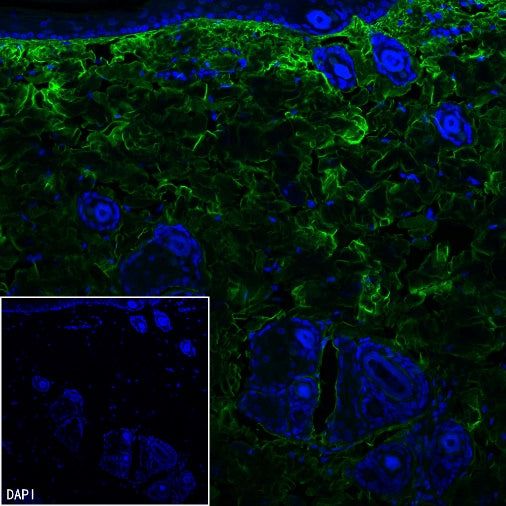
IF shows positive staining in paraffin-embedded mouse skin. Anti-COL1A1 antibody was used at 1/100 dilution (Green) and incubated overnight at 4°C. Goat polyclonal Antibody to Rabbit IgG - H&L (Alexa Fluor® 488) was used as secondary antibody at 1/1000 dilution. Counterstained with DAPI (Blue). Heat mediated antigen retrieval with EDTA buffer pH9.0 was performed before commencing with IF staining protocol.
IF shows positive staining in paraffin-embedded rat skin. Anti-COL1A1 antibody was used at 1/100 dilution (Green) and incubated overnight at 4°C. Goat polyclonal Antibody to Rabbit IgG - H&L (Alexa Fluor® 488) was used as secondary antibody at 1/1000 dilution. Counterstained with DAPI (Blue). Heat mediated antigen retrieval with EDTA buffer pH9.0 was performed before commencing with IF staining protocol.