WB result of Ckb Rabbit pAb
Primary antibody: Ckb Rabbit pAb at 1/1000 dilution
Lane 1: HEK-293 whole cell lysate 20 µg
Lane 2: HeLa whole cell lysate 20 µg
Lane 3: SH-SY5Y whole cell lysate 20 µg
Secondary antibody: Goat Anti- rabbit IgG, (H+L), HRP conjugated at 1/10000 dilution
Predicted MW: 43 kDa
Observed MW: 40 kDa
Ckb Rabbit Polyclonal Antibody
Ckb Rabbit Polyclonal Antibody
Price:
Regular price
$100 USD
Regular price
Sale price
$100 USD
Unit price
per
For shipping services or bulk orders, you may request a quotation.
Secure checkout with

View full details
Product Details
Product Details
Product Specification
| Host | Rabbit |
| Antigen | Ckb |
| Synonyms | Creatine kinase B-type; Brain creatine kinase (B-CK); Creatine kinase B chain; Creatine phosphokinase B-type (CPK-B); CKBB; CKB |
| Immunogen | Synthetic Peptide |
| Location | Cell membrane, Cytoplasm, Mitochondrion |
| Accession | P12277 |
| Antibody Type | Polyclonal antibody |
| Isotype | IgG |
| Application | WB |
| Reactivity | Hu, Ms, Rt |
| Positive Sample | HEK-293, HeLa, SH-SY5Y, mouse colon, mouse cerebellum, mouse brain, C6, rat brain |
| Purification | Immunogen Affinity |
| Concentration | 0.5 mg/ml |
| Conjugation | Unconjugated |
| Physical Appearance | Liquid |
| Storage Buffer | PBS, 40% Glycerol, 0.05% BSA, 0.02% sodium azide |
| Stability & Storage | 12 months from date of receipt / reconstitution, -20 °C as supplied |
Dilution
| application | dilution | species |
| WB | 1:1000-1:2000 | Hu, Ms, Rt |
Background
Creatine kinase B-type (CKB), also known as brain-type creatine kinase, is a crucial cytosolic enzyme encoded by the CKB gene in humans that catalyzes the reversible transfer of a phosphate group from ATP to creatine, thereby generating phosphocreatine and ADP to serve as a rapid energy buffer system particularly vital in tissues with high and fluctuating energy demands such as the brain, smooth muscle, and retina. As part of the creatine kinase family, CKB typically functions as a homodimer (BB-CK) or heterodimer (MB-CK when paired with the muscle type) and plays an indispensable role in maintaining cellular energy homeostasis by facilitating the efficient shuttling of high-energy phosphates from mitochondrial sites of production to cytosolic sites of consumption, a process often referred to as the "phosphocreatine shuttle." Beyond its metabolic function, CKB has gained significant attention in clinical diagnostics and biomedical research as a potential biomarker for various pathological conditions, including neurodegenerative diseases like Alzheimer's and Parkinson's, where altered CKB expression or activity may reflect neuronal damage or metabolic dysfunction, as well as in certain cancers where its upregulation supports the heightened energetic needs of proliferating tumor cells.
Picture
Picture
Western Blot
WB result of Ckb Rabbit pAb
Primary antibody: Ckb Rabbit pAb at 1/1000 dilution
Lane 1: mouse colon lysate 20 µg
Lane 2: mouse cerebellum lysate 20 µg
Lane 3: mouse brain lysate 20 µg
Secondary antibody: Goat Anti- rabbit IgG, (H+L), HRP conjugated at 1/10000 dilution
Predicted MW: 43 kDa
Observed MW: 40 kDa
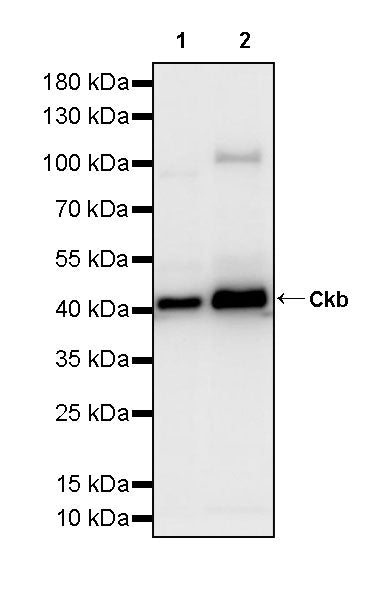
WB result of Ckb Rabbit pAb
Primary antibody: Ckb Rabbit pAb at 1/1000 dilution
Lane 1: C6 whole cell lysate 20 µg
Lane 2: rat brain lysate 20 µg
Secondary antibody: Goat Anti- rabbit IgG, (H+L), HRP conjugated at 1/10000 dilution
Predicted MW: 43 kDa
Observed MW: 43 kDa