CHMP4B/CHMP4C Recombinant Rabbit mAb
CHMP4B/CHMP4C Recombinant Rabbit mAb
Price:
Regular price
$100 USD
Regular price
Sale price
$100 USD
Unit price
per
For shipping services or bulk orders, you may request a quotation.
Secure checkout with

View full details
Product Details
Product Details
Product Specification
| Host | Rabbit |
| Antigen | CHMP4B/CHMP4C |
| Synonyms | Charged multivesicular body protein 4b; Chromatin-modifying protein 4b (CHMP4b); SNF7 homolog associated with Alix 1; SNF7-2 (hSnf7-2); Vacuolar protein sorting-associated protein 32-2 (Vps32-2; hVps32-2); C20orf178; SHAX1; CHMP4B; Charged multivesicular body protein 4c; Chromatin-modifying protein 4c (CHMP4c); SNF7 homolog associated with Alix 3; SNF7-3; hSnf7-3; Vacuolar protein sorting-associated protein 32-3 (Vps32-3; hVps32-3); SHAX3 |
| Location | Cytoplasm, Nucleus |
| Accession | Q9H444、Q96CF2 |
| Antibody Type | Recombinant mAb |
| Isotype | IgG |
| Application | WB, ICFCM |
| Reactivity | Hu, Ms |
| Positive Sample | KU812, Jurkat, HT-29, IMR-32 |
| Purification | Protein A |
| Concentration | 1 mg/ml |
| Conjugation | Unconjugated |
| Physical Appearance | Liquid |
| Storage Buffer | PBS, 40% Glycerol, 0.05% BSA, 0.02% sodium azide |
| Stability & Storage | 12 months from date of receipt / reconstitution, -20 °C as supplied |
Dilution
| application | dilution | species |
| WB | 1: 2000-1:10000 | Hu, Ms |
| ICFCM | 1:400 | Hu, Ms |
Background
CHMP4B and CHMP4C are key proteins belonging to the CHMP4 subfamily, serving as core components of the ESCRT-III complex and playing important roles in critical life processes such as endomembrane system remodeling and cell division. As downstream elements of the ESCRT pathway, one of their primary functions is to participate in the sorting and degradation of internalized cell surface receptors during multivesicular body (MVB) formation—they polymerize into membrane-attached filamentous structures to promote or stabilize budding, thereby facilitating the generation of intraluminal vesicles. Furthermore, they are essential during the final stage of cell division—cytokinesis—where they assist in completing the final separation between two daughter cells. Both CHMP4B and CHMP4C can be recruited to functional sites through interaction with the key adaptor protein ALIX, with the Bro1 domain of ALIX specifically recognizing and binding to members of the CHMP4 protein family. Despite their functional similarities, the two proteins also exhibit division of labor: CHMP4B is essential for driving membrane scission, whereas CHMP4C plays a unique role in the "cytokinetic checkpoint"—it can be phosphorylated by Aurora B kinase to delay the progression of division, thereby preventing the accumulation of DNA damage.
Picture
Picture
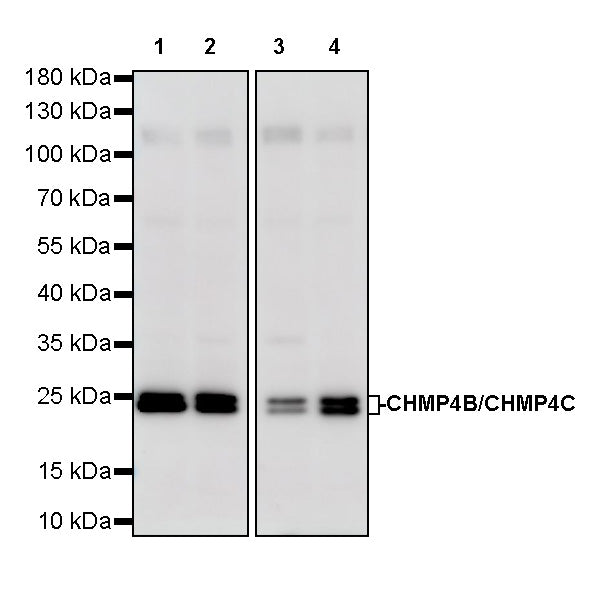
Western Blot
WB result of CHMP4B/CHMP4C Recombinant Rabbit mAb
Primary antibody: CHMP4B/CHMP4C Recombinant Rabbit mAb at 1/2000 dilution
Lane 1: KU812 whole cell lysate 20 µg
Lane 2: Jurkat whole cell lysate 20 µg
Lane 3: HT-29 whole cell lysate 20 µg
Lane 4: IMR-32 whole cell lysate 20 µg
Secondary antibody: Goat Anti-Rabbit IgG, (H+L), HRP conjugated at 1/10000 dilution
Predicted MW: 25 kDa
Observed MW: 24, 25 kDa