cGAS Recombinant Rabbit mAb (S-5406)
cGAS Recombinant Rabbit mAb (S-5406)
Price:
Regular price
$100 USD
Regular price
Sale price
$100 USD
Unit price
per
For shipping services or bulk orders, you may request a quotation.
Secure checkout with

View full details
Product Details
Product Details
Product Specification
| Host | Rabbit |
| Antigen | cGAS |
| Synonyms | Cyclic GMP-AMP synthase; cGAMP synthase; m-cGAS; 2'3'-cGAMP synthase; Mab-21 domain-containing protein 1; Mb21d1 |
| Location | Cytoplasm, Nucleus, Cell membrane |
| Accession | Q8C6L5 |
| Clone Number | S-5406 |
| Antibody Type | Recombinant mAb |
| Isotype | IgG |
| Application | WB |
| Reactivity | Ms |
| Positive Sample | NIH/3T3, Neuro-2a, C2C12 |
| Purification | Protein A |
| Concentration | 0.5 mg/ml |
| Conjugation | Unconjugated |
| Physical Appearance | Liquid |
| Storage Buffer | PBS, 40% Glycerol, 0.05% BSA, 0.02% sodium azide |
| Stability & Storage | 12 months from date of receipt / reconstitution, -20 °C as supplied |
Dilution
| application | dilution | species |
| WB | 1:1000 | Ms |
Background
cGAS is a widely expressed DNA sensor in the mammalian cytoplasm that serves as a critical sentinel of the innate immune system, responsible for recognizing invading pathogen DNA or self-DNA that has leaked into the cytosol. This protein consists of approximately 522 amino acids, containing a conserved nucleotidyltransferase (NTase) core domain flanked by regulatory regions, with its catalytic activity dependent on binding to double-stranded DNA: upon recognition and binding of DNA, cGAS undergoes conformational rearrangement and catalyzes the production of the second messenger molecule cyclic GMP-AMP (cGAMP) from ATP and GTP. The newly synthesized cGAMP subsequently binds to and activates the adaptor protein STING on the endoplasmic reticulum, which in turn initiates the TBK1-IRF3 signaling cascade, inducing the transcriptional expression of type I interferons and pro-inflammatory cytokines, thereby establishing the first line of defense against microbial infections. Beyond antiviral defense, the cGAS-cGAMP-STING pathway also plays a significant role in anti-tumor immune surveillance, as genomic instability and DNA damage within tumor cells lead to micronucleus formation and release of DNA into the cytosol, thereby activating this pathway to recruit immune cells for tumor clearance. However, dysregulation of this pathway exhibits a "double-edged sword" effect: excessive or aberrant activation of cGAS can trigger autoinflammatory diseases such as Aicardi-Goutières syndrome, and even contributes to neurodegenerative diseases (such as Alzheimer's disease) and aging-related chronic inflammation. Therefore, cGAS is not only a key molecule for understanding the fundamental mechanisms of immune recognition, but has also emerged as a novel drug target for anti-infection, anti-tumor therapy, and the treatment of autoimmune diseases.
Picture
Picture
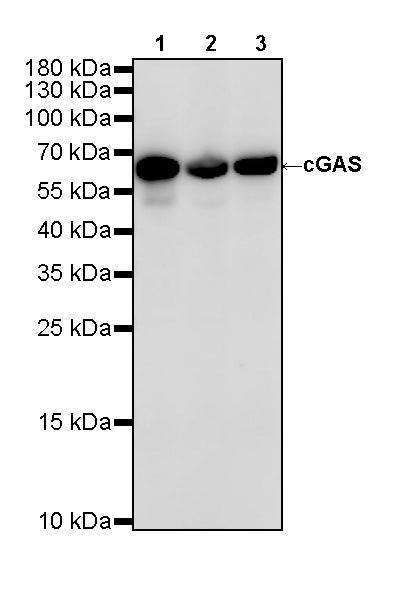
Western Blot
WB result of cGAS Recombinant Rabbit mAb
Primary antibody: cGAS Recombinant Rabbit mAb at 1/1000 dilution
Lane 1: NIH/3T3 whole cell lysate 20 µg
Lane 2: Neuro-2a whole cell lysate 20 µg
Lane 3: C2C12 whole cell lysate 20 µg
Secondary antibody: Goat Anti-rabbit IgG, (H+L), HRP conjugated at 1/10000 dilution
Predicted MW: 58 kDa
Observed MW: 62 kDa