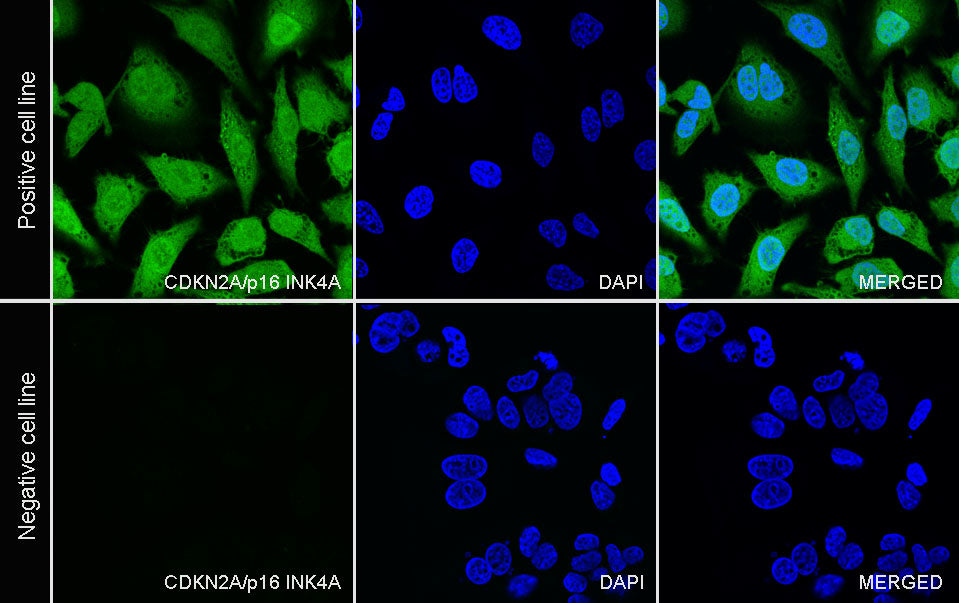
ICC shows positive staining in HeLa cells (top panel) and negative staining in MCF7 cells (below panel). Anti- CDKN2A/p16 INK4A (Alexa Fluor® 488 Conjugate) antibody was used at 1/500 dilution (Green) and incubated overnight at 4°C.The cells were fixed with 4% PFA and permeabilized with 0.1% PBS-Triton X-100. Nuclei were counterstained with DAPI (Blue).
CDKN2A/p16 INK4A Recombinant Mouse mAb (Alexa Fluor® 488 Conjugate) (SDT-4675)
CDKN2A/p16 INK4A Recombinant Mouse mAb (Alexa Fluor® 488 Conjugate) (SDT-4675)
Price:
Regular price
$80 USD
Regular price
Sale price
$80 USD
Unit price
per
For shipping services or bulk orders, you may request a quotation.
Secure checkout with

View full details
Product Details
Product Details
Product Specification
| Host | Mouse |
| Antigen | CDKN2A/p16 INK4A |
| Synonyms | Cyclin-dependent kinase inhibitor 2A; Cyclin-dependent kinase 4 inhibitor A (CDK4I); Multiple tumor suppressor 1 (MTS-1); p16-INK4a (p16-INK4; p16INK4A); CDKN2A; CDKN2; MTS1 |
| Location | Nucleus, Mitochondrion |
| Accession | P42771 |
| Clone Number | SDT-4675 |
| Antibody Type | Mouse mAb |
| Isotype | IgG2a,k |
| Application | ICC |
| Reactivity | Hu |
| Positive Sample | HeLa |
| Purification | Protein A |
| Concentration | 1 mg/ml |
| Conjugation | Alexa Fluor® 488 |
| Physical Appearance | Liquid |
| Storage Buffer | PBS, 1% BSA, 0.3% Proclin 300 |
| Stability & Storage | 12 months from date of receipt / reconstitution, 2 to 8 °C as supplied |
Dilution
| application | dilution | species |
| ICC | 1:500 | Hu |
Background
CDKN2A/p16INK4A is a critical tumor suppressor protein encoded by the CDKN2A gene that functions as a key negative regulator of the cell cycle by specifically inhibiting cyclin-dependent kinases 4 and 6 (CDK4/6), thereby preventing the phosphorylation of the retinoblastoma protein (Rb) and arresting cell progression from the G1 to the S phase to curb uncontrolled proliferation. Often referred to as p16, this protein acts as a vital checkpoint against oncogenic transformation, and its loss of function through genetic deletion, mutation, or epigenetic silencing is a hallmark event in numerous human cancers, including melanoma, pancreatic ductal adenocarcinoma, and glioblastoma; conversely, its overexpression is frequently observed in cells undergoing senescence or in HPV-associated malignancies where it serves as a reliable diagnostic biomarker due to the disruption of the Rb pathway by viral oncoproteins, making p16INK4A not only a fundamental component of cellular defense mechanisms but also a significant target for therapeutic strategies and prognostic assessments in oncology.
Picture
Picture
Immunocytochemistry