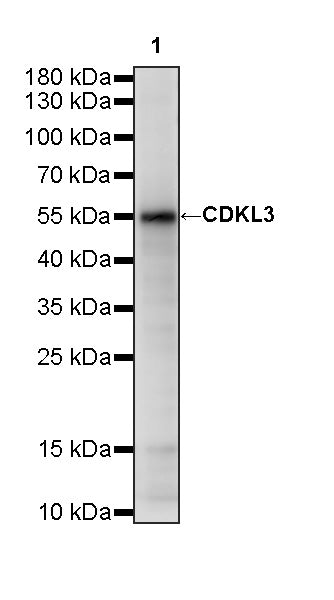
WB result of CDKL3 Recombinant Rabbit mAb
Primary antibody: CDKL3 Recombinant Rabbit mAb at 1/1000 dilution
Lane 1: HeLa whole cell lysate 20 µg
Lane 2: PC-3 whole cell lysate 20 µg
Lane 3: DU 145 whole cell lysate 20 µg
Lane 4: A549 whole cell lysate 20 µg
Secondary antibody: Goat Anti-Rabbit IgG, (H+L), HRP conjugated at 1/10000 dilution
Predicted MW: 68 kDa
Observed MW: 55 kDa
CDKL3 Recombinant Rabbit mAb (S-4356-11)
CDKL3 Recombinant Rabbit mAb (S-4356-11)
Price:
Regular price
$100 USD
Regular price
Sale price
$100 USD
Unit price
per
For shipping services or bulk orders, you may request a quotation.
Secure checkout with

View full details
Product Details
Product Details
Product Specification
| Host | Rabbit |
| Antigen | CDKL3 |
| Synonyms | Cyclin-dependent kinase-like 3; NKIAMRE |
| Immunogen | Synthetic Peptide |
| Location | Cytoplasm |
| Accession | Q8IVW4 |
| Clone Number | S-4356-11 |
| Antibody Type | Recombinant mAb |
| Isotype | IgG |
| Application | WB |
| Reactivity | Hu, Ms, Rt |
| Positive Sample | HeLa, PC-3, DU 145, A549, mouse brain, rat brain |
| Purification | Protein A |
| Concentration | 2 mg/ml |
| Conjugation | Unconjugated |
| Physical Appearance | Liquid |
| Storage Buffer | PBS, 40% Glycerol, 0.05% BSA, 0.02% sodium azide |
| Stability & Storage | 12 months from date of receipt / reconstitution, -20 °C as supplied |
Dilution
| application | dilution | species |
| WB | 1:1000 | Hu, Ms, Rt |
Background
CDKL3 (Cyclin-Dependent Kinase-Like 3) is a serine/threonine protein kinase belonging to the CDKL family, with its gene located on human chromosome 5q31.1. It was originally cloned from a fetal heart cDNA library in 1999 and named NKIAMRE due to its putative cyclin-binding motif. Although CDKL3 shares sequence similarity with classical CDKs and MAPK kinases, suggesting potential involvement in cell cycle regulation and signal transduction, it has long been one of the less-studied members of this family. Recent systematic studies have gradually revealed the multifunctionality of CDKL3, demonstrating that it not only plays a critical role in cell cycle regulation but is also closely associated with metabolic diseases (such as MASLD) and the development and progression of various cancers, including osteosarcoma, non-small cell lung cancer, prostate cancer, hepatocellular carcinoma, and clear cell renal cell carcinoma. Mechanistically, CDKL3 exhibits remarkable functional diversity: it can function as a classical kinase, while also serving as a catalytically inactive adaptor protein in specific contexts (e.g., activating Akt signaling via mTORC2 in the cytoplasm), with different isoforms displaying distinct subcellular localization and regulatory mechanisms. Furthermore, CDKL3 participates in regulating neuronal dendritic morphogenesis, and its aberrant expression has been linked to neurodevelopmental disorders such as mental retardation. Given its oncogenic role in multiple tumors and its pharmacologically targetable properties, CDKL3 is increasingly being recognized as a promising novel anticancer therapeutic target.
Picture
Picture
Western Blot
WB result of CDKL3 Recombinant Rabbit mAb
Primary antibody: CDKL3 Recombinant Rabbit mAb at 1/1000 dilution
Lane 1: mouse brain lysate 20 µg
Secondary antibody: Goat Anti-Rabbit IgG, (H+L), HRP conjugated at 1/10000 dilution
Predicted MW: 68 kDa
Observed MW: 55 kDa
WB result of CDKL3 Recombinant Rabbit mAb
Primary antibody: CDKL3 Recombinant Rabbit mAb at 1/1000 dilution
Lane 1: rat brain lysate 20 µg
Secondary antibody: Goat Anti-Rabbit IgG, (H+L), HRP conjugated at 1/10000 dilution
Predicted MW: 68 kDa
Observed MW: 55 kDa