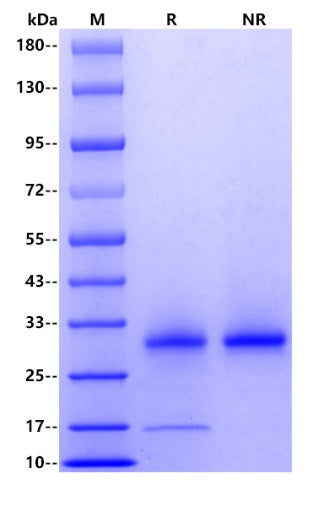
2 μg(R: reducing conditions; NR: non-reducing conditions)
CD99 His Tag Protein, Human
CD99 His Tag Protein, Human
Price:
Regular price
$170 USD
Regular price
Sale price
$170 USD
Unit price
per
For shipping services or bulk orders, you may request a quotation.
Secure checkout with

View full details
Product Details
Product Details
Product Specification
| Species | Human |
| Synonyms | 12E7, E2 antigen, Protein MIC2, T-cell surface glycoprotein E2, MIC2, MIC2X, MIC2Y |
| Accession | P14209 |
| Amino Acid Sequence | Asp23-Asp122, with C-10*His |
| Expression System | HEK293 |
| Molecular Weight | Predicted MW: 11.8 kDa Observed MW: 17, 30 kDa |
| Purity | >95% by SDS-PAGE |
| Endotoxin | <1EU/μg |
| Conjugation | Unconjugated |
| Tag | His Tag |
| Physical Appearance | Lyophilized powder |
| Storage Buffer | 0.2M PBS, pH7.4 |
| Reconstitution | Reconstitute no more than 1 mg/mL according to the size in deionized water after rapid centrifugation. |
| Stability & Storage | 12 months from date of receipt, -20 to -70 °C as supplied. |
Background
CD99 antigen (Cluster of differentiation 99), also known as MIC2 or single-chain type-1 glycoprotein, is a heavily O-glycosylated transmembrane protein that is encoded by the CD99 gene in humans. The CD99 gene does not undergo X inactivation on the X chromosome and it was the first such pseudoautosomal gene to be discovered in humans. It is expressed on all leukocytes but highest on thymocytes and is believed to augment T-cell adhesion and apoptosis of double positive T cells. It also participates in migration and activation. It is found on the cell surface of Ewing's sarcoma tumors and is positive in granulosa cell tumors. It is more expressed in malignant gliomas than in the brain, and such overexpression results in higher levels of invasiveness and lower rates of survival. Antibodies to CD99 are used in diagnostic immunohistochemistry to distinguish Ewing's sarcoma from other tumours of similar histological appearance, as well as for the identification of thymic tumours, and of spindle cell tumours, such as synovial sarcoma, haemangiopericytoma, and meningioma.
Picture
Picture
SDS-PAGE