2μg (R: reducing condition, N: non-reducing condition).
CD5(159-372) Fc Chimera Protein, Human
CD5(159-372) Fc Chimera Protein, Human
Price:
Regular price
$215 USD
Regular price
Sale price
$215 USD
Unit price
per
For shipping services or bulk orders, you may request a quotation.
Secure checkout with

View full details
Product Details
Product Details
Product Specification
| Species | Human |
| Synonyms | CD5, LEU1, T1, Tp67 |
| Accession | P06127 |
| Amino Acid Sequence | Leu 159 - Pro 372 with hIgG1 Fc Tag at the C-Terminus |
| Expression System | HEK293 |
| Molecular Weight | 55-70kDa (Reducing) |
| Purity | >95% by SDS-PAGE & HPLC |
| Conjugation | Unconjugated |
| Tag | Human IgG1 Fc |
| Physical Appearance | Lyophilized powder |
| Storage Buffer | PBS, pH7.4, 5% trehalose |
| Reconstitution | Reconstitute at 0.1-1 mg/ml according to the size in ultrapure water after rapid centrifugation. |
| Stability & Storage | · 12 months from date of receipt, lyophilized powder stored at -20 to -80℃. |
| Reference | 1. Van de Velde, H., et al. (1991). The B-cell surface protein CD72/Lyb-2 is the ligand for CD5. Nature, 351(6328), 662-665. |
Background
CD5 is a type I transmembrane glycoprotein with a molecular weight of approximately 67 kDa. Its extracellular region is composed of three group B scavenger receptor cysteine-rich domains (D1, D2, D3), each containing 8 cysteines. The cytoplasmic domain comprises 93 amino acids and includes an immunoreceptor tyrosine-based inhibitory motif-like domain responsible for recruiting the protein tyrosine phosphatase SHP-1.
The 159-372 amino acid fragment of the human CD5 protein corresponds to the second and third SRCR domains of its extracellular region. This fragment is typically located in the membrane-proximal region of full-length CD5. By lacking the N-terminal first SRCR domain, its potential conformation and ligand-binding properties may differ from the full extracellular region, making it an important target for functional studies.
This fragment contains multiple functional sites and may be involved in interactions with other immune molecules, such as CD72 on the surface of B cells. Due to the high conservation of SRCR domains, this fragment likely plays a crucial role in maintaining the structural integrity of the whole protein.
Picture
Picture
SDS-PAGE
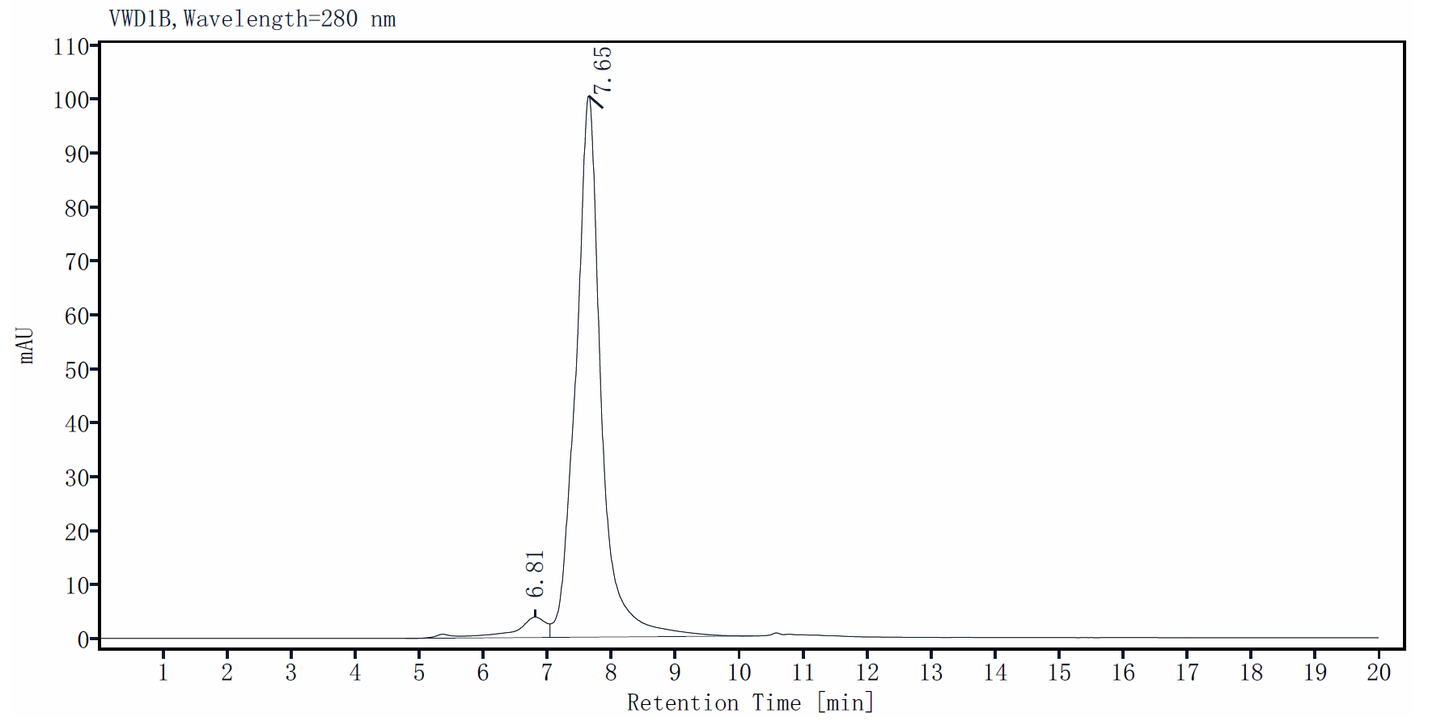
SEC-HPLC
The purity of CD5(159-372) Fc Chimera Protein, Human is more than 95% determined by SEC-HPLC.
RP-HPLC
The purity of CD5(159-372) Fc Chimera Protein, Human is more than 95% determined by RP-HPLC.
ELISA
Immobilized CD5(159-372) Fc Chimera Protein, Human (Cat. No. UA016083) at 1.0μg/mL (100μL/well) can bind CD5 Recombinant Rabbit mAb (SDT-2857-16) (Cat. No. S0B2441) with EC50 of 2.54-5.96 ng/mL.