2μg (R: reducing condition, N: non-reducing condition).
CD3 epsilon&CD3 gamma Heterodimer, Fc, His Tag&Fc, Flag Tag Protein, Human
CD3 epsilon&CD3 gamma Heterodimer, Fc, His Tag&Fc, Flag Tag Protein, Human
Price:
Regular price
$345 USD
Regular price
Sale price
$345 USD
Unit price
per
For shipping services or bulk orders, you may request a quotation.
Secure checkout with

View full details
Product Details
Product Details
Product Specification
| Species | Human |
| Synonyms | CD3 epsilon&CD3 gamma, CD3E & CD3G |
| Accession | P07766-1(CD3E)、P09693-1(CD3G) |
| Amino Acid Sequence | Asp 23 - Asp 126 (CD3E) with hIgG1 Fc Tag at the C-Terminus, followed by polyhistidine tag |
| Expression System | HEK293 |
| Molecular Weight | 40-55kDa (Reducing) |
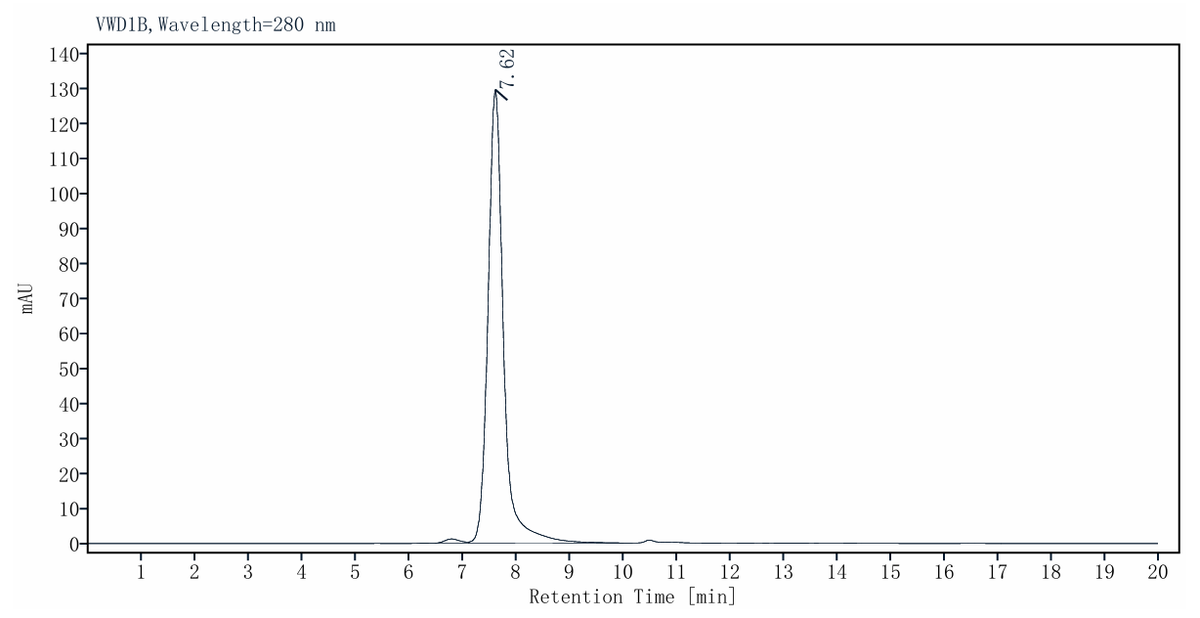
| Purity | >95% by SDS-PAGE & HPLC |
| Conjugation | Unconjugated |
| Tag | His Tag, Flag Tag, Human IgG1 Fc |
| Physical Appearance | Lyophilized powder |
| Storage Buffer | PBS, PH7.4, 5% trehalose |
| Reconstitution | Reconstitute at 0.1-1 mg/ml according to the size in ultrapure water after rapid centrifugation. |
| Stability & Storage | · 12 months from date of receipt, lyophilized powder stored at -20 to -80℃. |
| Reference | 1. Deconstructing the form and function of the TCR/CD3 complex. Immunity, 24(2), 133-139. |
Background
CD3ε and CD3γ are two essential and homologous subunits of the T cell receptor (TCR) complex. They are type I transmembrane glycoproteins belonging to the immunoglobulin superfamily. Unlike the variable TCRαβ or TCRγδ chains that recognize antigens, CD3ε and CD3γ, along with CD3δ and the ζ-chain homodimer, form the invariant CD3 signaling module.
These subunits exist primarily as a CD3εγ heterodimer on the cell surface. Their primary function is to mediate signal transduction from the engaged TCR to the T cell interior. Each subunit contains three immunoreceptor tyrosine-based activation motifs (ITAMs) in their cytoplasmic tails. Upon TCR-pMHC engagement, these ITAMs are phosphorylated by Src-family kinases, initiating a downstream cascade that leads to T cell activation, proliferation, and differentiation.
Structurally, the CD3εγ heterodimer plays a critical role in the assembly, surface expression, and conformational stability of the TCR complex. Their extracellular immunoglobulin domains interact with the TCRαβ constant regions, while their unique transmembrane charged residues are crucial for interactions within the complete TCR-CD3 assembly. CD3γ is particularly notable for having a conserved di-leucine-based motif in its cytoplasmic tail that can mediate TCR-CD3 complex internalization and downregulation, a key mechanism for modulating T cell responses. Defects in CD3γ are a known cause of severe combined immunodeficiency (SCID). The CD3εγ pair is also a stable surface marker for T cells.
Picture
Picture
SDS-PAGE
SEC-HPLC
The purity of CD3E&CD3G Heterodimer, Fc, His Tag&Fc, Flag Tag Protein, Human is more than 95% determined by SEC-HPLC.
RP-HPLC
The purity of CD3E&CD3G Heterodimer, Fc, His Tag&Fc, Flag Tag Protein, Human is more than 95% determined by RP-HPLC.
ELISA
Immobilized CD3E&CD3G Heterodimer, Fc, His Tag&Fc, Flag Tag Protein, Human (Cat. No. UA016009) at 1.0μg/mL (100μL/well) can bind Monoclonal Anti-Human CD3 Antibody, Mouse IgG1 (UCHT1) with EC50 of 1.61-2.78 ng/mL.
SPR
Anti-His antibody Immobilized on CM5 Chip captured CD3E&CD3G Heterodimer, Fc, His Tag&Fc, Flag Tag Protein, Human (Cat. No. UA016009), can bind NA/LE Mouse anti-human CD3 mAb (Cat. No. S0B0009) with an affinity constant of 2.08 nM as determined in SPR assay.