2μg (R: reducing condition, N: non-reducing condition).
CD3E&CD3D Heterodimer, Fc, His Tag&Fc, Flag Tag Protein, Cynomolgus
CD3E&CD3D Heterodimer, Fc, His Tag&Fc, Flag Tag Protein, Cynomolgus
Price:
Regular price
$200 USD
Regular price
Sale price
$200 USD
Unit price
per
For shipping services or bulk orders, you may request a quotation.
Secure checkout with

View full details
Product Details
Product Details
Product Specification
| Species | Human |
| Synonyms | CD3 epsilon&CD3 delta, CD3E & CD3D |
| Accession | Q95LI5-1(CD3E)、Q95LI8-1 (CD3D) |
| Amino Acid Sequence | Gln 22 - Asp 117 (CD3E) with hIgG1 Fc Tag at the C-Terminus, followed by polyhistidine tag; Phe 22 - Ala 105 (CD3D) with hIgG1 Fc Tag at the C-Terminus, followed by Flag tag |
| Expression System | HEK293 |
| Molecular Weight | 40-55kDa&55-70kDa (Reducing) |
| Purity | >95% by SDS-PAGE & HPLC |
| Conjugation | Unconjugated |
| Physical Appearance | Lyophilized powder |
| Storage Buffer | PBS, pH7.4, 5% trehalose |
| Reconstitution | Reconstitute at 0.1-1 mg/ml according to the size in ultrapure water after rapid centrifugation. |
| Stability & Storage |
· 12 months from date of receipt, lyophilized powder stored at -20 to -80℃. · 3 months, -20 to -80℃ under sterile conditions after reconstitution. · 1 week, 2 to 8℃ under sterile conditions after reconstitution. · Please avoid repeated freeze-thaw cycles. |
| Reference | 1. Wang, Z., et al. (2004). Expression and characterization of recombinant soluble monkey CD3 molecules: mapping the FN18 polymorphic epitope. Molecular Immunology, 40(16), 1179-1188. |
Background
Cynomolgus macaque (Macaca fascicularis) CD3E (CD3 epsilon chain) and CD3D (CD3 delta chain) are two key subunits of the T cell receptor (TCR)-CD3 complex, both of which are single-pass type I membrane glycoproteins. These two subunits form a CD3εδ heterodimer on the cell surface, serving as one of the core signal-transducing components of the TCR-CD3 complex.
The ectodomains of cynomolgus CD3E and CD3D correspond to Gln22-Asp117 of CD3E and Phe22-Ala105 of CD3D, respectively. The UniProt accession numbers are Q95LI5 for CD3E and Q95LI8 for CD3D. Due to glycosylation, recombinant CD3E&CD3D heterodimers typically exhibit higher apparent molecular weights on SDS-PAGE than their calculated values.
CD3E and CD3D, together with CD3G and CD3Z (CD247), constitute the signaling module of the TCR-CD3 complex. When antigen-presenting cells (APCs) activate the T cell receptor (TCR), TCR-mediated signals are transmitted across the cell membrane by the CD3 chains (CD3D, CD3E, CD3G, and CD3Z). The immunoreceptor tyrosine-based activation motifs (ITAMs) within the cytoplasmic tails of CD3 subunits become phosphorylated, creating docking sites for the protein kinase ZAP-70 and initiating downstream signaling cascades
Picture
Picture
SDS-PAGE
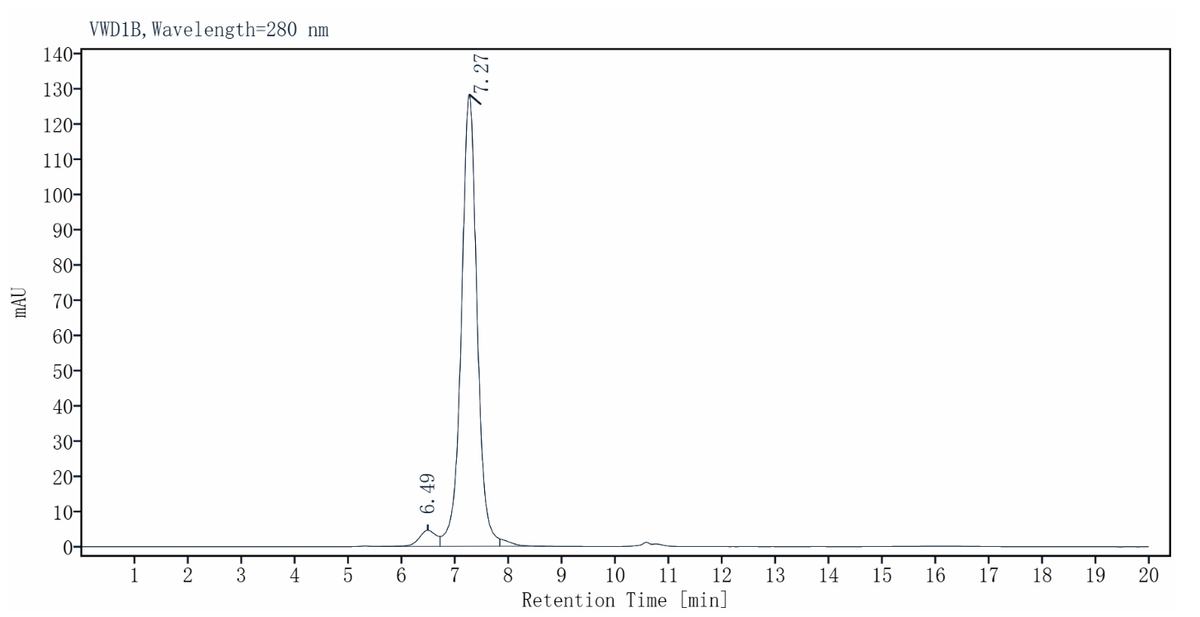
SEC-HPLC
The purity of CD3E&CD3D Heterodimer, Fc, His Tag&Fc, Flag Tag Protein, Cynomolgus is more than 95% determined by SEC-HPLC.
RP-HPLC
The purity of CD3E&CD3D Heterodimer, Fc, His Tag&Fc, Flag Tag Protein, Cynomolgus is more than 95% determined by RP-HPLC.
ELISA
Immobilized CD3E&CD3D Heterodimer, Fc, His Tag&Fc, Flag Tag Protein, Cynomolgus (UA016156) at 1 μg/mL (100 μL/well) can bind Monoclonal Anti-Human CD3 Antibody, Mouse IgG1 (SP34-2) with a linear range of 14.36-21.41 ng/mL.