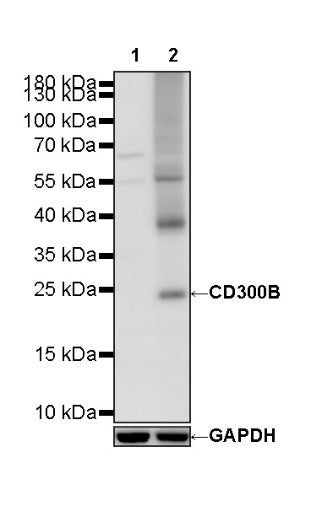
WB result of CD300B Recombinant Rabbit mAb
Primary antibody: CD300B Recombinant Rabbit mAb at 1/1000 dilution
Lane 1: unboiled 293F transfected with empty vector whole cell lysate 20 µg
Lane 2: unboiled 293F transfected with CD300B-His fusion protein whole cell lysate 20 µg
Secondary antibody: Goat Anti-Rabbit IgG (H+L), HRP conjugated at 1/10000 dilution
Predicted MW: 23 kDa
Observed MW: 23 kDa
CD300B Recombinant Rabbit mAb (S-2937-112)
CD300B Recombinant Rabbit mAb (S-2937-112)
Price:
Regular price
$100 USD
Regular price
Sale price
$100 USD
Unit price
per
For shipping services or bulk orders, you may request a quotation.
Secure checkout with

View full details
Product Details
Product Details
Product Specification
| Host | Rabbit |
| Antigen | CD300B |
| Synonyms | CMRF35-like molecule 7; CD300 antigen-like family member B; CMRF35-A2; Immune receptor expressed on myeloid cells 3 (IREM-3); Leukocyte mono-Ig-like receptor 5; Triggering receptor expressed on myeloid cells 5 (TREM-5); CD300b; CLM7; CMRF35A2; IREM3; LMIR5; TREM5; CD300LB |
| Immunogen | Synthetic Peptide |
| Location | Cell membrane |
| Accession | A8K4G0 |
| Clone Number | S-2937-112 |
| Antibody Type | Recombinant mAb |
| Isotype | IgG |
| Application | WB |
| Reactivity | Hu |
| Purification | Protein A |
| Concentration | 0.5 mg/ml |
| Conjugation | Unconjugated |
| Physical Appearance | Liquid |
| Storage Buffer | PBS, 40% Glycerol, 0.05% BSA, 0.02% sodium azide |
| Stability & Storage | 12 months from date of receipt / reconstitution, -20 °C as supplied |
Dilution
| application | dilution | species |
| WB | 1:1000 | Hu |
Background
CD74, also known as the MHC class II-associated invariant chain (Ii chain), is a functionally versatile and critically important molecule in the immune system. Its most canonical function is to serve as a "chaperone" protein for MHC class II molecules in antigen-presenting cells, where it stabilizes the peptide-binding groove of MHC class II molecules, prevents premature binding of endogenous peptides, and directs their trafficking from the endoplasmic reticulum to endosomes/lysosomes, thereby ensuring efficient presentation of exogenous antigens to initiate specific immune responses. However, the functions of CD74 extend far beyond this: it also acts as a high-affinity cell surface receptor for the pro-inflammatory cytokine macrophage migration inhibitory factor (MIF). Upon binding of MIF to CD74—often in cooperation with CD44—multiple signaling pathways including NF-κB and PI3K-Akt are activated, subsequently regulating cell proliferation, survival, and inflammatory responses. This dual identity in both antigen presentation and inflammatory signaling casts CD74 as a "double-edged sword" in various diseases—it participates in B-cell development and the maintenance of immune homeostasis on one hand, while on the other, it is found to be aberrantly overexpressed in autoimmune diseases such as rheumatoid arthritis and systemic lupus erythematosus, as well as in numerous hematological malignancies and solid tumors, where it promotes disease progression through its survival signaling pathways. Consequently, CD74-targeted therapeutic strategies (such as the humanized antibody Milatuzumab) and explorations of its utility as a diagnostic and prognostic biomarker in cancer and inflammatory diseases have become hot topics in current research.
Picture
Picture
Western Blot