2μg (R: reducing condition, N: non-reducing
condition).
CD3 epsilon Fc Chimera, Human
CD3 epsilon Fc Chimera, Human
Price:
Regular price
$430 USD
Regular price
Sale price
$430 USD
Unit price
per
For shipping services or bulk orders, you may request a quotation.
Secure checkout with

View full details
Product Details
Product Details
Product Specification
| Species | Human |
| Synonyms | CD3 epsilon, CD3E |
| Accession | P07766-1 |
| Amino Acid Sequence | Asp 23 - Asp 126 with hIgG1 Fc Tag at the C-Terminus |
| Expression System | HEK293 |
| Molecular Weight | 40-55kDa (Reducing) |
| Endotoxin | <0.1EU/μg |
| Conjugation | Unconjugated |
| Tag | Huamn IgG1 Fc |
| Physical Appearance | Lyophilized powder |
| Storage Buffer | PBS, pH7.4, 5% trehalose |
| Reconstitution | Reconstitute at 0.1-1 mg/ml according to the size in ultrapure water after rapid centrifugation |
| Stability & Storage |
· 12 months from date of receipt,lyophilized powder stored at -20 to -80℃. · 3 months, -20 to -80℃under sterile conditions after reconstitution. · 1 week, 2 to 8℃under sterile conditions after reconstitution. · Please avoid repeated freeze-thaw cycles. |
| Reference |
1. Severecombined immunodeficiency caused by deficiency in either the CD3 epsilon or theCD3 gamma subunit of the T-cell antigen receptor complex. Journal of ClinicalInvestigation, 114(10), 1512-1517. 2.Structural basis of assembly of the human T cell receptor-CD3 complex. Nature,585(7823), 116-121. 3. The TCR-CD3 complex: a 3:1 stoichiometry ofsignaling subunits. Trends in Immunology, 44(5), 345-358. |
Background
TheCD3E (CD3 epsilon subunit of T-cell receptor complex) gene encodes the CD3εchain of the T-cell surface glycoprotein, an essential component of the T cell receptor(TCR)-CD3 complex. The gene is located on human chromosome 11q23.3, and theCD3ε protein is a single-pass type I transmembrane protein belonging to theimmunoglobulin (Ig) superfamily.
Structure and Function: Human CD3ε protein consists ofan extracellular domain (104 amino acids), a transmembrane domain (26 aminoacids), and a cytoplasmic domain (55 amino acids). The extracellular regioncontains an immunoglobulin-like domain, and the cytoplasmic tail contains animmunoreceptor tyrosine-based activation motif (ITAM) domain. CD3ε, togetherwith CD3γ, CD3δ, and CD3ζ, forms the signaling module of the TCR-CD3 complex.Upon TCR engagement by antigen-presenting cells, the ITAM motifs of CD3 chainsbecome phosphorylated, initiating downstream signaling cascades that convertantigen recognition into intracellular activation signals.
Picture
Picture
SDS-PAGE

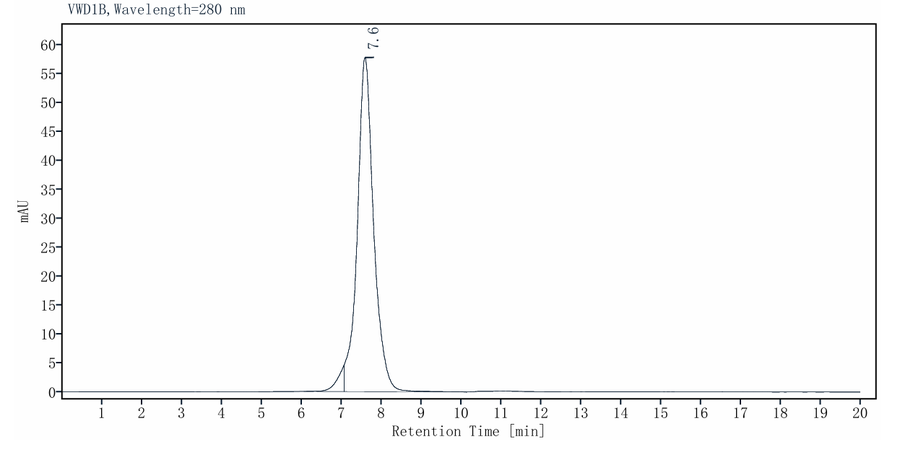
SEC-HPLC
ELISA
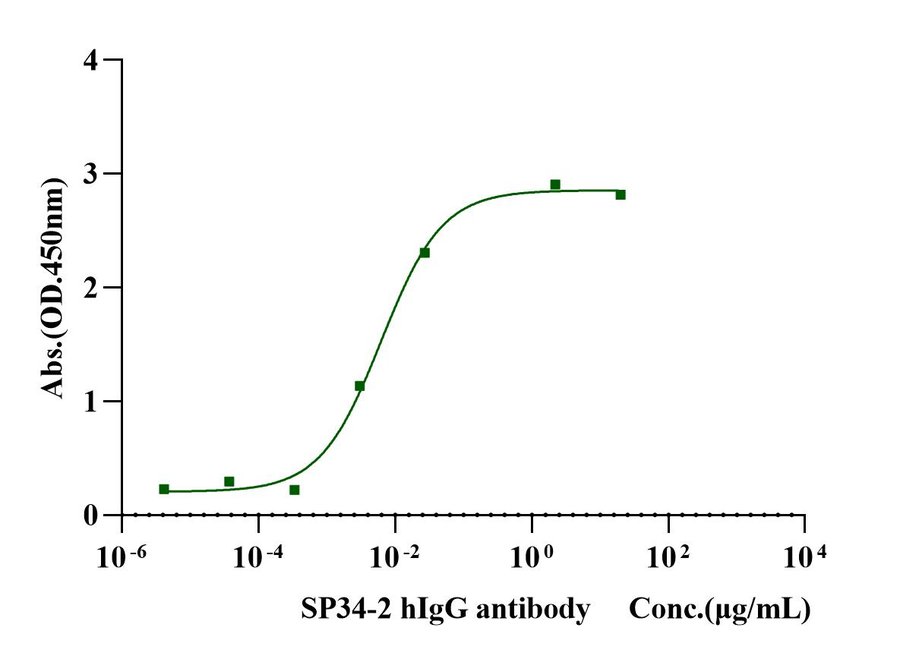
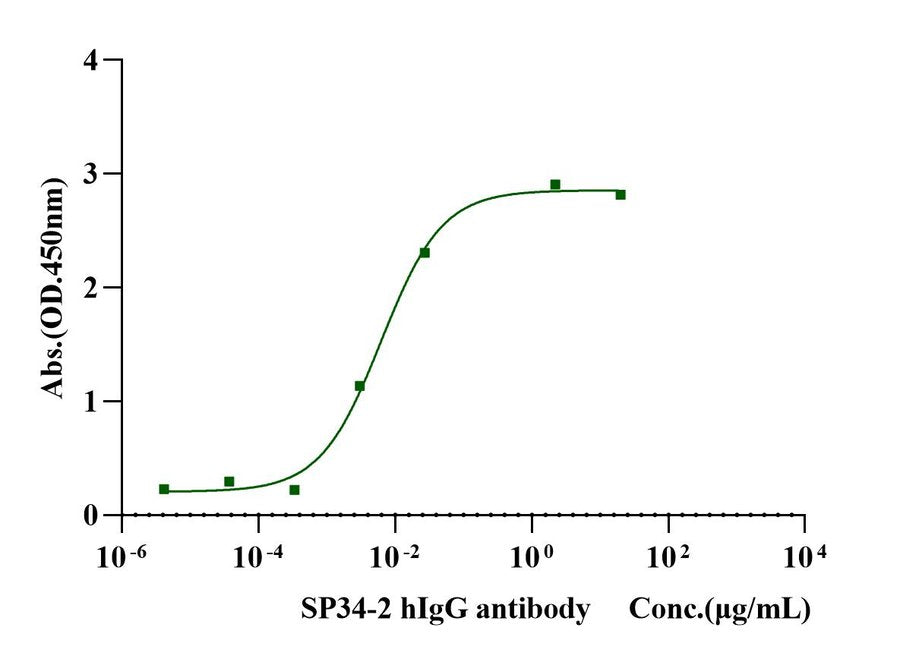
Immobilized CD3 epsilon Fc Chimera Protein,
Human (Cat. No. UA016269) at 2 μg/mL (100 μL/well) can bind SP34-2 hIgG
antibody with a linear range of 3.5-11 ng/mL.