


2μg (R: reducing condition, N:non-reducing condition).
CD221/IGF1R His Tag Protein, Human
CD221/IGF1R His Tag Protein, Human
Price:
Regular price
$215 USD
Regular price
Sale price
$215 USD
Unit price
per
For shipping services or bulk orders, you may request a quotation.
Secure checkout with

View full details
Product Details
Product Details
Product Specification
| Species | Human |
| Synonyms | IGF-I receptor, Insulin-like growth factor 1 receptor alpha chain |
| Accession | P08069 |
| Amino Acid Sequence | Glu31-Asn932 with His Tag at the C-Terminus |
| Expression System | HEK293 |
| Molecular Weight | 40-55kDa (Reducing)&100-130kDa (Reducing) |
| Purity | >95% by SDS-PAGE & HPLC |
| Conjugation | Unconjugated |
| Tag | His Tag |
| Physical Appearance | Lyophilized powder |
| Storage Buffer | PBS, pH7.4, 5% trehalose |
| Reconstitution | Reconstitute at 0.1-1 mg/ml according to the size in ultrapure water after rapid centrifugation. |
| Stability & Storage | · 12 months from date of receipt, lyophilized powder stored at -20 to -80℃. |
| Reference | 1.Fürstenberger G, Senn HJ. Insulin-like growth factors and cancer. Lancet Oncol. 2002 May;3(5):298-302. |
Background
IGF1R (CD221, insulin-like growth factor 1 receptor) is a transmembrane tyrosine kinase receptor composed of disulfide-linked α₂β₂ heterotetrameric subunits. It exhibits substantial structural homology with the insulin receptor and can form functionally active hybrid receptors. Ligand engagement of IGF-1 or IGF-2 to the cysteine-rich extracellular α chains induces conformational changes that trigger trans-autophosphorylation of the intracellular β-chain tyrosine kinase domains, thereby activating downstream PI3K/AKT and RAS/RAF/MEK/ERK signaling pathways to orchestrate cellular proliferation, survival, anti-apoptotic responses, and metabolic adaptation. Clinically, IGF1R overexpression or genomic amplification has been identified in diverse human malignancies, notably non-small cell lung cancer, breast carcinoma, and Ewing sarcoma, where it serves as an independent prognostic indicator and a druggable therapeutic target. Multiple monoclonal antibodies—including figitumumab and ganitumab—have entered clinical development; however, monotherapy has demonstrated limited efficacy, shifting the strategic focus toward rational combination therapies with EGFR inhibitors, cytotoxic agents, or immune checkpoint blockade, coupled with rigorous biomarker-driven patient selection to identify responsive molecular subtypes.
Picture
Picture
SDS-PAGE
SEC-HPLC
The purity of CD221/IGF1R His Tag Protein, Human is more than 95% determined by SEC-HPLC.
ELISA
Immobilized CD221/IGF1R His Tag Protein, Human (Cat. No. UA016097) at 5.0μg/mL (100μL/well) can bind Recombinant Human IGF1 Protein (Fc Tag) with EC50 of 29.25-35.48ng/mL.
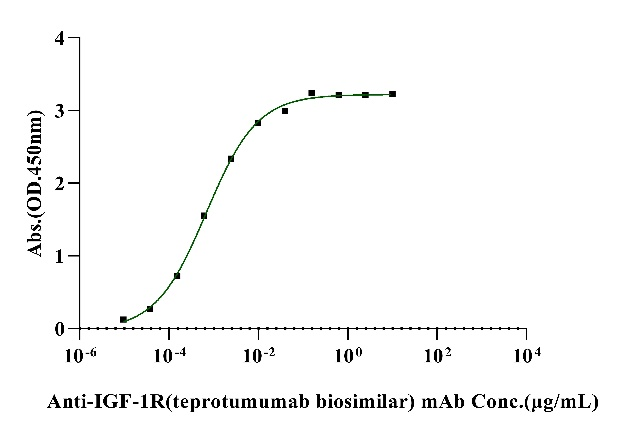
Immobilized CD221/IGF1R His Tag Protein, Human (Cat. No. UA016097) at 0.5μg/mL (100μL/well) can bind Anti-IGF-1R (Teprotumumab biosimilar) mAb with EC50 of 0.56-0.84 ng/mL.
SPR
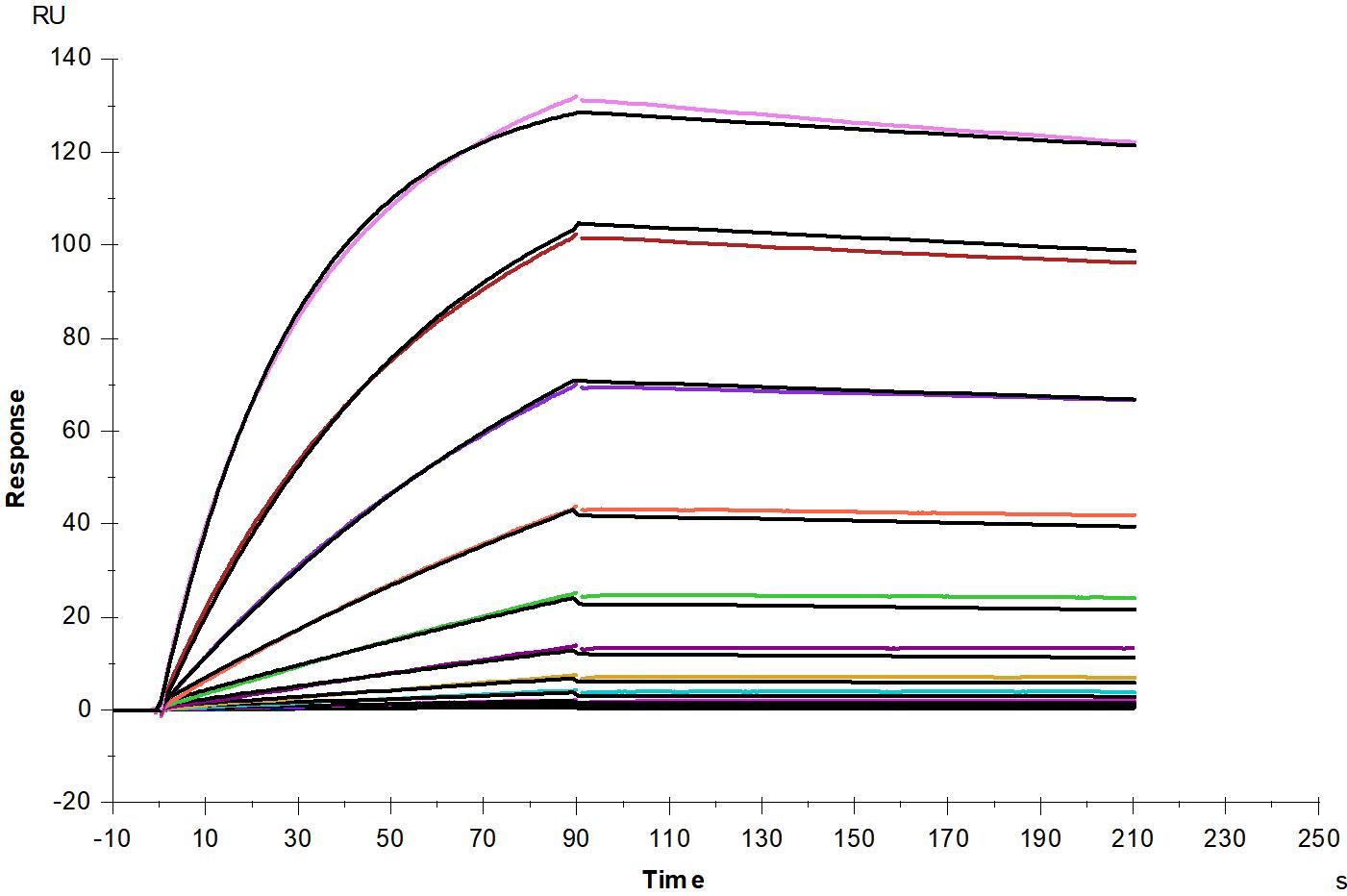
CD221/IGF1R His Tag Protein, Human (Cat. No. UA016097) captured on CM5 chip via anti-His antibody can bind Recombinant Human IGF1 Protein (Fc Tag) with an affinity constant of 29.26nM as determined in a SPR assay.


