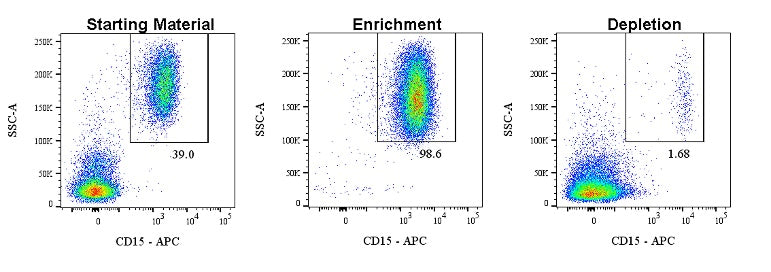
Use CD15 Nanobeads, human S or L Separation Columns, and a magnetic sorter to enrich or deplete CD15+ cells from human peripheral blood. Subsequently, perform fluorescent staining with APC anti-human CD15 (SSEA-1) Antibody (Clone: HI98), and gate on the live cell population for analysis.
CD15 Nanobeads, human(RUO)
CD15 Nanobeads, human(RUO)
Price:
Regular price
$450 USD
Regular price
Sale price
$450 USD
Unit price
per
For shipping services or bulk orders, you may request a quotation.
Secure checkout with

View full details
Product Details
Product Details
Product Specification
| Format | Dextran-coated iron tetroxide magnetic nanoparticles conjugated with an anti-human CD15 monoclonal antibody. |
| Capacity |
1 mL magnetic beads: suitable for a total cell count of 5×10⁸and can perform up to 50 sorting runs. 2 mL magnetic beads: suitable for a total cell count of 1×10⁹and can perform up to 100 sorting runs. |
| Principle of Separation | CD15⁺ cells are magnetically labeled using CD15 Nanobeads. The cell suspension is then loaded into a separation column placed within the sorter's magnetic field. The magnetically labeled CD15⁺ cells remain retained in the column, while the unlabeled cells elute; this fraction constitutes the negative fraction after removal of CD15⁺ cells. After removing the separation column from the magnetic field, the magnetically captured CD15⁺ cells can be eluted, yielding the positive sorted fraction. |
| Applications in cell sorting | Eosinophils and neutrophils can be isolated from or depleted from tissue samples, such as human peripheral blood or ovarian cancer tissues. |
| Reactivity | Human |
| Magnetic Bead Size | 20 nm |
| Separation Method | Column-Based |
| Selection Strategy | Positive Selection |
| Stability & Storage | Store protected from light at 2–8°C; do not freeze. |
Background
CD15 Nanobeads, human are designed to positively select or deplete CD15-positive cells from human peripheral blood or tissue single-cell suspensions. The CD15 antigen is expressed on neutrophils, eosinophils, and myeloid lineage monoblast progenitor cells, but it is not expressed on basophils or lymphocytes. Furthermore, this antigen is also expressed in Hodgkin/Reed-Sternberg cells.
Picture
Picture
Validation Data