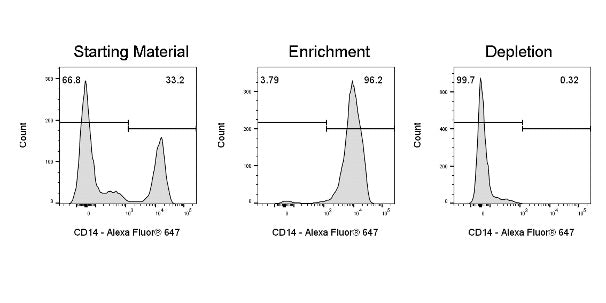
Enrich or deplete CD14+ cells from human PBMCs (human peripheral blood mononuclear cells). Subsequently, perform fluorescent staining with anti-CD14 (clone: 61D3) APC and gate on the live cell population for analysis.
CD14 Nanobeads, human(RUO)
CD14 Nanobeads, human(RUO)
Price:
Regular price
$283 USD
Regular price
Sale price
$283 USD
Unit price
per
For shipping services or bulk orders, you may request a quotation.
Secure checkout with

View full details
Product Details
Product Details
Product Specification
| Format | Dextran-coated iron tetroxide nanomagnetic beads coupled with an anti-human CD14 monoclonal antibody |
| Capacity |
2 mL magnetic beads: suitable for a total cell count of 1×10⁹, and can perform up to 100 sorting runs 1 mL magnetic beads: suitable for 5×10⁸total cells, and can perform up to 50 sorting runs |
| Principle of Separation | CD14⁺ cells are magnetically labeled using CD14 Nanobeads. The cell suspension is then loaded into a separation column placed within the sorter's magnetic field. The magnetically labeled CD14⁺ cells remain retained in the column, while the unlabeled cells elute; this fraction constitutes the negative fraction after removal of CD14⁺ cells. After removing the separation column from the magnetic field, the magnetically captured CD14⁺ cells can be eluted, yielding the positive sorted fraction. |
| Reactivity | Human |
| Magnetic Bead Size | 20 nm |
| Separation Method | Column-Based |
| Selection Strategy | Positive Selection |
| Stability & Storage | Store protected from light at 2–8°C; do not freeze. |
Background
CD14 Nanobeads are used for the positive selection or depletion of human monocytes and macrophages from umbilical cord blood or peripheral blood mononuclear cells (PBMCs), as well as from pleural effusions, ascitic fluid, synovial fluid, or various tissues such as the spleen and lymph nodes. The CD14 antigen is part of the LPS receptor complex. Because CD14 lacks a cytoplasmic domain, antibody binding to CD14 does not trigger signal transduction. CD14 is strongly expressed on most monocytes and macrophages and weakly expressed on neutrophils and some myeloid dendritic cells.
Picture
Picture
Validation Data