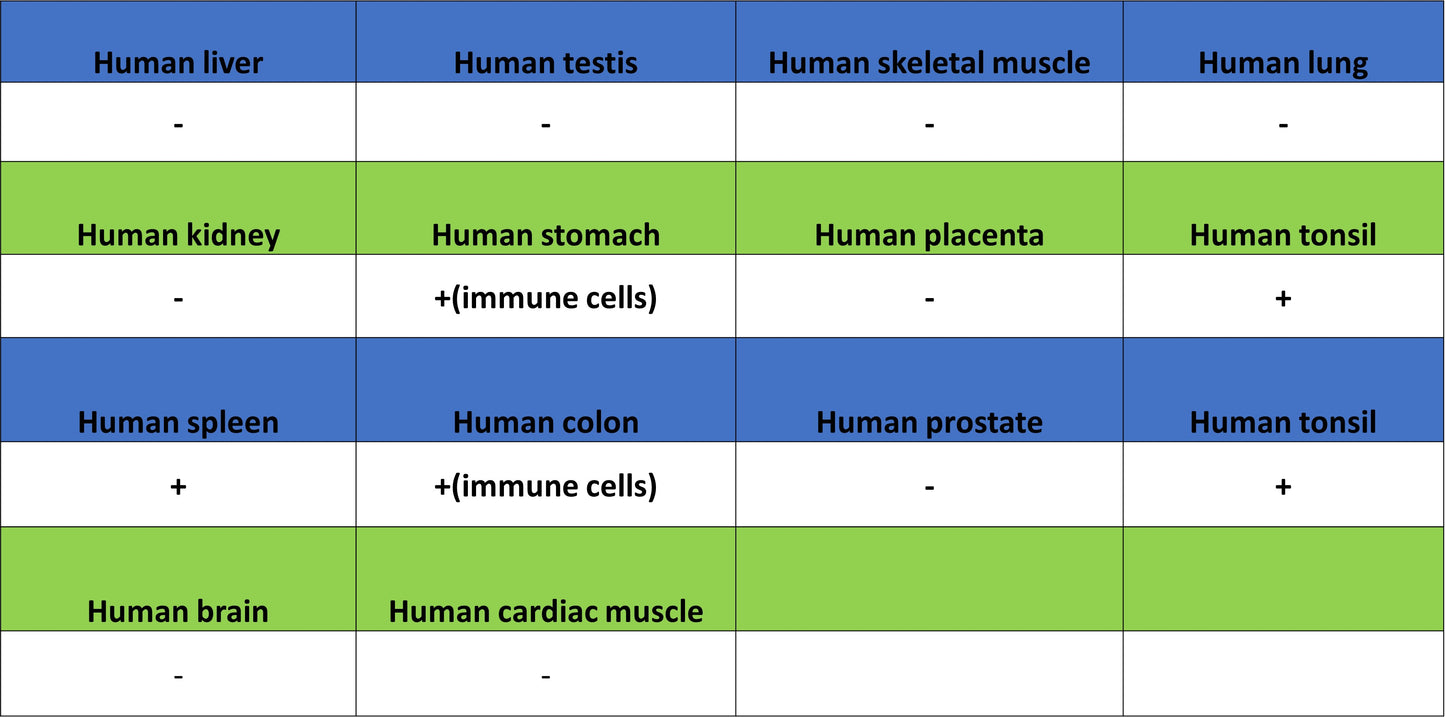
IHC shows positive staining in paraffin-embedded human spleen. Anti-CD127 antibody was used at 1/250 dilution, followed by a HRP Polymer for Rabbit IgG (ready to use). Counterstained with hematoxylin. Heat mediated antigen retrieval with Tris/EDTA buffer pH9.0 was performed before commencing with IHC staining protocol.
CD127 Recombinant Rabbit mAb (S-4826)
CD127 Recombinant Rabbit mAb (S-4826)
Price:
Regular price
$100 USD
Regular price
Sale price
$100 USD
Unit price
per
For shipping services or bulk orders, you may request a quotation.
Secure checkout with

View full details
Product Details
Product Details
Product Specification
| Host | Rabbit |
| Antigen | CD127 |
| Synonyms | Interleukin-7 receptor subunit alpha; IL-7 receptor subunit alpha; IL-7R subunit alpha; IL-7R-alpha; IL-7RAAlternative nameCDw127; IL7R |
| Location | Secreted, Cell membrane |
| Accession | P16871 |
| Clone Number | S-4826 |
| Antibody Type | Recombinant mAb |
| Isotype | IgG |
| Application | IHC-P |
| Reactivity | Hu |
| Purification | Protein A |
| Concentration | 0.5 mg/ml |
| Conjugation | Unconjugated |
| Physical Appearance | Liquid |
| Storage Buffer | PBS, 40% Glycerol, 0.05% BSA, 0.03% Proclin 300 |
| Stability & Storage | 12 months from date of receipt / reconstitution, -20 °C as supplied |
Dilution
| application | dilution | species |
| IHC-P | 1:250 | Hu |
Background
CD127, also known as the alpha chain of the interleukin-7 receptor (IL-7Rα), is a type I transmembrane glycoprotein that plays a pivotal role in lymphocyte development, survival, and homeostasis by pairing with the common gamma chain (CD132) to form the functional IL-7 receptor complex. Upon binding to its ligand, IL-7, CD127 triggers downstream signaling cascades, primarily through the JAK1/STAT5 pathway, which are essential for the generation and maintenance of naïve and memory T cells, as well as early B cell development in the bone marrow. Beyond its physiological importance in adaptive immunity, CD127 serves as a critical phenotypic marker in immunology and oncology; it is characteristically expressed on naïve and central memory T cells but downregulated on terminally differentiated effector cells and regulatory T cells (Tregs), making it a valuable tool for distinguishing Treg populations (typically CD4+CD25highCD127low/neg) from activated conventional T cells. Furthermore, aberrant expression or mutations in the gene encoding CD127 (IL7R) have been implicated in various pathologies, including severe combined immunodeficiency (SCID), multiple sclerosis susceptibility, and certain leukemias, highlighting its significance as both a diagnostic marker and a potential therapeutic target for modulating immune responses in autoimmunity, cancer immunotherapy, and immune reconstitution strategies.
Picture
Picture
Immunohistochemistry
IHC shows positive staining in paraffin-embedded human colon. Anti-CD127 antibody was used at 1/250 dilution, followed by a HRP Polymer for Rabbit IgG (ready to use). Counterstained with hematoxylin. Heat mediated antigen retrieval with Tris/EDTA buffer pH9.0 was performed before commencing with IHC staining protocol.
IHC shows positive staining in paraffin-embedded human colon cancer. Anti-CD127 antibody was used at 1/250 dilution, followed by a HRP Polymer for Rabbit IgG (ready to use). Counterstained with hematoxylin. Heat mediated antigen retrieval with Tris/EDTA buffer pH9.0 was performed before commencing with IHC staining protocol.
IHC shows positive staining in paraffin-embedded human pancreatic cancer. Anti-CD127 antibody was used at 1/250 dilution, followed by a HRP Polymer for Rabbit IgG (ready to use). Counterstained with hematoxylin. Heat mediated antigen retrieval with Tris/EDTA buffer pH9.0 was performed before commencing with IHC staining protocol.
Negative control: IHC shows negative staining in paraffin-embedded human cerebral cortex. Anti-CD127 antibody was used at 1/250 dilution, followed by a HRP Polymer for Rabbit IgG (ready to use). Counterstained with hematoxylin. Heat mediated antigen retrieval with Tris/EDTA buffer pH9.0 was performed before commencing with IHC staining protocol.