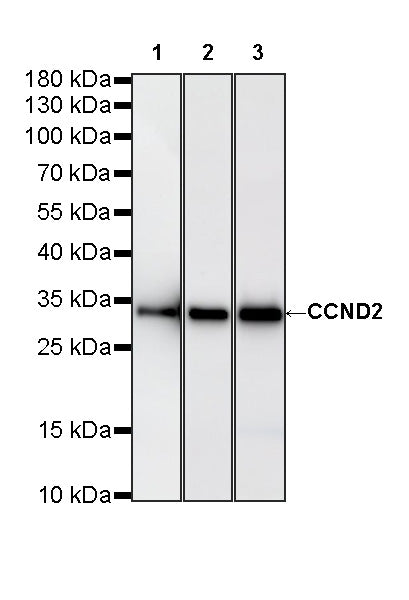
WB result of CCND2 Recombinant Rabbit mAb
Primary antibody: CCND2 Recombinant Rabbit mAb at 1/1000 dilution
Lane 1: Caco2 whole cell lysate 20 µg
Lane 2: U-2 OS whole cell lysate 20 µg
Lane 3: RD whole cell lysate 20 µg
Secondary antibody: Goat Anti-Rabbit IgG, (H+L), HRP conjugated at 1/10000 dilution
Predicted MW: 33 kDa
Observed MW: 33 kDa
This blot was developed with high sensitivity substrate
CCND2 Recombinant Rabbit mAb (S-5473)
CCND2 Recombinant Rabbit mAb (S-5473)
Price:
Regular price
$100 USD
Regular price
Sale price
$100 USD
Unit price
per
For shipping services or bulk orders, you may request a quotation.
Secure checkout with

View full details
Product Details
Product Details
Product Specification
| Host | Rabbit |
| Antigen | CCND2 |
| Synonyms | G1/S-specific cyclin-D2 |
| Location | Cytoplasm, Nucleus |
| Accession | P30279 |
| Clone Number | S-5473 |
| Antibody Type | Recombinant mAb |
| Isotype | IgG |
| Application | WB |
| Reactivity | Hu |
| Positive Sample | Caco2, U-2 OS, RD |
| Purification | Protein A |
| Concentration | 0.5 mg/ml |
| Conjugation | Unconjugated |
| Physical Appearance | Liquid |
| Storage Buffer | PBS, 40% Glycerol, 0.05% BSA, 0.02% sodium azide |
| Stability & Storage | 12 months from date of receipt / reconstitution, -20 °C as supplied |
Dilution
| application | dilution | species |
| WB | 1:1000 | Hu |
Background
CCND2 (Cyclin D2) is a key member of the D-type cyclin family, which plays a central role in the initiation and progression of cell proliferation by primarily binding to and activating cyclin-dependent kinases CDK4 and CDK6, thereby driving the cell cycle transition from G1 to S phase. Its expression is tightly regulated by extracellular mitogenic signals, exhibiting specific spatiotemporal distribution in various tissues such as ovary, skeletal muscle, and B lymphocytes, and is indispensable for the formation of certain organs during embryonic development—for instance, CCND2-knockout mice display defects in cerebellar and retinal development. As a core component of the cell cycle engine, dysregulation of CCND2 is closely associated with various diseases: gene amplification or overexpression is commonly observed in malignant tumors such as breast cancer, colorectal cancer, and melanoma, promoting uncontrolled tumor cell proliferation. Recent studies have also identified germline activating mutations in the CCND2 gene as the causative factor for MPPH syndrome (megalencephaly-polymicrogyria-polydactyly-hydrocephalus syndrome), a rare neurodevelopmental disorder characterized by cerebral cortical malformations and overgrowth. Therefore, CCND2 has garnered significant attention not only as a key biomarker for predicting the efficacy of CDK4/6 inhibitors in cancer therapy, but also as an important bridge for understanding both normal development and pathological processes through its regulatory mechanisms.
Picture
Picture
Western Blot