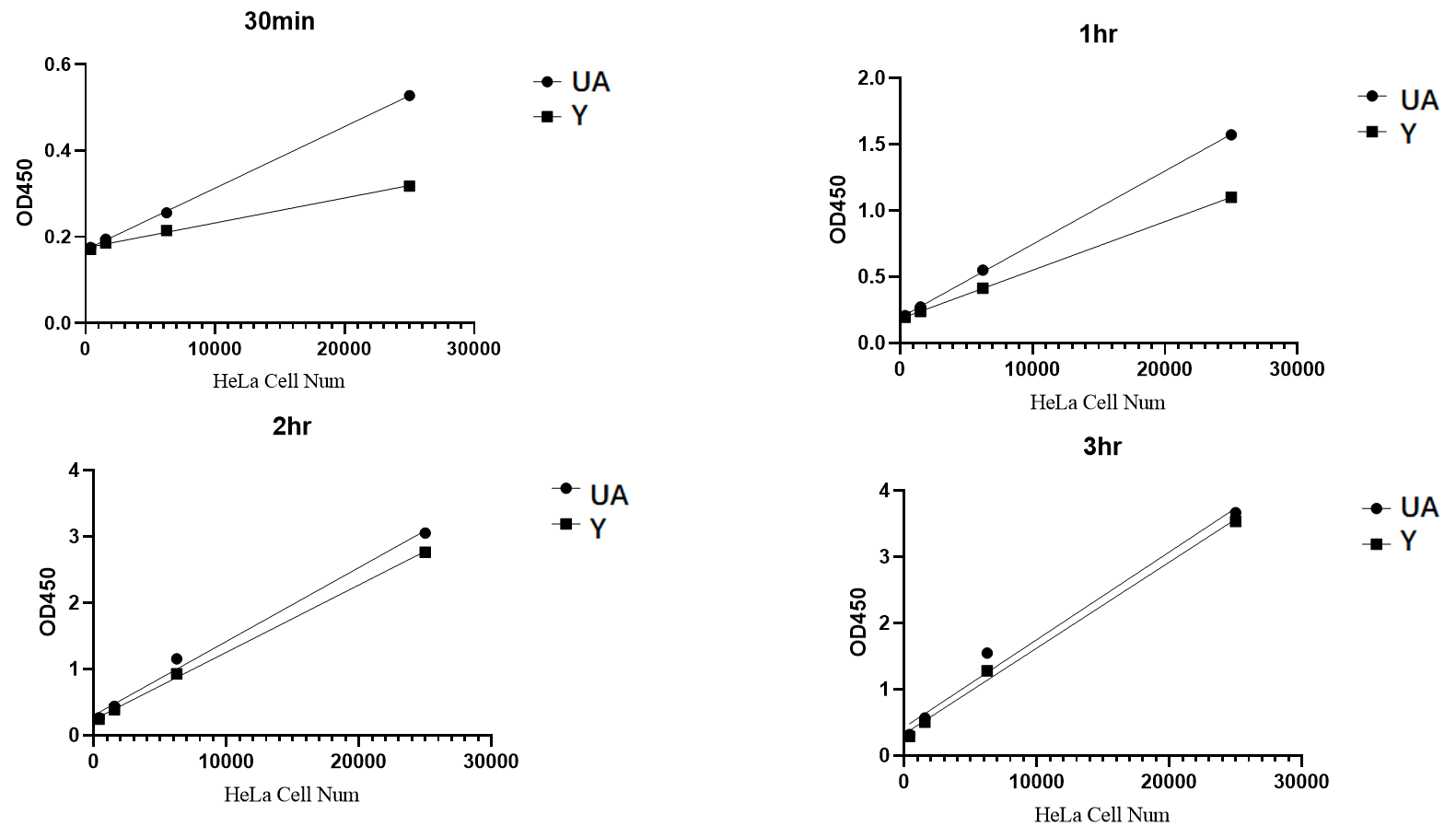
"Comparative data between the UA CCK-8 Cell Viability Assay Kit and the Y‑brand CCK‑8 Kit show that, when tested on HeLa cells, the UA CCK‑8 reagent reacts faster. Both kits exhibit similar linearity, with R² > 0.99 for detection times between 30 and 180 minutes. Their background signals (cell‑free DMEM + 10% FBS) are also comparable."**
CCK-8 Cell Viability Detection Kit
CCK-8 Cell Viability Detection Kit
Price:
Regular price
$23 USD
Regular price
Sale price
$23 USD
Unit price
per
For shipping services or bulk orders, you may request a quotation.
Secure checkout with

View full details
Product Details
Product Details
Product Specification
| Stability & Storage |
Shipped on dry ice. Store protected fromlight at –20 °C. After the first use, the reagent may be stored at 4 °C. For long‑term storage, aliquot and store at –20 °C. The expiration date is printed on the reagent bottle label. |
Background
The CCK-8 Cell Viability Detection Kit measures cell viability by detecting the metabolic state of cells using WST‑8 (2-(2-methoxy-4-nitrophenyl)-3-(4-nitrophenyl)-5-(2,4-disulfophenyl)-2H-tetrazolium monosodium salt). The colorless, water-soluble tetrazolium salt WST‑8 is reduced by intracellular dehydrogenases in the presence of the electron carrier 1‑Methoxy PMS to produce a water‑soluble orange‑yellow formazan dye. The amount of formazan is determined by colorimetry and is directly proportional to the number of living cells. CCK‑8 Cell Viability Detection Kit is a homogeneous reagent that can be added directly to cells to quantify viable cells in cell proliferation and cytotoxicity assays. The reagent exhibits very low cytotoxicity and permits prolonged incubation. The detection sensitivity of this CCK‑8 kit is superior to that of other tetrazolium salts such as MTT, XTT or MTS.
Components
The specifications of CCK‑8 Cell Viability Detection Kit are shown below. The number of reactions for 96‑well and 384‑well plates is calculated based on a culture medium volume of 100 μL and 40 μL per well, respectively, and addition of 10 μL and 4 μL of detection reagent per well, respectively.
Size |
No. of assays for 96‑well plates |
No. of assays for 384‑well plates |
1mL |
100 |
250 |
5 mL |
500 |
1,250 |
10 mL |
1,000 |
2,500 |
30 mL |
3,000 |
7,500 |
100 mL |
10,000 |
25,000 |
Protocol
The CCK‑8 Cell Viability Detection Kit measures the number of viable cells through a WST‑8 redox reaction. Redox substances present in the culture medium may affect the reaction and thus the results. A cell‑free medium control can be included to assess the magnitude of this effect, or the experimental values can be corrected by subtracting the cell‑free medium control values. Under most experimental conditions, direct comparison of absolute sample readings is not recommended. It is advisable to include the same reference controls on each plate (e.g., when testing tumor cell proliferation, include the same reference toxic compound and solvent vehicle control). Normalize sample readings to those of the reference toxic compound and solvent vehicle control before data processing and comparison.
The procedure below is described for 96‑well cell culture plates.
1. Seed the desired cell density in 100 μL of medium per well of a 96‑well plate with a clear flat bottom.
2. Treat the cells according to the experimental design (e.g., for tumor cell proliferation assays, add the test compounds and incubate for the required time).
3. After cell treatment, remove the CCK‑8 Cell Viability Detection Kit reagent from storage for cell viability detection.
4. Add 10 μL of CCK‑8 Cell Viability Detection reagent to each well of the 96‑well plate that contains 100 μL of culture medium. If a different culture volume is used per well, maintain a ratio of culture medium to added reagent of 10 : 1.
5. Incubate the plate at 37 °C in a 5 % CO₂ incubator. Read the plate after 1–4 hours; the earliest readout is 0.5 hour. The optimal reading time depends on the specific cells and experimental conditions and can be determined by preliminary experiments.
6. Measure the absorbance at 450 nm. Other filters with wavelengths between 430 and 490 nm can also be used, but the 450 nm filter provides the highest detection sensitivity.
Guidelines
1. Do not mix different batches of the kit.
2. Do not alter the volume of detection reagent without rigorousvalidation.
3. For research use only.
Picture
Picture
Bioactivity