2μg (R: reducing condition, N: non-reducing condition).
CBLB/RNF56(36-426) His Tag Protein, Human
CBLB/RNF56(36-426) His Tag Protein, Human
Price:
Regular price
$470 USD
Regular price
Sale price
$470 USD
Unit price
per
For shipping services or bulk orders, you may request a quotation.
Secure checkout with

View full details
Product Details
Product Details
Product Specification
| Species | Human |
| Synonyms | CBL-B, CBLB, RNF56, Casitas B-lineage lymphoma proto-oncogene b, RING finger protein 56 |
| Accession | Q13191 |
| Amino Acid Sequence | Pro36-Phe426 with His Tag at the N-Terminus |
| Expression System | E.coli |
| Molecular Weight | 40-55kDa (Reducing) |
| Purity | >95% by SDS-PAGE & HPLC |
| Conjugation | Unconjugated |
| Tag | His Tag |
| Physical Appearance | Liquid |
| Storage Buffer | 50mM Tris, 200mM NaCl, 1mM DTT, pH7.5, 10%Glycerol |
| Stability & Storage | Stable for 12 months upon stored at -80℃ from the date of receipt. And avoid repeated freeze-thaws cycles. |
| Reference | 1. PKC-theta modulates the strength of T cell responses by targeting Cbl-b for ubiquitination and degradation. Science Signaling, 2(76), ra30. |
Background
CBLB (Casitas B-lineage Lymphoma Proto-Oncogene B), also known as RNF56 (RING Finger Protein 56), is an E3 ubiquitin-protein ligase that plays a critical role as a negative regulator of immune receptor signaling. It belongs to the CBL family of RING finger E3 ubiquitin ligases and is encoded by the gene located on chromosome 3q13.11.
Mechanism of Action: CBLB promotes proteasome-mediated protein degradation by transferring ubiquitin from specific E2 ubiquitin-conjugating enzymes to substrate proteins. Structurally, it contains several functional domains: an N-terminal tyrosine kinase-binding (TKB) domain (composed of a four-helix bundle, a Ca²⁺-binding EF-hand, and a variant SH2 domain), a proline-rich domain, a nuclear localization signal, a C3HC4-type RING-HC finger, and a ubiquitin-associated (UBA) domain. The RING finger domain confers the E3 ligase activity essential for ubiquitination.
Picture
Picture
SDS-PAGE
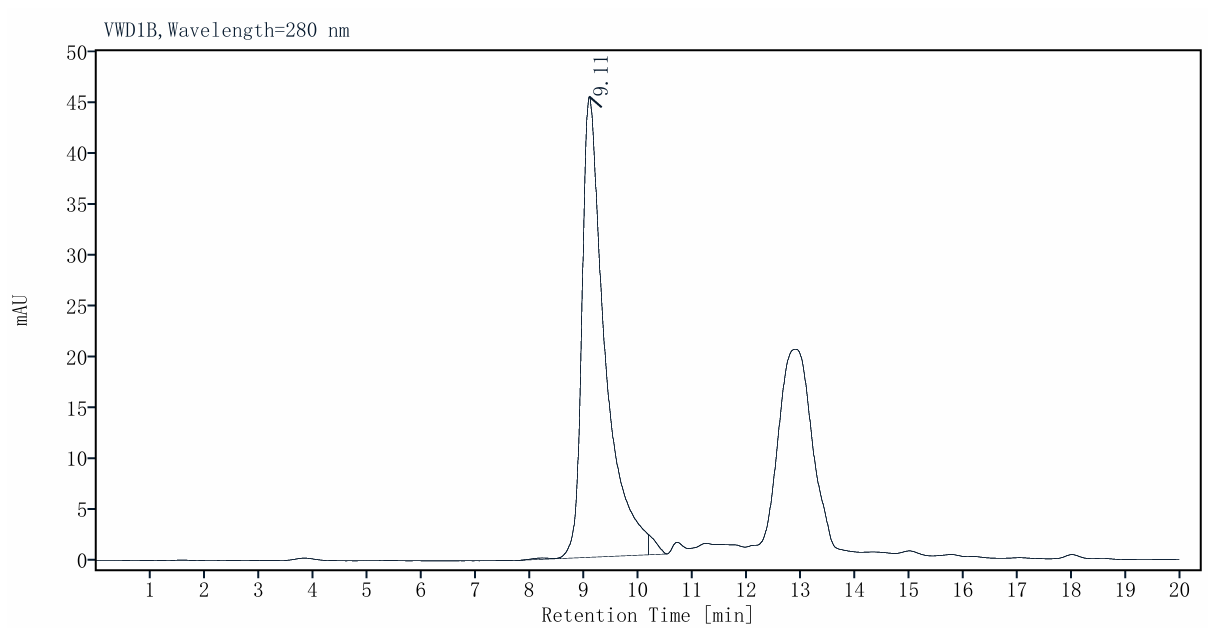
SEC-HPLC
The purity of CBLB/RNF56(36-426) His Tag Protein, Human is more than 95% determined by SEC-HPLC.