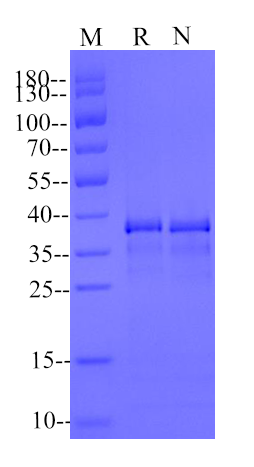
1μg (R: reducing condition, N: non-reducing condition).
Cathepsin S His Tag Protein, Human
Cathepsin S His Tag Protein, Human
Price:
Regular price
$615 USD
Regular price
Sale price
$615 USD
Unit price
per
For shipping services or bulk orders, you may request a quotation.
Secure checkout with

View full details
Product Details
Product Details
Product Specification
| Species | Human |
| Synonyms | CTSS |
| Accession | P25774 |
| Amino Acid Sequence | Gln17-Ile331 with His Tag at the C-Terminus |
| Expression System | HEK293 |
| Molecular Weight | 35-40kDa (Reducing) |
| Purity | >90% by SDS-PAGE |
| Conjugation | Unconjugated |
| Tag | His Tag |
| Physical Appearance | Lyophilized powder |
| Storage Buffer | PBS, PH7.4, 5% trehalose |
| Reconstitution | Reconstitute at 0.1-1 mg/ml according to the size in ultrapure water after rapid centrifugation. |
| Stability & Storage | · 12 months from date of receipt, lyophilized powder stored at -20 to -80℃. |
| Reference | 1.Taheri Baghmisheh S, Chen CH, Yeh YM, Lin PC, Chen PC, Chan RH, Kang JW, Lee CT, Tsai HJ, Fang YC, Cheung CHA, Chang KY, Chang JY, Chen SH. Cathepsin S regulates antitumor immunity through autophagic degradation of PD-L1 in colorectal cancer cells. Cancer Immunol Immunother. 2025 Aug 12;74(9):287. |
Background
Cathepsin S (CTSS) is a member of the lysosomal cysteine protease C1 family. It is synthesized as an inactive precursor of 331 amino acids and activated in lysosomes into a mature protease of 217 amino acids through proteolytic removal of its 99-amino acid propeptide. It is primarily expressed in the lysosomes of antigen-presenting cells, such as dendritic cells, B cells, and macrophages.Its core functions are characterized by unique substrate specificity:1) Key Enzyme in Antigen Presentation: It specifically degrades the invariant chain of MHC class II molecules, an essential step for presenting antigenic peptides to CD4⁺ T cells, and also participates in the direct processing and cross-presentation of exogenous antigens.2) Extracellular Matrix Degradation: As an elastase, it can degrade extracellular matrix components over a broad pH range.It holds significant clinical relevance, as dysregulation of its activity is closely associated with various diseases, including arthritis,atherosclerosis,neurological disorders, and chronic obstructive pulmonary disease. It primarily contributes to pathological processes by regulating inflammatory responses, immune reactions, and tissue remodeling, making it a potential therapeutic target for these conditions.
Protocol
Assay protocol
Principle: Measured by its ability to cleave the fluorogenic peptide substrate, MCA RPKPVE-Nval-WRK(Dnp)-NH2.
Materials
Assay Buffer: 50 mM NaOAc, 5 mM DTT, 250 mM NaCl, pH 4.5
Cathepsin S His Tag Protein, Human
Substrate: MCA-Arg-Pro-Lys-Pro-Val-Glu-NVAL-Trp-Arg-Lys(DNP) NH2 (ES002)
96 ELISA Removable Plate, Black, High binding (GENEVER, Catalog # GMO2-96H)
Plate Reader (PerkinElmer, excitation 320 nm and emission 405 nm)
Produce
Dilute Cathepsin S protein to 10 µg/mL in Assay Buffer.
Incubate at room temperature for 2 hours.
Dilute Cathepsin S protein to 0.25 µg/mL、0.125 µg/mL in Assay Buffer.
Dilute substrate to 80 µM in Assay Buffer.
Load 50 µL of the 0.25 µg/mL、0.125 µg/mL Cathepsin S protein in a black well plate and start the reaction by adding 50 µL of 80 µM Substrate. Include a Substrate with Assay Buffer as Blank.
Read at excitation and emission wavelengths of 320 nm and 405 nm, kinetic mode,60s/cycle, 5 cycles.
Calculate specific activity:
Specific Activity (pmol/min/µg) = |
Adjusted Fluorescence* (RFU) xConversion Factor** (pmol/RFU) |
Incubation time (min) x amount of enzyme (µg) |
*Adjusted for Substrate Blank
**Derived using calibration standard MCA-Pro-Leu-OH.
Picture
Picture
SDS-PAGE