
Feline Normal Lung Organoid Culture Medium
Feline Normal Lung Organoid Culture Medium

Product Details
Product Details
Product Specification
| Usage |
With 24 Aperture plate as an example I. Pre-sample processing: 1 Experimental materials: Primary culture buffer ( 4 ℃ Pre-cooling), tissue preservation solution, sampling tube, tissue transport box, ice pack. 2 Sample sampling and transportation: The tissue should be in vitro. 30 min Insert tissue preservation solution and wash with primary culture buffer. 3-5 Next, the blood on the tissue surface is washed clean, placed in tissue preservation solution, and the sampling tube is then placed in... 4 ℃ Cryogenic storage and transportation ( 72 h inside). 2. Primary culture of organoids: 1 Experimental materials: ( 1 Materials required: Matrix glue (in advance) 24 h Put in 4 ℃ (Refrigerator melting), tweezers ( 10 cm ), pointed ophthalmic surgical scissors / Surgical blade, disposable 60 mm Petri dishes, 1.5 mL/15 mL/50 mL EP tube, 100 μm a cell screen, 3 mL pasteurized straw /1000 μL pipetting gun, 24 Well cell culture plate, metal ice box, primary culture buffer ( 4 ℃ ), primary tissue digestive juice ( 37 ℃ )。 ( 2 Reagent: Cat normal lung organoid culture medium (room temperature or 37 ℃ )。 2 Organoid Construction: ( 1 Organizational recommendations after data collection are as follows: 2-8 ℃ Store and transport under these conditions, and quickly transfer to a clean laboratory for the experimental process of constructing normal cat lung organoids. Organize photography and register detailed information. ( 2 After sterilizing the sampling tube, the tissue was removed from the ultra-clean bench, placed in a petri dish, and primary culture buffer was added. 3 mL pasteurized straw or 1000 μL Pipette gun blow cleaning, repeat cleaning operation 3 Number of times or more. ( 3 Remove tissue impurities using ophthalmic scissors or a surgical blade, and transfer them to... 1.5 mL EP In the tube, ophthalmic scissors are used to further mechanically dissociate the tissue into a volume of approximately 1-3 mm3 The tissue block was transferred to 15 mL EP In the tube, add 5 mL Digestive fluid of normal cat lung primary tissue 37 ℃ oscillation digestion 15-25 min 。 Each digestive process 10 min The tissue digestion was observed under a microscope. A small amount of digestive juice was taken and observed under the microscope, and a larger amount was observed. 70 μm The following cell clusters or individual cells are followed by the next step. Note: If the amount of tissue is too small or the biopsy tissue is used 1 mL Digestive fluid from normal primary lung tissue in cats 1.5 mL EP Tubular digestion. ( 4 Digestion is completed and the tissue passes through 100 μm The cell sieve with a pore size is filtered, the filtrate is collected, and added... 3 Double volume of primary culture buffer Rinsing terminates digestion. 300 g enrichment centrifugation 5 min Abandoning the supernatural; If the cell pellet contains red blood cells, add 1-2 mL erythrocyte lysate 1-2 min Then, dilute to 10 mL , 300 g enrichment centrifugation 5 min They abandoned their superiors. Note: Tumor organoid culture is performed directly when there is too little sedimentation or no red blood cells. ( 5 Observe the volume of cell pellets collected by centrifugation and add... 25 Double the volume of matrix glue is resuspended, forming 3D Cultivate the spatial structure to avoid bubbles during the resuspension process. The cell pellet volume is shown in the figure below. Add the cell pellet volume according to the figure. 200 μL 、 150 μL 、 100 μL 、 50 μL Matrix glue. 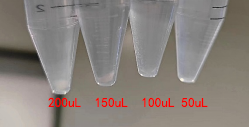 Example: 24 well cell culture plate according to 25 μL-30 μL/ hole Dispensing glue, matrix rubber whole course Maintain 0-4 ℃ operation under conditions 。 cell culture plate placement 37 ℃ Incubator 10-15 min After the matrix gum has set, add to each well. 500μL-750 μL Cat normal lung organoid culture medium (advance 37 ℃ (Preheating) for cultivation. 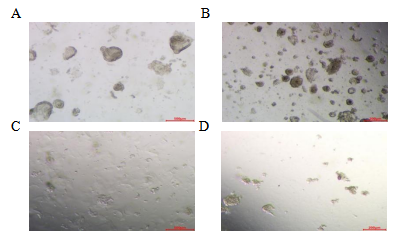 ( 3 Observe the volume of organoid pellets collected by centrifugation. If there is very little pellet, it can be reserved. 1 Dispense the supernatant with twice the precipitation volume; a large amount of precipitated supernatant can be absorbed. Add... 25 The organoids were resuspended in an amount of matrix gel twice the organoid pellet volume. Example: 24 well cell culture plate according to 25 μL-30 μL/ hole Dispensing glue, The matrix adhesive is maintained throughout the entire process. 0-4 ℃ operation under conditions 。 cell culture plate placement 37 ℃ Incubator 10-15 min After the matrix gum has set, add to each well. 500 μL-750 μL Cat normal lung organoid culture medium (advance 37 ℃ (Preheating) for cultivation. IV. Cryopreservation of organoids: 1 Experimental materials: ( 1 Materials required: 15 mL EP Tubes, cell cryopreservation tubes, programmed cooling cassettes, pipetting guns, organoid subculture buffer ( 4 ℃ ), organoid cryopreservation solution. 2 Organoid cryopreservation: Organoids that are temporarily unused should be frozen and stored in a low-temperature environment. ( 1 Aspirate off the culture medium, add an equal volume of organoid subculture buffer to each well, gently blow the matrix gel with a pipette, and collect... 15 mLEP In the tube, each 6-8 The hole is transferred to one EP tube, 4 ℃ standing 10-15 min 。 300 g centrifuge 5 min Discard the supernatant and add it every three holes. 2 mL Organoid cryopreservation solution, gently blown and mixed, transferred to cell cryopreservation tubes, each tube... 1 mL 。 ( 2 Mark the information, place it in the program cooling box, and move it to... -80 ℃ In the refrigerator, 48 h Afterwards, it was placed in a liquid nitrogen tank for storage. Or put in 4 ℃ refrigerator 40 min Then, put in -20 ℃ in the refrigerator 2 h , move to -80 ℃ In the refrigerator, 48 h Afterwards, it was placed in a liquid nitrogen tank for storage. V. Organoid resuscitation culture: 1 Experimental materials: ( 1 Materials required: Matrix glue (in advance) 24 h Put in 4 ℃ (Refrigerator melting) 15 mL EP Pipe, water bath, pipette gun, 24 Well cell culture plate, ice box. ( 2 Kit reagents: Organoid subculture buffer ( 4 ℃ ), cat normal lung organoid culture medium. 2 Organoid resuscitation culture: ( 1 The frozen organoids were removed from the cryogenic environment and quickly placed in... 37 ℃ The cryopreservation tube needs to be gently shaken during the water bath thawing process to ensure that the cryopreservation liquid is completely thawed in a short time. Rapid transfer of thawed organoids to 15 mLEP Gently blow on the tube using a pipette. 6-8 next time, 300 g centrifuge 5 min Abandon the Shangqing; Add an appropriate amount of passage buffer G Resuspend, move in 1.5 mL EP tube 300 g centrifuge 5 min They abandoned the Shangqing ( 2 ) Add per cryopreservation tube 100 μL The matrix glue is resuspended, 24 well cell culture plate according to 25 μL-30 μL/ hole Dispensing adhesive, the matrix adhesive is maintained throughout 0-4 ℃ Operate under these conditions. cell culture plate placement 37 ℃ Incubator 10-15 min After the matrix gum has set, add to each well. 500 μL-750 μL Cat normal lung organoid culture medium (advance 37 ℃ (Preheating) for cultivation. |
| General Notes | 1. Normal cat lung organoid culture medium can be stored at 4℃ for 3 months. After receiving the goods, store at 4℃. It is recommended to use it up within 1 month. If not used for a long time, it is recommended to store it at -20℃ to avoid repeated freezing and thawing more than twice.。 2. Tissue preservation solution E, the digestive solution of primary cat normal lung tissue, contains nutrients that maintain cell activity. In order to maintain the activity of the reagent nutrients, it is recommended to store them at -20℃ without long-term use to avoid repeated freezing and thawing more than twice. 3. Thaw the matrix glue overnight at 2–8℃. When using matrix glue, keep it in an ice box to prevent premature setting. The matrix gel formed a gel within 20 min at 37°C. |
| Storage Temp. | Store at -20°C with a shelf life of 1 year. |