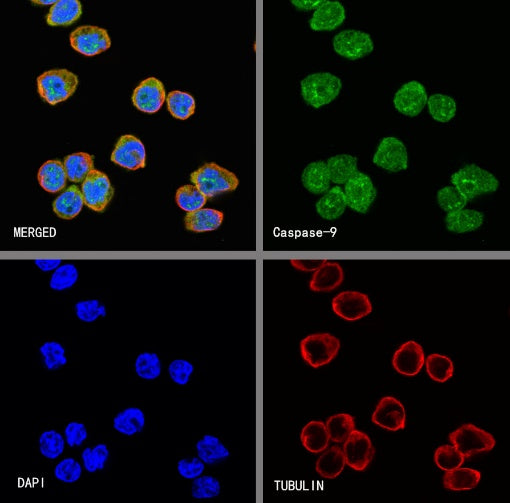
ICC shows positive staining in THP-1 cells. Anti- Caspase-9 antibody was used at 1/500 dilution (Green) and incubated overnight at 4°C. Goat polyclonal Antibody to Rabbit IgG - H&L (Alexa Fluor® 488) was used as secondary antibody at 1/1000 dilution. The cells were fixed with 4% PFA and permeabilized with 0.1% PBS-Triton X-100. Nuclei were counterstained with DAPI (Blue). Counterstain with tubulin (Red).
Caspase-9 Recombinant Rabbit mAb (S-1541-20)
Caspase-9 Recombinant Rabbit mAb (S-1541-20)
Price:
Regular price
$100 USD
Regular price
Sale price
$100 USD
Unit price
per
For shipping services or bulk orders, you may request a quotation.
Secure checkout with

View full details
Product Details
Product Details
Product Specification
| Host | Rabbit |
| Antigen | Caspase-9 |
| Synonyms | CASP-9; Apoptotic protease Mch-6; Apoptotic protease-activating factor 3 (APAF-3); ICE-like apoptotic protease 6 (ICE-LAP6) |
| Immunogen | Synthetic Peptide |
| Location | Cytoplasm |
| Accession | P55211 |
| Clone Number | S-1541-20 |
| Antibody Type | Recombinant mAb |
| Isotype | IgG |
| Application | WB, ICC |
| Reactivity | Hu, Ms, Rt |
| Positive Sample | THP-1, HepG2, C2C12, NIH/3T3, mouse brain, mouse heart, mouse spleen, rat brain, rat heart, rat spleen |
| Purification | Protein A |
| Concentration | 0.5 mg/ml |
| Conjugation | Unconjugated |
| Physical Appearance | Liquid |
| Storage Buffer | PBS, 40% Glycerol, 0.05% BSA, 0.03% Proclin 300 |
| Stability & Storage | 12 months from date of receipt / reconstitution, -20 °C as supplied |
Dilution
| application | dilution | species |
| WB | 1:1000 | Hu, Ms, Rt |
| ICC | 1:500 | Hu |
Background
Caspase-9 is a cysteine-aspartic protease that plays a critical role as an initiator of the intrinsic apoptosis pathway, also known as the mitochondrial pathway. Caspase-9 is activated in response to various apoptotic stimuli, such as DNA damage, growth factor deprivation, and oxidative stress. It is a key initiator caspase that, once activated, can activate downstream effector caspases like Caspase-3, -6, and -7, leading to the execution of apoptosis. Recent research has revealed that Caspase-9 has functions beyond apoptosis, including the regulation of cellular differentiation/maturation, innate immunity, mitochondrial homeostasis, and autophagy. It has been shown that Caspase-9 can drive neurovascular injury through nonapoptotic endothelial cell dysfunction. Caspase-9 has also been implicated in the regulation of autophagy through its non-apoptotic functions. It maintains mitochondrial homeostasis, which is crucial for the maturation of autophagosomes. Genetic variations in the CASP9 gene have been linked to various diseases, including cancers, neurological disorders, autoimmune pathologies, and lumbar disc disease. Alterations in Caspase-9 expression, activity, or function may be associated with acute and chronic neurodegeneration, retinal neuropathy, and other conditions.
Picture
Picture
Western Blot
Immunocytochemistry