2μg (R: reducing condition, N:non-reducing condition).
C1q Flag Tag Full Length Protein, Human
C1q Flag Tag Full Length Protein, Human
Price:
Regular price
$195 USD
Regular price
Sale price
$195 USD
Unit price
per
For shipping services or bulk orders, you may request a quotation.
Secure checkout with

View full details
Product Details
Product Details
Product Specification
| Species | Human |
| Synonyms | Complement C1q |
| Accession | P02745(C1qA)、P02746(C1qB)、P02747(C1qC) |
| Amino Acid Sequence | C1qA :Glu23-Ala245 |
| Expression System | CHO |
| Molecular Weight | C1qA,20-35kDa(Reducing);C1qB,20-35kDa(Reducing);C1qC,20-35kDa(Reducing) |
| Purity | >90% by SDS-PAGE |
| Conjugation | Unconjugated |
| Tag | Flag Tag |
| Physical Appearance | Lyophilized Powder |
| Storage Buffer | PBS, pH7.4, 5% trehalose |
| Reconstitution | Reconstitute at 0.1-1 mg/ml according to the size in ultrapure water after rapid centrifugation. |
| Stability & Storage | · 12 months from date of receipt, lyophilized powder stored at -20 to -80℃. |
| Reference | 1.Xu Y, Zhang H, Jiao X, Zhang Y, Yin G, Wang C, Du Z, Liang M, Gao X, Gu Z, Jiang Y, Du B, Bi X. Dysregulations of C1QA, C1QB, C1QC and C5AR1 as candidate biomarkers of vascular dementia. NPJ Aging. 2025 May 25;11(1):42. |
Background
Complement C1q is the recognition subunit of the classical complement pathway. This ~460 kDa hexameric protein has a unique "bouquet of tulips" structure, with six globular heads connected to a collagen-like stalk. Each head binds to ligands such as antibody Fc regions (IgG1, IgG2, IgG3, and IgM), pentraxins, and apoptotic cells. This binding activates C1r and C1s proteases, triggering the complement cascade that drives opsonization, inflammation, and pathogen lysis. Beyond immunity, C1q is essential for clearing apoptotic cells and immune complexes, maintaining self-tolerance. C1q deficiency is strongly linked to systemic lupus erythematosus (SLE), highlighting its critical role in immune homeostasis.
Picture
Picture
SDS-PAGE
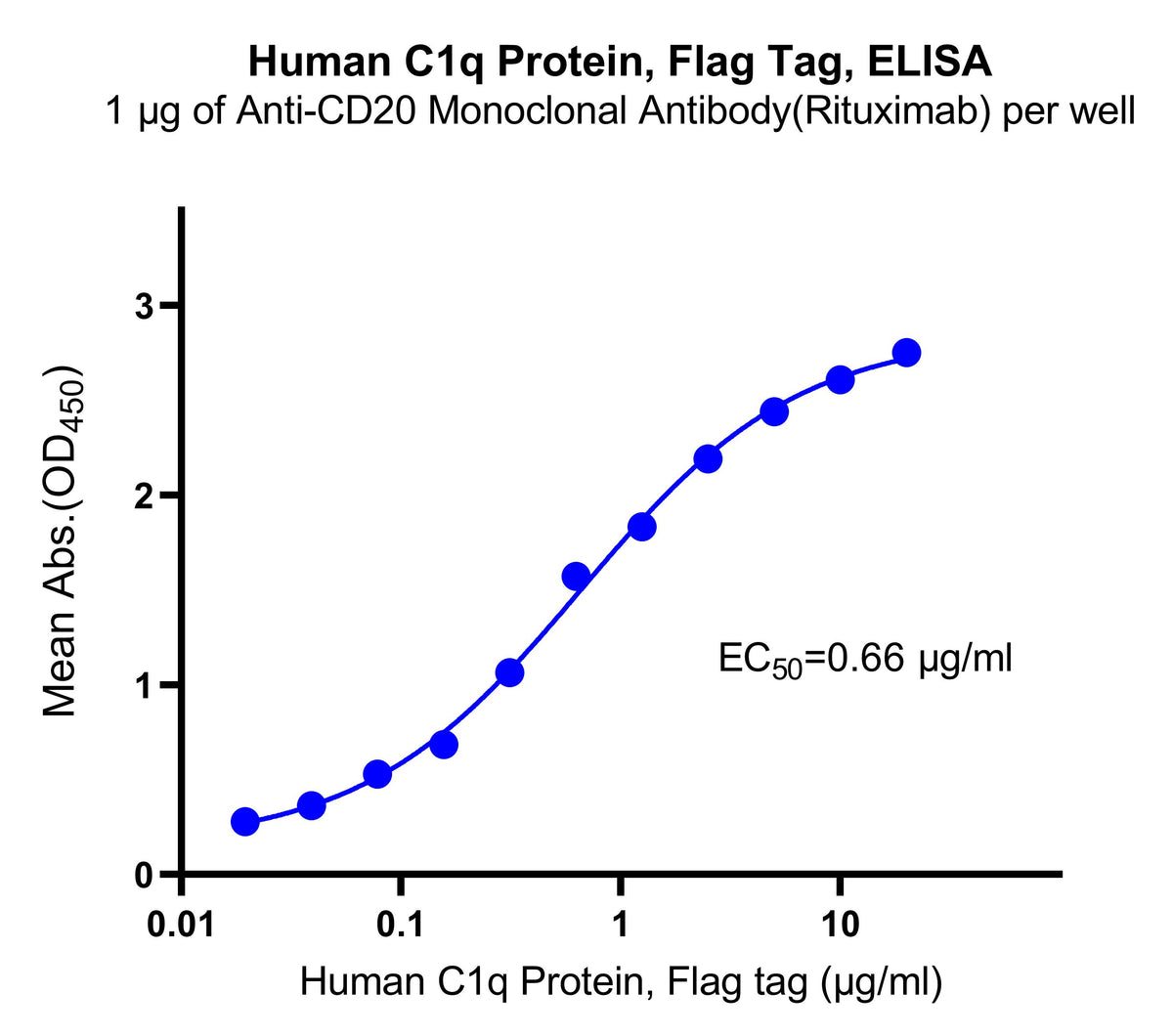
ELISA
Immobilized Anti-CD20 Monoclonal Antibody (Rituximab) (Cat. No. S0B0570) at 10 μg/mL (100 μL/well) can bind C1q Flag Tag Protein, Human(Cat. No. UA016164 ) with EC50 of 0.60-0.74 μg/ml.