WB result of BRIP1 Recombinant Rabbit mAb
Primary antibody: BRIP1 Recombinant Rabbit mAb at 1/1000 dilution
Lane 1: 293T whole cell lysate 20 ug
Lane 2: MCF7 whole cell lysate 20 ug
Lane 3: SH-SY5Y whole cell lysate 20 ug
Low expression control: 293T whole cell lysate
Secondary antibody: Goat Anti-Rabbit IgG (H+L), HRP conjugated at 1/10000 dilution
Predicted MW: 140 kDa
Observed MW: 140 kDa
BRIP1 Recombinant Rabbit mAb (S-4535-79)
BRIP1 Recombinant Rabbit mAb (S-4535-79)
Price:
Regular price
$100 USD
Regular price
Sale price
$100 USD
Unit price
per
For shipping services or bulk orders, you may request a quotation.
Secure checkout with

View full details
Product Details
Product Details
Product Specification
| Host | Rabbit |
| Antigen | BRIP1 |
| Synonyms | Fanconi anemia group J protein; BRCA1-associated C-terminal helicase 1; BRCA1-interacting protein C-terminal helicase 1 (BRCA1-interacting protein 1); DNA 5'-3' helicase FANCJ; BACH1; FANCJ |
| Immunogen | Synthetic Peptide |
| Location | Cytoplasm, Nucleus |
| Accession | Q9BX63 |
| Clone Number | S-4535-79 |
| Antibody Type | Recombinant mAb |
| Isotype | IgG |
| Application | WB, IP |
| Reactivity | Hu |
| Positive Sample | MCF7, SH-SY5Y |
| Purification | Protein A |
| Concentration | 0.5 mg/ml |
| Conjugation | Unconjugated |
| Physical Appearance | Liquid |
| Storage Buffer | PBS, 40% Glycerol, 0.05% BSA, 0.02% sodium azide |
| Stability & Storage | 12 months from date of receipt / reconstitution, -20 °C as supplied |
Dilution
| application | dilution | species |
| WB | 1:1000 | Hu |
| IP | 1:50 | Hu |
Background
BRIP1, full name BRCA1-interacting protein C-terminal helicase 1, also known as FANCJ or BACH1, is an iron‑sulfur cluster‑containing DNA helicase encoded by the BRIP1 gene and belongs to the SF2 helicase superfamily. Its core function is to act as a key factor in DNA damage repair: it uses the energy provided by ATP hydrolysis to unwind various DNA substrates in the 5′→3′ direction, including duplex DNA, D‑loops, and non‑canonical secondary structures such as G‑quadruplexes, which is essential for the smooth progression of replication forks and the maintenance of genomic stability. Functionally, BRIP1 serves as an important intersection between the Fanconi anemia (FA) pathway and the homologous recombination (HR) repair pathway; it directly interacts with the BRCT domain of the breast cancer susceptibility protein BRCA1 through its C‑terminal phosphorylation sites, participating in the repair of DNA interstrand crosslinks and double‑strand breaks. Consequently, pathogenic variants in BRIP1 lead to severe consequences: biallelic mutations cause Fanconi anemia complementation group J, characterized by bone marrow failure, developmental abnormalities, and a strong predisposition to cancer; while monoallelic germline loss‑of‑function mutations or functionally impaired missense variants (BRIP1 is an ovarian cancer susceptibility gene, with approximately 75% of rare missense variants resulting in loss of function) significantly increase the risk of breast and ovarian cancers, making it of great importance in clinical oncogenetic counseling.
Picture
Picture
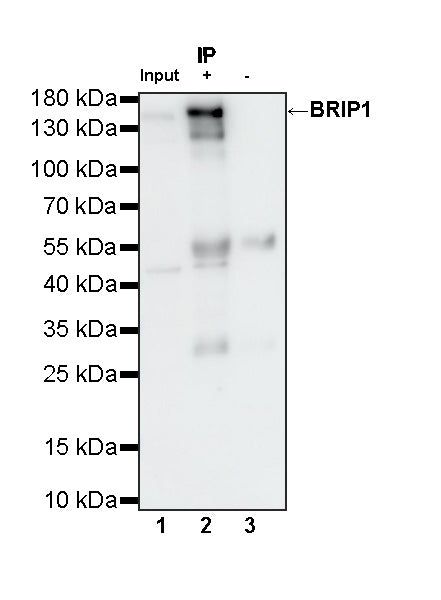
Western Blot
IP
BRIP1 Rabbit mAb at 1/50 dilution (1 µg) immunoprecipitating BRIP1 in 0.4 mg SH-SY5Y whole cell lysate.
Western blot was performed on the immunoprecipitate using BRIP1 Rabbit mAb at 1/1000 dilution.
Secondary antibody (HRP) for IP was used at 1/2000 dilution.
Lane 1: SH-SY5Y whole cell lysate 20 µg (Input)
Lane 2: BRIP1 Rabbit mAb IP in SH-SY5Y whole cell lysate
Lane 3: Rabbit monoclonal IgG IP in SH-SY5Y whole cell lysate
Predicted MW: 140 kDa
Observed MW: 140 kDa