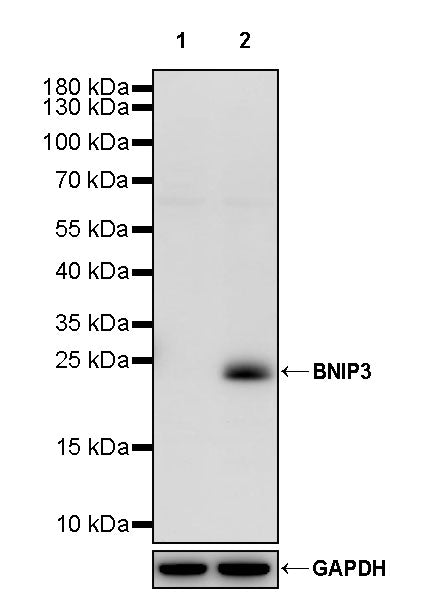
WB result of BNIP3 Recombinant Rabbit mAb
Primary antibody incubation conditions: overnight at 4°C
Primary antibody: BNIP3 Recombinant Rabbit mAb at 1/1000 dilution
Lane 1: untreated MCF7 whole cell lysate 20 µg
Lane 2: MCF7 treated with 100 µM CoCl2 overnight whole cell lysate 20 µg
Secondary antibody: Goat Anti- rabbit IgG, (H+L), HRP conjugated at 1/10000 dilution
Predicted MW: 21 kDa
Observed MW: 28 kDa
BNIP3 Recombinant Rabbit mAb (S-2699-151)
BNIP3 Recombinant Rabbit mAb (S-2699-151)
Price:
Regular price
$100 USD
Regular price
Sale price
$100 USD
Unit price
per
For shipping services or bulk orders, you may request a quotation.
Secure checkout with

View full details
Product Details
Product Details
Product Specification
| Host | Rabbit |
| Antigen | BNIP3 |
| Synonyms | BCL2/adenovirus E1B 19 kDa protein-interacting protein 3; NIP3 |
| Immunogen | Synthetic Peptide |
| Location | Mitochondrion |
| Accession | Q12983 |
| Clone Number | S-2699-151 |
| Antibody Type | Recombinant mAb |
| Isotype | IgG |
| Application | WB |
| Reactivity | Hu, Ms |
| Positive Sample | MCF7 treated with 100 µM CoCl2 overnight, C2C12 treated with 100 µM CoCl2 overnight |
| Purification | Protein A |
| Concentration | 0.5 mg/ml |
| Conjugation | Unconjugated |
| Physical Appearance | Liquid |
| Storage Buffer | PBS, 40% Glycerol, 0.05% BSA, 0.03% Proclin 300 |
| Stability & Storage | 12 months from date of receipt / reconstitution, -20 °C as supplied |
Dilution
| application | dilution | species |
| WB | 1:1000 | Hu, Ms |
Background
BNIP3 (BCL2/adenovirus E1B 19 kDa protein-interacting protein 3) is a pro-apoptotic member of the BH3-only subgroup within the BCL-2 protein family that plays a pivotal role in regulating mitochondrial dynamics, cell death, and autophagy, particularly under hypoxic conditions. Structurally characterized by a transmembrane domain at its C-terminus which anchors it to the outer mitochondrial membrane, BNIP3 functions as a direct transcriptional target of Hypoxia-Inducible Factor 1-alpha (HIF-1α), allowing cells to respond to low oxygen levels by disrupting the interaction between anti-apoptotic proteins like BCL-2 and pro-survival factors, thereby inducing mitochondrial depolarization, reactive oxygen species (ROS) generation, and either apoptosis or protective mitophagy depending on the cellular context and stress intensity. Beyond its canonical role in hypoxia-induced cell death, BNIP3 is critically involved in metabolic reprogramming, cardiac physiology, and cancer progression, where its dual capacity to trigger cell elimination or promote survival through the clearance of damaged mitochondria makes it a complex and context-dependent regulator of cellular homeostasis and a potential therapeutic target in diseases ranging from myocardial ischemia to various malignancies.
Picture
Picture
Western Blot
WB result of BNIP3 Recombinant Rabbit mAb
Primary antibody incubation conditions: overnight at 4°C
Primary antibody: BNIP3 Recombinant Rabbit mAb at 1/1000 dilution
Lane 1: untreated C2C12 whole cell lysate 20 µg
Lane 2: C2C12 treated with 100 µM CoCl2 overnight whole cell lysate 20 µg
Secondary antibody: Goat Anti- rabbit IgG, (H+L), HRP conjugated at 1/10000 dilution
Predicted MW: 21 kDa
Observed MW: 24 kDa