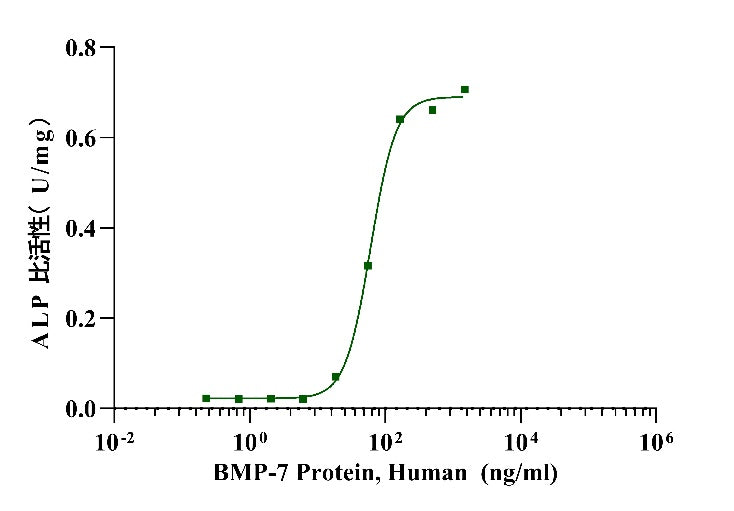
Determined by its ability to induce alkaline phosphatase production by ATDC-5 cells. The expected EC50 for this effect is 54-69 ng/ml.
BMP-7 Protein, Human
BMP-7 Protein, Human
Price:
Regular price
$305 USD
Regular price
Sale price
$305 USD
Unit price
per
For shipping services or bulk orders, you may request a quotation.
Secure checkout with

View full details
Product Details
Product Details
Product Specification
| Species | Human |
| Synonyms | Bone morphogenetic protein 7, BMP-7, Osteogenic protein 1 (OP-1), Eptotermin alfa |
| Accession | P18075 |
| Amino Acid Sequence | Ser293-His431 |
| Expression System | HEK293 |
| Molecular Weight | 15-25 kDa (Reducing) |
| Purity | >95% by SDS-PAGE. |
| Endotoxin | <0.1EU/μg |
| Conjugation | Unconjugated |
| Tag | No Tag |
| Physical Appearance | Lyophilized Powder |
| Storage Buffer | 4mM HCl |
| Reconstitution | Reconstitute at 0.1-1 mg/ml according to the size in ultrapure water after rapid centrifugation. |
| Stability & Storage | ·12 months from date of receipt, lyophilized powder stored at -20 to -80℃. |
| Reference | Nat Med. 2007 Aug;13(8):952-61 |
Background
Bone Morphogenetic Protein-7 (BMP-7), also known as Osteogenic Protein-1 (OP-1), is a member of the transforming growth factor-beta (TGF-β) superfamily and plays a critical role in embryonic development, particularly in skeletal and renal organogenesis. Initially identified in 1990 through independent cloning efforts by Ozkaynak et al. and Celeste et al., BMP-7 was recognized for its potent ability to induce endochondral bone formation. The mature protein functions by binding to type I and type II serine/threonine kinase receptors, activating SMAD-dependent (e.g., SMAD1/5/8) and independent signaling pathways that regulate target genes involved in cell differentiation, apoptosis, and extracellular matrix remodeling. Beyond its osteogenic properties, research over the past two decades has revealed its crucial role as a guardian of epithelial and mesenchymal homeostasis, where it counteracts pro-fibrotic and pro-inflammatory signals, particularly those mediated by TGF-β.
Picture
Picture
Bioactivity
SDS-PAGE
2μg (R: reducing condition, N: non-reducing condition).