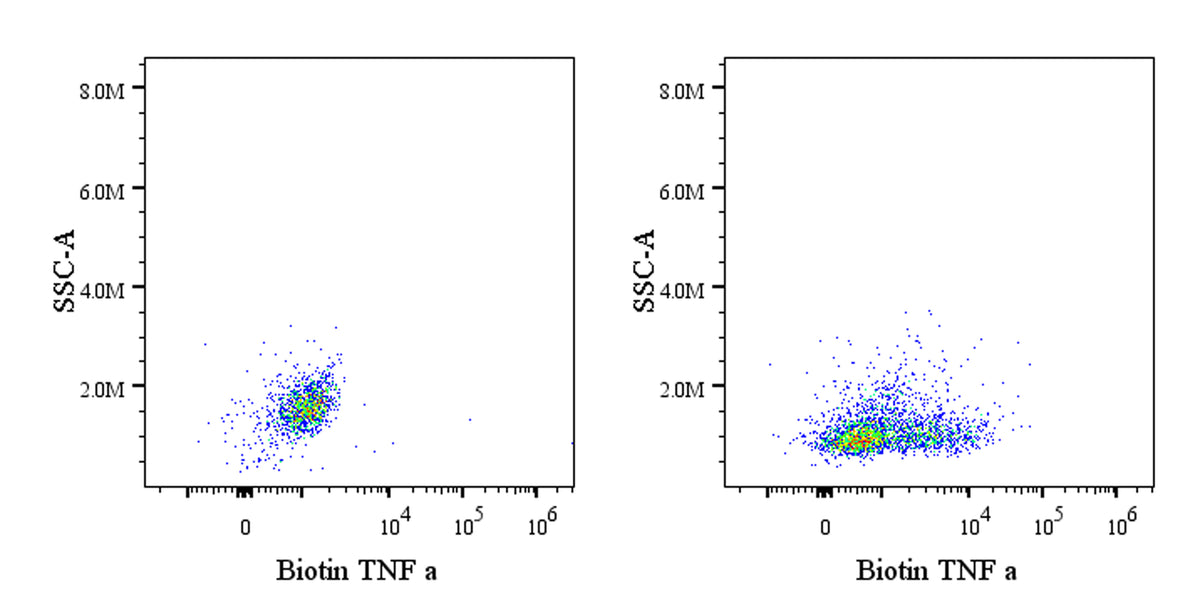
Flow cytometric analysis of TNF α expression in C57BL/6 mouse splenocytes polarized with Th1 Polarization Kit, Mouse (UA090017). Th1 polarized C57BL/6 mouse splenocytes were harvested and restimulated for 5 hr with PMA and Ionomycin in the presence of Brefeldin A (right Panel) or unstimulated (left Panel).
The cells were harvested and fixed with 4% PFA and permeabilized with Intracellular Fixation & Permeabilization Buffer Set. The cells were then stained with SDT Biotin Rat Anti-Mouse TNF α Antibody at 2 μl/test followed by Sav-PE. Total viable cells, as determined by Fixable Viability Dye 452 (S0D0021), were used for analysis. Flow cytometry and data analysis were performed using BD FACSymphony™ A1 and FlowJo™ software.
Biotin Rat Anti-Mouse TNF α Antibody (S-R604)
Biotin Rat Anti-Mouse TNF α Antibody (S-R604)
Price:
Regular price
$270 USD
Regular price
Sale price
$270 USD
Unit price
per
For shipping services or bulk orders, you may request a quotation.
Secure checkout with

View full details
Product Details
Product Details
Product Specification
| Host | Rat |
| Antigen | TNF α |
| Synonyms | Tumor necrosis factor; Cachectin; TNF-alpha; Tumor necrosis factor ligand superfamily member 2 (TNF-a); Tnfa; Tnfsf2; Tnf |
| Location | Secreted, Cell membrane |
| Accession | P06804 |
| Clone Number | S-R604 |
| Antibody Type | Rat mAb |
| Isotype | IgG1,k |
| Application | ICFCM |
| Reactivity | Ms |
| Positive Sample | Th1 polarized C57BL/6 mouse splenocytes |
| Purification | Protein G |
| Concentration | 0.5 mg/ml |
| Conjugation | Biotin |
| Physical Appearance | Liquid |
| Storage Buffer | PBS pH7.4, 0.03% Proclin 300 |
| Stability & Storage | 12 months from date of receipt / reconstitution, 2 to 8 °C as supplied |
Dilution
| application | dilution | species |
| ICFCM | 1μg per million cells in 100μl volume | Ms |
Background
Tumor necrosis factor alpha (TNF alpha) is a multifunctional cytokine that plays a crucial role in regulating immune responses and inflammation. It is primarily produced by macrophages, but can also be synthesized by other cell types including monocytes, neutrophils, and T cells. TNF alpha exerts its effects by binding to two distinct receptors, TNF receptor 1 (TNFR1) and TNF receptor 2 (TNFR2), which are widely expressed on various cell types. It is involved in a wide range of biological processes such as promoting inflammation, inducing apoptosis, and stimulating cell proliferation and differentiation. In the context of immune response, TNF alpha helps to activate immune cells and enhance their ability to combat infections and cancer cells. However, excessive or uncontrolled production of TNF alpha can lead to chronic inflammatory diseases like rheumatoid arthritis, inflammatory bowel disease, and psoriasis. Therefore, TNF alpha is a key target for therapeutic interventions aimed at modulating the immune system and treating inflammatory disorders.
Picture
Picture
FC