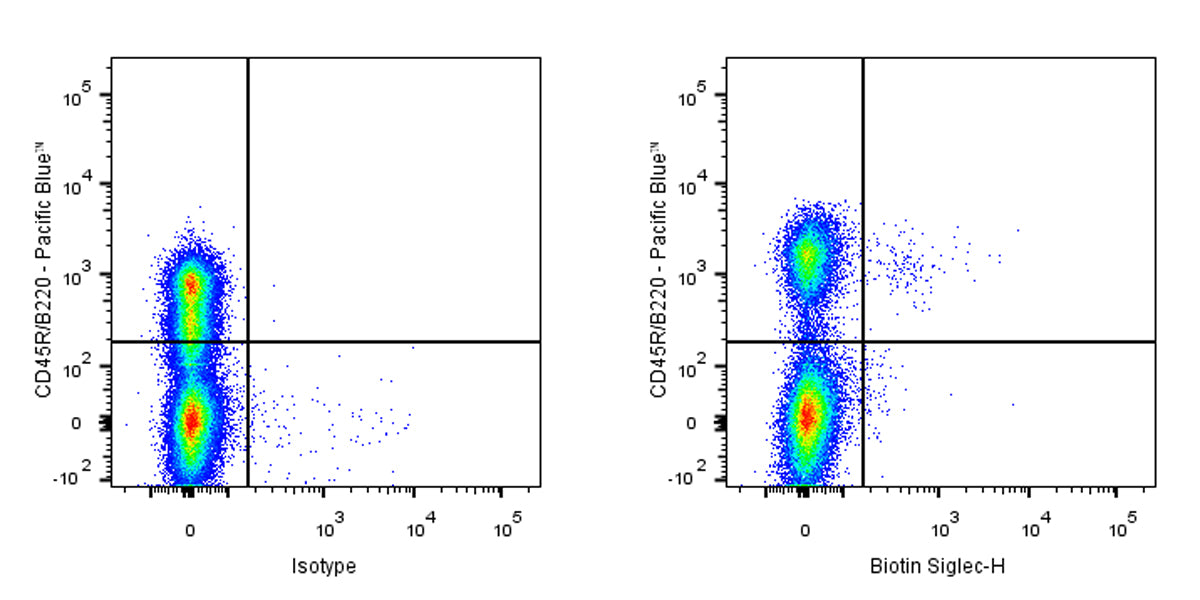
Flow cytometric analysis of Mouse Siglec-H expression on Fresh C57BL/6 mouse splenocytes. Fresh C57BL/6 mouse splenocytes were stained with Pacific Blue™ Rat Anti-Mouse CD45R/B220 and either Biotin Rat IgG2b Isotype Control (Left panel) or SDT Biotin Rat Anti-Mouse Siglec-H Antibody (Right panel) at 5 μl/test followed by Sav-PE. Flow cytometry and data analysis were performed using BD FACSymphony™ A1 and FlowJo™ software.
Biotin Rat Anti-Mouse Siglec-H Antibody (S-3779)
Biotin Rat Anti-Mouse Siglec-H Antibody (S-3779)
Price:
Regular price
$60 USD
Regular price
Sale price
$60 USD
Unit price
per
For shipping services or bulk orders, you may request a quotation.
Secure checkout with

View full details
Product Details
Product Details
Product Specification
| Host | Rat |
| Antigen | Siglec-H |
| Synonyms | Siglec-H; Siglech |
| Location | Membrane |
| Accession | Q3Y597 |
| Clone Number | S-3779 |
| Antibody Type | Rat mAb |
| Isotype | IgG2b |
| Application | FCM |
| Reactivity | Ms |
| Positive Sample | Fresh C57BL/6 mouse splenocytes |
| Purification | Protein G |
| Concentration | 0.2 mg/ml |
| Conjugation | Biotin |
| Physical Appearance | Liquid |
| Storage Buffer | PBS pH7.4, 0.03% Proclin 300 |
| Stability & Storage | 12 months from date of receipt / reconstitution, 2 to 8 °C as supplied |
Dilution
| application | dilution | species |
| FCM | 5μl per million cells in 100μl volume | Ms |
Background
Siglec-H is a sialic acid-binding Ig-like lectin expressed almost exclusively on murine plasmacytoid dendritic cells (pDCs) and microglia, where it partners with the ITAM-bearing adaptor DAP12 to deliver inhibitory signals that restrain type I interferon (IFN-α) secretion, limits TLR7/9-mediated viral responses, and thereby prevents overt systemic autoimmunity while still permitting antigen uptake and presentation; genetic deletion or antibody-mediated ligation of Siglec-H heightens IFN-α output, skews T-cell polarization toward IL-21⁺ CD4 subsets, and can either exacerbate or attenuate inflammatory diseases depending on context, making it a key rheostat of innate–adaptive immune crosstalk.
Picture
Picture
FC