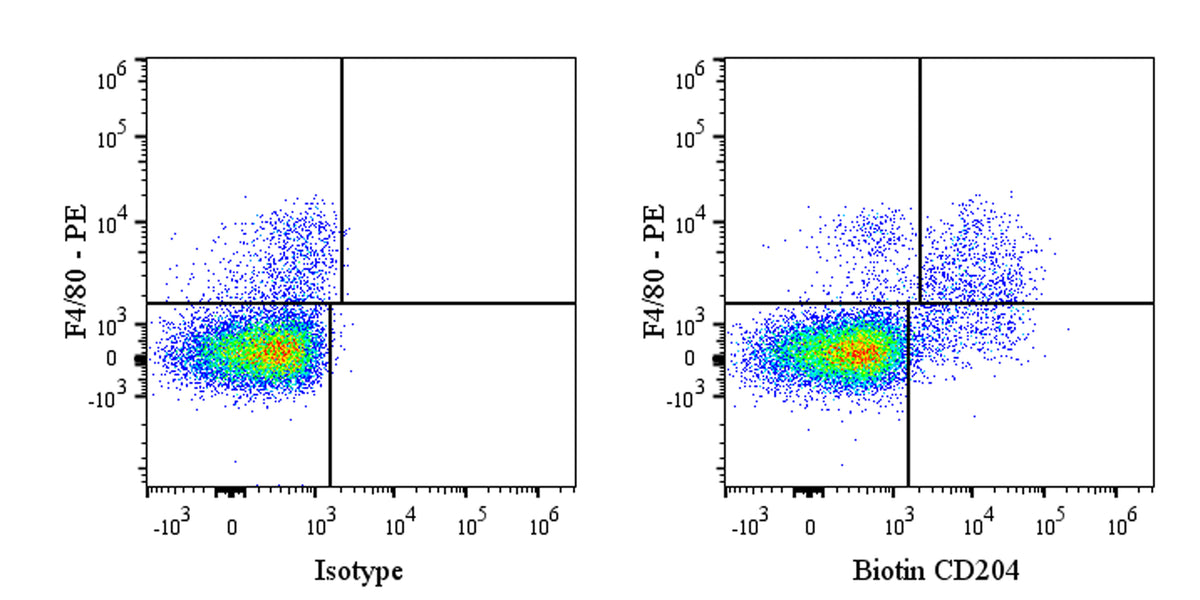
Flow cytometric analysis of CD204 expression on BALB/c mouse peritoneal exudates cells. BALB/c mouse peritoneal exudates cells were stained with PE Rat Anti-Mouse F4/80 Antibody and either Biotin Rat IgG2b, κ Isotype Control (left panel) or SDT Biotin Rat Anti-Mouse CD204 Antibody (right panel) at 2 μl/test. Flow cytometry and data analysis were performed using BD FACSymphony™ A1 and FlowJo™ software.
Biotin Rat Anti-Mouse CD204 Antibody (S-R712)
Biotin Rat Anti-Mouse CD204 Antibody (S-R712)
Price:
Regular price
$120 USD
Regular price
Sale price
$120 USD
Unit price
per
For shipping services or bulk orders, you may request a quotation.
Secure checkout with

View full details
Product Details
Product Details
Product Specification
| Host | Rat |
| Antigen | CD204 |
| Synonyms | Macrophage scavenger receptor types I and II; Macrophage acetylated LDL receptor I and II; Scavenger receptor type A (SR-A); Scvr; Msr1 |
| Accession | P30204 |
| Clone Number | S-R712 |
| Antibody Type | Rat mAb |
| Isotype | IgG2b,k |
| Isotype Control | S0B8274 |
| Application | FCM |
| Reactivity | Ms |
| Positive Sample | BALB/c mouse peritoneal exudates cells |
| Purification | Protein G |
| Concentration | 0.5 mg/ml |
| Conjugation | Biotin |
| Physical Appearance | Liquid |
| Storage Buffer | PBS pH7.4, 0.09% sodium azide |
| Stability & Storage | 12 months from date of receipt / reconstitution, 2 to 8 °C as supplied |
Dilution
| application | dilution | species |
| FCM | 1μg per million cells in 100μl volume | Ms |
Background
CD204, also known as scavenger receptor A, is a type of class A scavenger receptor that is a transmembrane protein with homotrimeric structures. It is primarily expressed on macrophages and dendritic cells, and is involved in a variety of physiological and pathological processes. CD204 can bind to a broad range of ligands, including chemically modified or altered molecules, bacterial surface components, apoptotic cells, and endogenous danger molecules such as stress protein. It plays a significant role in atherosclerosis as it was the first receptor identified for modified lipoproteins that are pertinent to the development of vascular disease. In addition, CD204 has been found to have regulatory functions in the immune response, such as suppressing the dimerization and autoubiquitination of TRAF6, and dampening the immunostimulatory adjuvant activities derived from damage-associated molecular patterns or pathogen-associated molecular patterns.
Picture
Picture
FC