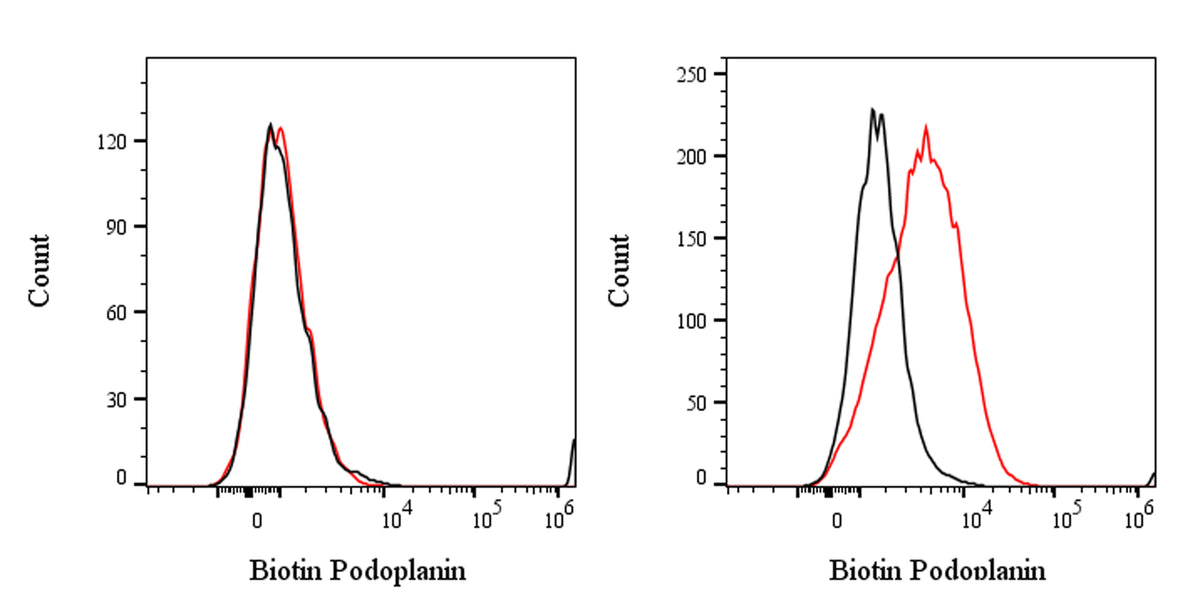
Flow cytometric analysis of Human Podoplanin expression on U-87 MG. Cells from the U-87 MG (Human glioblastoma-astrocytoma epithelial cells, right) or HUVEC (Human umbilical vein endothelial cells, left) were stained with either Biotin Rat IgG2a, λ Isotype Control (black line histogram) or SDT Biotin Rat Anti-Human Podoplanin Antibody (red line histogram) at 5 μl/test followed by Sav-iFluor 488. Flow cytometry and data analysis were performed using Agilent NovoCyte Quanteon and FlowJo™ software.
Biotin Rat Anti-Human Podoplanin Antibody (S-2796)
Biotin Rat Anti-Human Podoplanin Antibody (S-2796)
Price:
Regular price
$200 USD
Regular price
Sale price
$200 USD
Unit price
per
For shipping services or bulk orders, you may request a quotation.
Secure checkout with

View full details
Product Details
Product Details
Product Specification
| Host | Rat |
| Antigen | Podoplanin |
| Synonyms | Aggrus; Glycoprotein 36 (Gp36); PA2.26 antigen; T1-alpha (T1A); GP36; PDPN |
| Location | Membrane |
| Accession | Q86YL7 |
| Clone Number | S-2796 |
| Antibody Type | Rat mAb |
| Isotype | IgG2a, λ |
| Application | FCM |
| Reactivity | Hu |
| Positive Sample | U-87 MG |
| Purification | Protein G |
| Concentration | 0.2 mg/ml |
| Conjugation | Biotin |
| Physical Appearance | Liquid |
| Storage Buffer | PBS pH7.4, 0.09% sodium azide |
| Stability & Storage | 12 months from date of receipt / reconstitution, 2 to 8 °C as supplied |
Dilution
| application | dilution | species |
| FCM | 5μl per million cells in 100μl volume | Hu |
Background
Podoplanin is a small mucin-type O-glycosylated type-I transmembrane protein of 162 amino acids, highly expressed on lymphatic endothelium, alveolar type I cells, tumor cells and brain neurons, where its extracellular domain—bearing the platelet-aggregation-stimulating PLAG motif and sialylated O-glycans—engages CLEC-2 on platelets to trigger platelet activation, binds CD44 and galectin-8 to promote directional cell migration and invadopodia maturation, associates with ERM proteins (ezrin-radixin-moesin) to reorganize the actin cytoskeleton and drive epithelial-mesenchymal transition, and is indispensable for developmental separation of blood and lymphatic vessels, normal alveolus formation, lymphatic vessel integrity and hippocampus-dependent synaptic plasticity and memory, while its overexpression in cancers fosters invasion, metastasis and thrombotic risk, making it a key diagnostic and therapeutic target.
Picture
Picture
FC