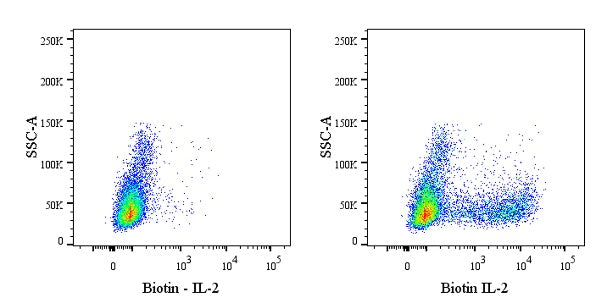
Flow cytometric analysis of IL-2 expression in human PBMCs stimulated with PMA and Ionomycin in the presence of Brefeldin A for 6hr (right Panel) or unstimulated (left Panel).
The cells were harvested and fixed with 4% PFA and permeabilized with Intracellular Fixation & Permeabilization Buffer Set. The cells were then stained with SDT Biotin Rat Anti-Human IL-2 Antibody at 5 μl/test followed by Sav-iFluor 488. Total viable cells, as determined by Fixable Viability Dye 452 (S0D0021), were used for analysis. Flow cytometry and data analysis were performed using BD FACSymphony™ A1 and FlowJo™ software.
Biotin Rat Anti-Human IL-2 Antibody (MQ1-17H12)
Biotin Rat Anti-Human IL-2 Antibody (MQ1-17H12)
Price:
Regular price
$130 USD
Regular price
Sale price
$130 USD
Unit price
per
For shipping services or bulk orders, you may request a quotation.
Secure checkout with

View full details
Product Details
Product Details
Product Specification
| Host | Rat |
| Antigen | IL-2 |
| Location | Secreted |
| Accession | P60568 |
| Clone Number | MQ1-17H12 |
| Antibody Type | Rat mAb |
| Application | ICFCM |
| Reactivity | Hu |
| Positive Sample | PMA stimulated human PBMC |
| Purification | Protein G |
| Concentration | 0.2 mg/ml |
| Conjugation | Biotin |
| Physical Appearance | Liquid |
| Storage Buffer | PBS pH7.4, 0.09% sodium azide |
| Stability & Storage | 12 months from date of receipt / reconstitution, 2 to 8 °C as supplied |
Dilution
| application | dilution | species |
| ICFCM | 5μl per million cells in 100μl volume | Hu |
Background
Interleukin-2 (IL-2) is a pivotal cytokine primarily secreted by activated CD4+ T helper cells and, to a lesser extent, by CD8+ cytotoxic T cells, playing a central role in the regulation of the immune system’s growth, differentiation, and homeostasis. Often referred to as T-cell growth factor, IL-2 exerts its biological effects by binding to a specific cell-surface receptor complex composed of three subunits: CD25 (IL-2Rα), CD122 (IL-2Rβ), and CD137 (IL-2Rγc), with the high-affinity trimeric receptor being crucial for robust signal transduction via the JAK-STAT pathway. This signaling cascade promotes the proliferation and survival of antigen-stimulated T cells, enhances the cytotoxic activity of natural killer (NK) cells, and supports the development and maintenance of regulatory T cells (Tregs), which are essential for preventing autoimmunity and maintaining peripheral tolerance. Due to its potent immunostimulatory properties, recombinant IL-2 has been clinically utilized as an immunotherapy agent for treating metastatic renal cell carcinoma and malignant melanoma, although its therapeutic application is often limited by significant systemic toxicity, prompting ongoing research into engineered variants or targeted delivery systems that can selectively enhance anti-tumor immunity while minimizing adverse effects on healthy tissues.
Picture
Picture
FC