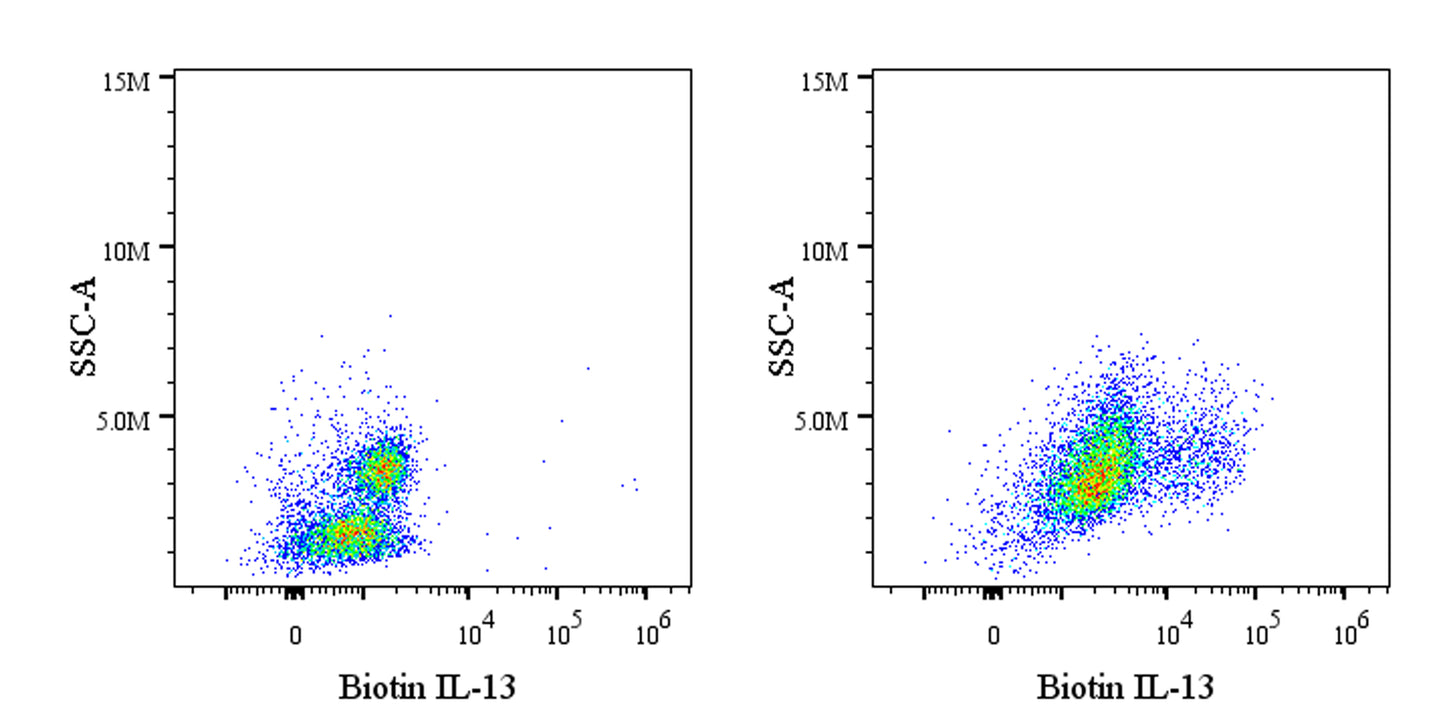
Flow cytometric analysis of IL-13 expression in human PBMC polarized with Th2 Polarization Kit, Human (UA090018). Th2 polarized human PBMC were harvested and restimulated for 5 hr with PMA and Ionomycin in the presence of Brefeldin A (right Panel) or unstimulated (left Panel).
The cells were harvested and fixed with 4% PFA and permeabilized with Intracellular Fixation & Permeabilization Buffer Set. The cells were then stained with SDT Biotin Rat Anti-Human IL-13 Antibody at 5μl/test. Total viable cells, as determined by Fixable Viability Dye 452 (S0D0021), were used for analysis. Flow cytometry and data analysis were performed using BD FACSymphony™ A1 and FlowJo™ software."
Biotin Rat Anti-Human IL-13 Antibody (S-4442)
Biotin Rat Anti-Human IL-13 Antibody (S-4442)
Price:
Regular price
$135 USD
Regular price
Sale price
$135 USD
Unit price
per
For shipping services or bulk orders, you may request a quotation.
Secure checkout with

View full details
Product Details
Product Details
Product Specification
| Host | Rat |
| Antigen | IL-13 |
| Synonyms | Interleukin-13; NC30; IL13 |
| Location | Secreted |
| Accession | P35225 |
| Clone Number | S-4442 |
| Antibody Type | Rat mAb |
| Isotype | IgG1 |
| Application | ICFCM |
| Reactivity | Hu |
| Positive Sample | Th2 polarized human PBMC |
| Purification | Protein G |
| Concentration | 0.2 mg/ml |
| Conjugation | Biotin |
| Physical Appearance | Liquid |
| Storage Buffer | PBS pH7.4, 0.03% Proclin 300 |
| Stability & Storage | 12 months from date of receipt / reconstitution, 2 to 8 °C as supplied |
Dilution
| application | dilution | species |
| ICFCM | 5μl per million cells in 100μl volume | Hu |
Background
Interleukin-13 (IL-13) is a pleiotropic cytokine primarily secreted by activated type 2 helper T cells (Th2), group 2 innate lymphoid cells (ILC2s), mast cells, and basophils, playing a central role in regulating inflammatory and immune responses, particularly those associated with allergic reactions and parasitic infections. Structurally homologous to IL-4, IL-13 exerts its biological effects by binding to a heterodimeric receptor complex composed of the IL-4Rα chain and the specific IL-13Rα1 chain, which subsequently activates the JAK-STAT signaling pathway, notably STAT6, to modulate gene expression in target cells such as epithelial cells, fibroblasts, and B cells. Its key physiological functions include inducing class switching to IgE in B cells, stimulating mucus hypersecretion and goblet cell metaplasia in airway epithelium, promoting alternative activation (M2 polarization) of macrophages, and driving tissue fibrosis by enhancing collagen production, making it a critical mediator in the pathogenesis of asthma, atopic dermatitis, and other fibrotic disorders, thereby establishing it as a major therapeutic target for biologics like dupilumab and tralokinumab that aim to block the IL-4/IL-13 signaling axis.
Picture
Picture
FC