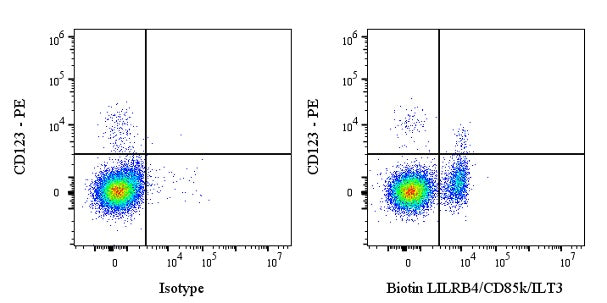
Flow cytometric analysis of human LILRB4/CD85k/ILT3 expression on human peripheral blood cells. Human peripheral blood cells were stained with PE Mouse Anti-Human CD123 Antibody and either Biotin Rabbit IgG Isotype Control (left panel) or SDT Biotin Rabbit Anti-Human LILRB4/CD85k/ILT3 Antibody (right panel) at 5 μl/test followed by Sav-iFluor 488. Flow cytometry and data analysis were performed using Agilent NovoCyte Quanteon and FlowJo™ software.
Biotin Rabbit Anti-Human LILRB4/CD85k/ILT3 Antibody (S-280-51)
Biotin Rabbit Anti-Human LILRB4/CD85k/ILT3 Antibody (S-280-51)
Price:
Regular price
$195 USD
Regular price
Sale price
$195 USD
Unit price
per
For shipping services or bulk orders, you may request a quotation.
Secure checkout with

View full details
Product Details
Product Details
Product Specification
| Host | Rabbit |
| Antigen | LILRB4 |
| Immunogen | Recombinant Protein |
| Location | Cell membrane |
| Accession | Q8NHJ6 |
| Clone Number | S-280-51 |
| Antibody Type | Recombinant mAb |
| Isotype | IgG |
| Isotype Control | S0B8273 |
| Application | FCM |
| Reactivity | Hu |
| Positive Sample | Human peripheral blood cells |
| Purification | Protein A |
| Concentration | 0.2 mg/ml |
| Conjugation | Biotin |
| Physical Appearance | Liquid |
| Storage Buffer | PBS pH7.4, 0.09% sodium azide |
| Stability & Storage | 12 months from date of receipt / reconstitution, 2 to 8 °C as supplied |
Dilution
| application | dilution | species |
| FCM | 5μl per million cells in 100μl volume | Hu |
Background
LILRB4 (Leukocyte Immunoglobulin-Like Receptor B4), also known as ILT3, is a type I transmembrane protein with two extracellular Ig-like domains and three intracellular ITIM motifs that recruit SHP-1/2 phosphatases to dampen myeloid-cell activation; expressed chiefly on monocytes, macrophages and dendritic cells, it functions as a key immune checkpoint that maintains self-tolerance by inhibiting NF-κB/MAPK signaling, suppressing T-cell proliferation and promoting Treg/Ts differentiation, but is exploited by tumors such as AML through ligands like ApoE to enable immune evasion, leukemia invasion and poor prognosis, making it an emerging therapeutic target in cancer, autoimmunity and transplantation.
Picture
Picture
FC