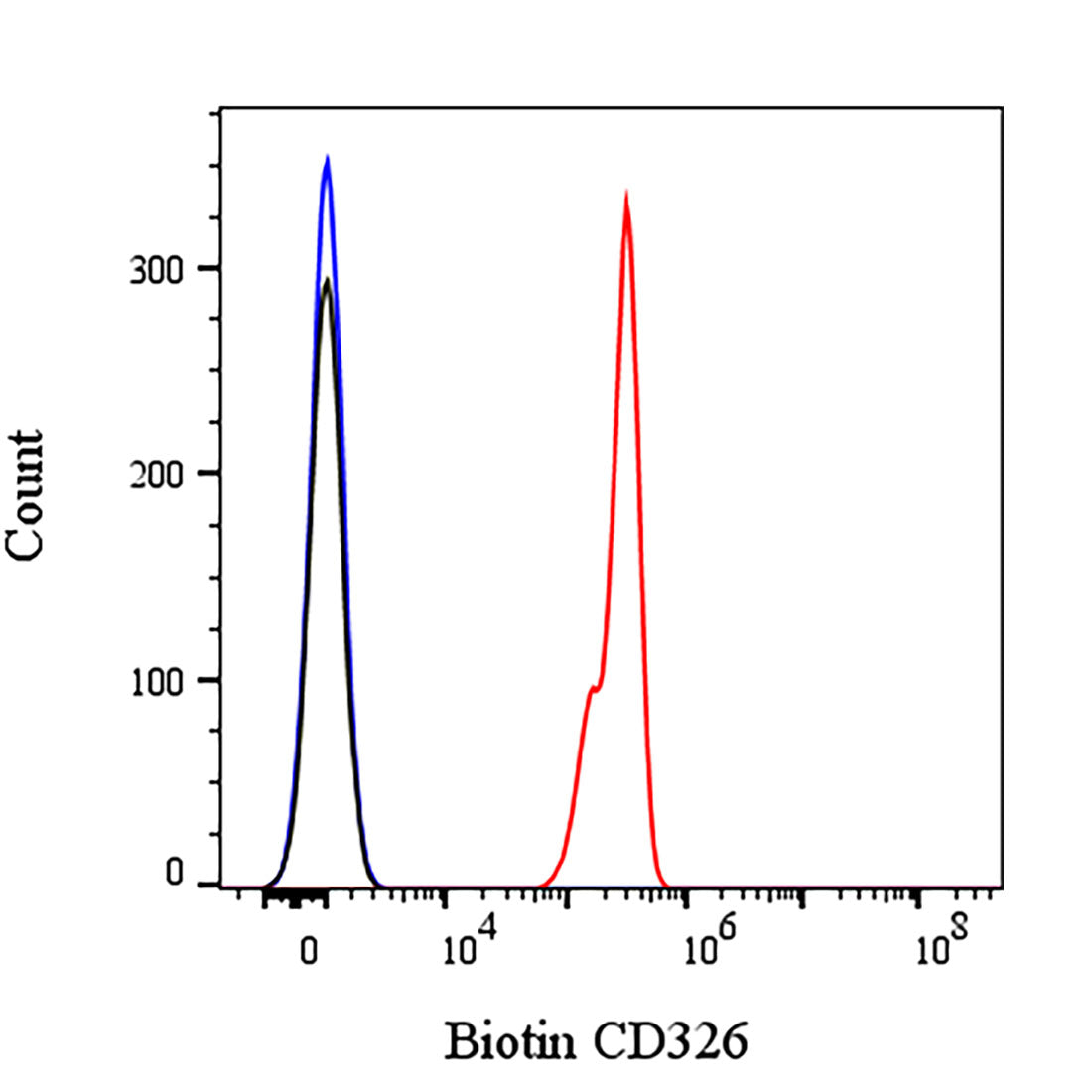
Flow cytometric analysis of human CD326 expression on HT-29 (Human colorectal adenocarcinoma epithelial cell). HT-29 were stained with Biotin Mouse IgG Isotype Control (black line histogram) or SDT Biotin Rabbit Anti-Human CD326 Antibody (red line histogram) at 1.25 μl/test followed by Sav-iFluor 488, cells without incubation with primary antibody and secondary antibody (blue line histogram) was used as unlabeled control. Flow cytometry and data analysis were performed using BD FACSymphony™ A1 and FlowJo™ software.
Biotin Rabbit Anti-Human CD326 Antibody (S-1009-76)
Biotin Rabbit Anti-Human CD326 Antibody (S-1009-76)
Price:
Regular price
$100 USD
Regular price
Sale price
$100 USD
Unit price
per
For shipping services or bulk orders, you may request a quotation.
Secure checkout with

View full details
Product Details
Product Details
Product Specification
| Host | Rabbit |
| Antigen | CD326 |
| Synonyms | Epithelial cell adhesion molecule; Ep-CAM; Adenocarcinoma-associated antigen; Cell surface glycoprotein Trop-1; Epithelial cell surface antigen; Epithelial glycoprotein (EGP); Epithelial glycoprotein 314 (EGP314; hEGP314); KS 1/4 antigen; KSA; Major gastrointestinal tumor-associated protein GA733-2; Tumor-associated calcium signal transducer 1; GA733-2; M1S2; M4S1; MIC18; TACSTD1; TROP1 |
| Immunogen | Recombinant Protein |
| Location | Cell membrane, Cell junction |
| Accession | P16422 |
| Clone Number | S-1009-76 |
| Antibody Type | Recombinant mAb |
| Isotype | IgG |
| Application | FCM |
| Reactivity | Hu |
| Positive Sample | HT-29 |
| Purification | Protein A |
| Concentration | 0.2 mg/ml |
| Conjugation | Biotin |
| Physical Appearance | Liquid |
| Storage Buffer | PBS pH7.4, 0.03% Proclin 300 |
| Stability & Storage | 12 months from date of receipt / reconstitution, 2 to 8 °C as supplied |
Dilution
| application | dilution | species |
| FCM | 1.25μl per million cells in 100μl volume | Hu |
Background
Epithelial cell adhesion molecule (EpCAM), also known as CD326 among other names, is a transmembrane glycoprotein mediating Ca2+-independent homotypic cell–cell adhesion in epithelia. EpCAM is also involved in cell signaling, migration, proliferation, and differentiation. Additionally, EpCAM has oncogenic potential via its capacity to upregulate c-myc, e-fabp, and cyclins A & E. Since EpCAM is expressed exclusively in epithelia and epithelial-derived neoplasms, EpCAM can be used as diagnostic marker for various cancers. It appears to play a role in tumorigenesis and metastasis of carcinomas, so it can also act as a potential prognostic marker and as a potential target for immunotherapeutic strategies.
Picture
Picture
FC