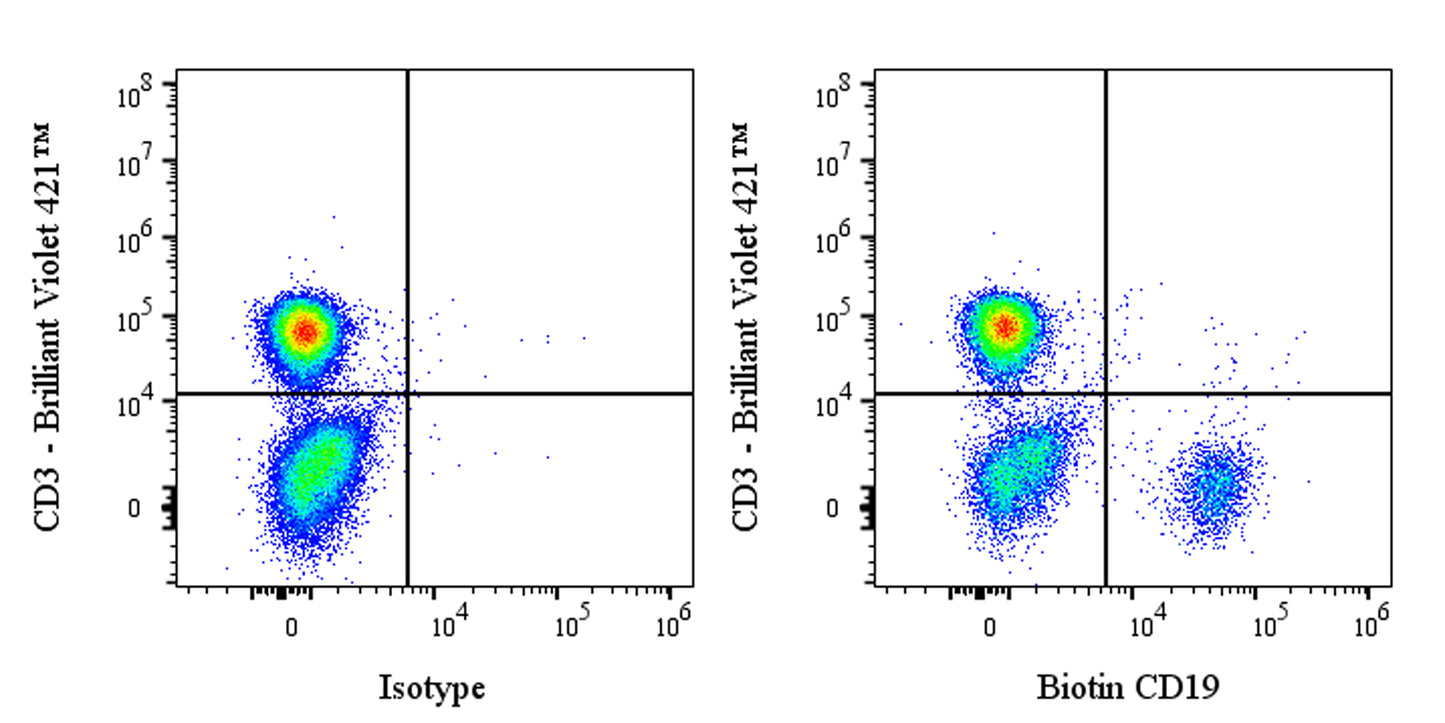
Flow cytometric analysis of Human CD19 expression on human PBMCs (human peripheral blood mononuclear cell). Human PBMCs were stained with Brilliant Violet 421™ Mouse Anti-Human CD3 Antibody and either Biotin Rabbit IgG Isotype Control (left panel) or SDT Biotin Rabbit Anti-Human CD19 Antibody (right panel) at 5 μl/test followed by Sav-iFluor 488. Flow cytometry and data analysis were performed using Agilent NovoCyte Quanteon and FlowJo™ software.
Biotin Rabbit Anti-Human CD19 Antibody (S-164-41)
Biotin Rabbit Anti-Human CD19 Antibody (S-164-41)
Price:
Regular price
$100 USD
Regular price
Sale price
$100 USD
Unit price
per
For shipping services or bulk orders, you may request a quotation.
Secure checkout with

View full details
Product Details
Product Details
Product Specification
| Host | Rabbit |
| Antigen | CD19 |
| Synonyms | B-lymphocyte antigen CD19; B-lymphocyte surface antigen B4; Differentiation antigen CD19; T-cell surface antigen Leu-12 |
| Immunogen | Recombinant Protein |
| Location | Cell membrane |
| Accession | P15391 |
| Clone Number | S-164-41 |
| Antibody Type | Recombinant mAb |
| Isotype | IgG |
| Isotype Control | S0B80066 |
| Application | FCM |
| Positive Sample | human PBMC |
| Purification | Protein A |
| Concentration | 0.2 mg/ml |
| Conjugation | Biotin |
| Physical Appearance | Liquid |
| Storage Buffer | PBS pH7.4, 0.09% sodium azide |
| Stability & Storage | 12 months from date of receipt / reconstitution, 2 to 8 °C as supplied |
Dilution
| application | dilution | species |
| FCM | 5μl per million cells in 100μl volume | Hu |
Background
CD19, also known as B-lymphocyte antigen CD19 or B-Lymphocyte Surface Antigen B4, is a 95 kDa type I transmembrane glycoprotein that belongs to the immunoglobulin superfamily and is encoded by the CD19 gene. It is primarily expressed on all B lineage cells, from early pro-B cells to plasma cells, and plays a crucial role in B cell development, activation, and signaling. As a co-receptor, CD19 enhances signaling through the B cell receptor (BCR) complex, lowering the threshold for B cell activation and promoting B cell proliferation and differentiation. It forms a complex with CD21, CD81, and other proteins, which helps in the recognition of antigens tagged with complement and amplifies BCR signaling. CD19 is also a biomarker for B cell-related diseases and a target for immunotherapies, including monoclonal antibodies and CAR-T cell therapies, due to its consistent expression on B cells and B cell malignancies.
Picture
Picture
FC