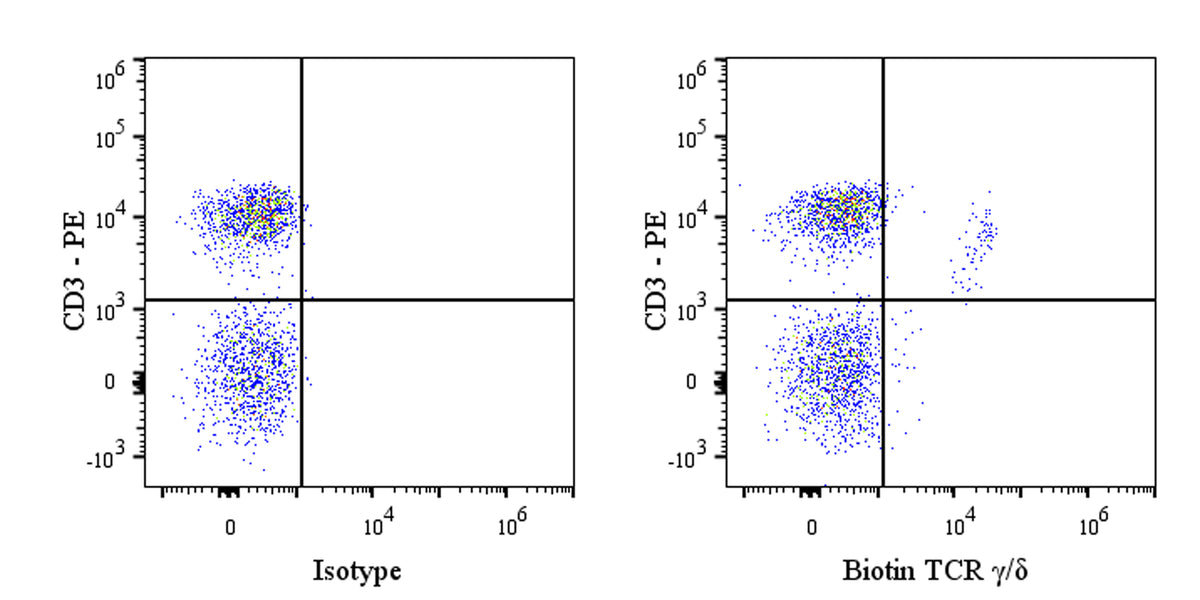
Flow cytometric analysis of rat CD161 expression on rat peripheral blood cells. Rat peripheral blood cells were stained with PE Mouse Anti-Rat CD3 Antibody and either Biotin Mouse IgG1, κ Isotype Control (left panel) or SDT Biotin Mouse Anti-Rat TCR γ/δ Antibody (right panel) at 2 μl/test followed by Sav-iFluor 488. Flow cytometry and data analysis were performed using BD FACSymphony™ A1 and FlowJo™ software.
Biotin Mouse Anti-Rat TCR γ/δ Antibody (V65)
Biotin Mouse Anti-Rat TCR γ/δ Antibody (V65)
Price:
Regular price
$130 USD
Regular price
Sale price
$130 USD
Unit price
per
For shipping services or bulk orders, you may request a quotation.
Secure checkout with

View full details
Product Details
Product Details
Product Specification
| Host | Mouse |
| Antigen | TCR γ/δ |
| Location | Cell membrane |
| Accession | A0A8I6G2Y5 |
| Clone Number | V65 |
| Antibody Type | Mouse mAb |
| Isotype Control | S0B5431 |
| Application | FCM |
| Reactivity | Rt |
| Positive Sample | Rat peripheral blood cells |
| Purification | Protein G |
| Concentration | 0.5 mg/ml |
| Conjugation | Biotin |
| Physical Appearance | Liquid |
| Storage Buffer | PBS pH7.4, 0.09% sodium azide |
| Stability & Storage | 12 months from date of receipt / reconstitution, 2 to 8 °C as supplied |
Dilution
| application | dilution | species |
| FCM | 1μg per million cells in 100μl volume | Rt |
Background
TCR γ/δ is a heterodimeric receptor—composed of one γ and one δ chain, each with a variable (V) and constant (C) immunoglobulin-like domain plus a short cytoplasmic tail—whose extracellular V regions recognize phosphoantigens, stress molecules or butyrophilin family ligands without MHC restriction, while its membrane-proximal C regions associate with CD3δε, γε and ζζ signaling modules; upon ligand binding the γ/δ chains undergo conformational change that exposes CD3 ITAMs to Lck-mediated phosphorylation, recruiting ZAP-70 and triggering a Vav1–PLC-γ1 cascade that elevates intracellular Ca²⁺, activates PKC-θ, NFAT, NF-κB and AP-1, and thereby drives γδ T-cell cytotoxicity, cytokine release and tumor lysis.
Picture
Picture
FC