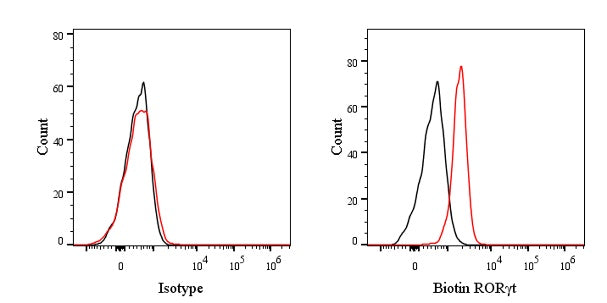
Flow cytometric analysis of RORγt expression in C57BL/6 mouse splenocytes. C57BL/6 mouse splenocytes were fixed and permeabilized with Foxp3 / Transcription Factor Staining Buffer Set. The cells were then stained with Biotin Mouse IgG2a, κ Isotype Control (left panel) or SDT Biotin Mouse Anti- Mouse RORγt Antibody at 2 μl/test (right panel) followed by Sav-iFluor 488. Flow cytometry and data analysis were performed using BD FACSymphony™ A1 and FlowJo™ software. (Black line histogram: gated on CD4⁺CD8⁻ cells; red line histogram: gated on CD4⁺CD8⁺ cells.)
Biotin Mouse Anti-Mouse RORγt Antibody (S-4440)
Biotin Mouse Anti-Mouse RORγt Antibody (S-4440)
Price:
Regular price
$155 USD
Regular price
Sale price
$155 USD
Unit price
per
For shipping services or bulk orders, you may request a quotation.
Secure checkout with

View full details
Product Details
Product Details
Product Specification
| Host | Mouse |
| Antigen | RORγt |
| Location | Nucleus |
| Accession | P51450 |
| Clone Number | S-4440 |
| Antibody Type | Mouse mAb |
| Isotype Control | S0B5432 |
| Application | ICFCM |
| Reactivity | Ms |
| Positive Sample | C57BL/6 mouse splenocytes |
| Purification | Protein A |
| Concentration | 0.5 mg/ml |
| Conjugation | Biotin |
| Physical Appearance | Liquid |
| Storage Buffer | PBS pH7.4, 0.09% sodium azide |
| Stability & Storage | 12 months from date of receipt / reconstitution, 2 to 8 °C as supplied |
Dilution
| application | dilution | species |
| ICFCM | 1μg per million cells in 100μl volume | Ms |
Background
RORγt (Retinoic Acid Receptor-Related Orphan Nuclear Receptor-γt) is a critical transcription factor in the immune system, predominantly expressed in immune cells such as Th17 cells, γδT cells, and type 3 innate lymphoid cells (ILC3s), where it serves as the "master regulator" driving the production of the pro-inflammatory cytokine IL-17. Its function is multifaceted: under normal physiological conditions, it is essential for the development of secondary lymphoid organs (e.g., lymph nodes, Peyer's patches) and the maintenance of intestinal immune homeostasis; however, its aberrant function or hyperactivation drives the pathological processes of various autoimmune and chronic inflammatory diseases (such as psoriasis, rheumatoid arthritis, multiple sclerosis, etc.). Consequently, the development of small-molecule drugs targeting its ligand-binding domain (LBD) has become a prominent focus in the treatment of these conditions, yet it also faces the challenge of suppressing its pathogenic inflammatory functions without compromising its normal immunoregulatory roles.
Picture
Picture
FC