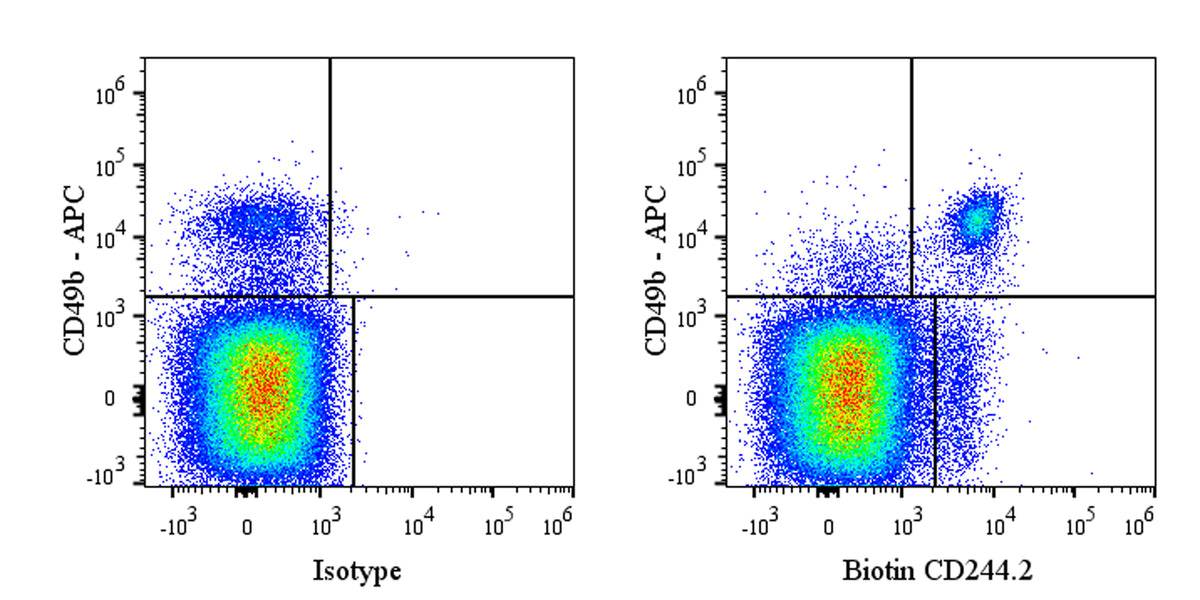
Flow cytometric analysis of CD244.2 expression on C57BL/6 mouse splenocytes. C57BL/6 mouse splenocytes were stained with APC Rat Anti-Mouse CD49b Antibody and either Biotin Mouse IgG1, κ Isotype Control (left panel) or SDT Biotin Mouse Anti-Mouse CD244.2 Antibody (right panel) at 2 μl/test followed by Sav-iFluor 488. Flow cytometry and data analysis were performed using BD FACSymphony™ A1 and FlowJo™ software.
Biotin Mouse Anti-Mouse CD244.2 Antibody (2B4)
Biotin Mouse Anti-Mouse CD244.2 Antibody (2B4)
Price:
Regular price
$35 USD
Regular price
Sale price
$35 USD
Unit price
per
For shipping services or bulk orders, you may request a quotation.
Secure checkout with

View full details
Product Details
Product Details
Product Specification
| Host | Mouse |
| Antigen | CD244.2 |
| Synonyms | Natural killer cell receptor 2B4; NK cell type I receptor protein 2B4 (NKR2B4); Non-MHC restricted killing associated; SLAM family member 4 (SLAMF4); Signaling lymphocytic activation molecule 4; 2b4; Nmrk; Cd244 |
| Location | Cell membrane |
| Accession | Q07763 |
| Clone Number | 2B4 |
| Antibody Type | Mouse mAb |
| Isotype | IgG1,k |
| Isotype Control | S0B5431 |
| Application | FCM |
| Reactivity | Ms |
| Positive Sample | C57BL/6 mouse splenocytes |
| Purification | Protein G |
| Concentration | 0.5 mg/ml |
| Conjugation | Biotin |
| Physical Appearance | Liquid |
| Storage Buffer | PBS pH7.4, 0.09% sodium azide |
| Stability & Storage | 12 months from date of receipt / reconstitution, 2 to 8 °C as supplied |
Dilution
| application | dilution | species |
| FCM | 1μg per million cells in 100μl volume | Ms |
Background
CD244.2, also known as natural killer cell receptor 2B4 isoform 2 precursor, is a type-I transmembrane protein belonging to the signaling lymphocytic activation molecule (SLAM) family. It is encoded by the CD244 gene and primarily expressed in various immune cells such as NK cells, T cells, monocytes, eosinophils, myeloid-derived suppressor cells, and dendritic cells. This protein mainly binds to its ligand CD48, another SLAM family member, to transmit stimulatory or inhibitory signals and regulate immune responses, including NK cell-mediated cytotoxicity, leukocyte activation, and cytokine production. CD244.2 plays a crucial role in the immune system and has potential as a therapeutic target in cancer and other immune-related diseases.
Picture
Picture
FC