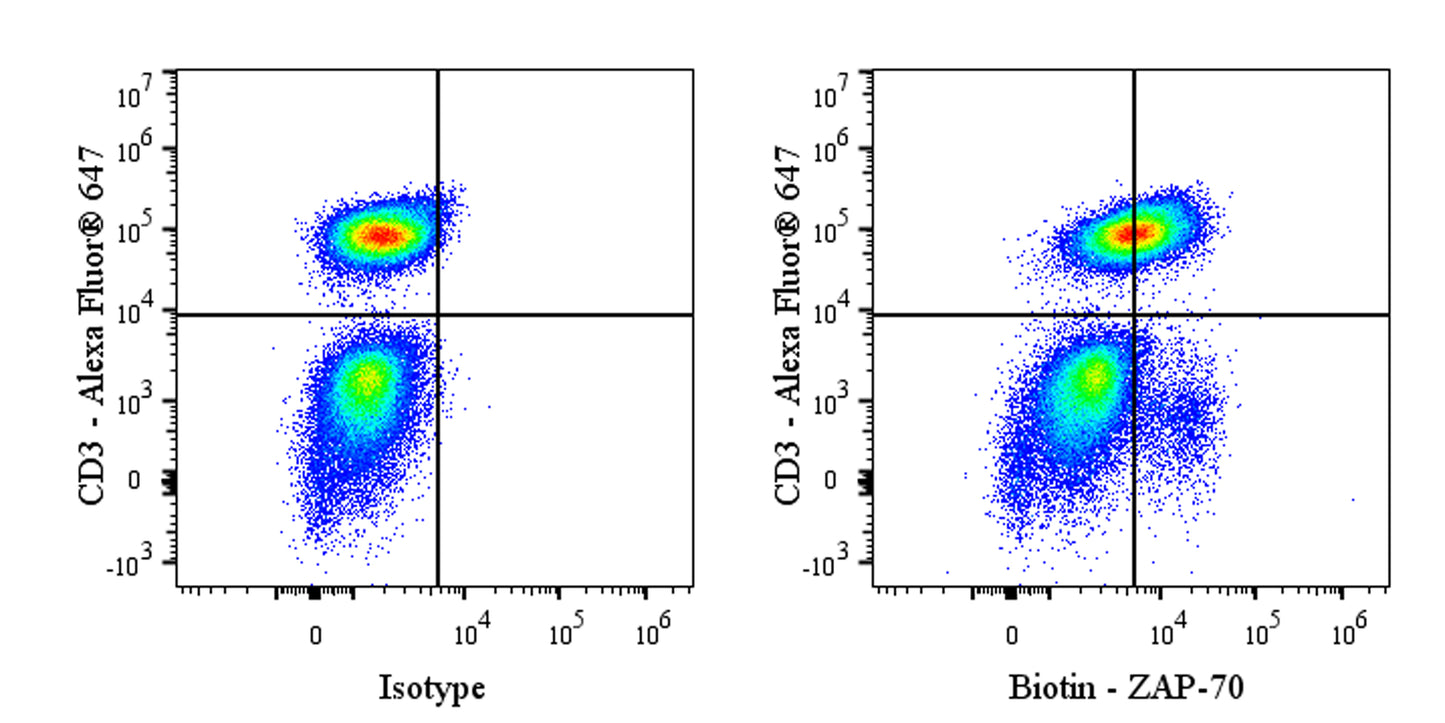
Human PBMCS (human peripheral blood mononuclear cells) were stained with Alexa Fluor® 647 Mouse Anti-Human CD3 and then fixed and permeabilized with Foxp3/Transcription Factor Fixation/Permeabilization buffer and then intracellularly stained with SDT Biotin Mouse Anti-Human/Mouse ZAP-70 Antibody at 2 μl/test / (right panel) compared with a Mouse IgG1, k Isotype Control / (left panel) followed by Sav-iFluor 488. Total viable cells, as determined by Fixable Viability Dye 452 (S0B88801), were used for analysis. Flow cytometry and data analysis were performed using BD FACSymphony™ A1 and FlowJo™ software.
Biotin Mouse Anti-Human/Mouse ZAP-70 Antibody (1E7.2)
Biotin Mouse Anti-Human/Mouse ZAP-70 Antibody (1E7.2)
Price:
Regular price
$70 USD
Regular price
Sale price
$70 USD
Unit price
per
For shipping services or bulk orders, you may request a quotation.
Secure checkout with

View full details
Product Details
Product Details
Product Specification
| Host | Mouse |
| Antigen | Zap-70 |
| Synonyms | Tyrosine-protein kinase ZAP-70; 70 kDa zeta-chain associated protein; Syk-related tyrosine kinase; SRK; ZAP70 |
| Location | Cell membrane, Cytoplasm |
| Accession | P43403、P43404 |
| Clone Number | 1E7.2 |
| Antibody Type | Mouse mAb |
| Isotype | IgG1,k |
| Isotype Control | S0B5431 |
| Application | FCM |
| Reactivity | Hu, Ms |
| Positive Sample | Human PBMC |
| Purification | Protein G |
| Concentration | 0.5 mg/ml |
| Conjugation | Biotin |
| Physical Appearance | Liquid |
| Storage Buffer | PBS pH7.4, 0.09% sodium azide |
| Stability & Storage | 12 months from date of receipt / reconstitution, 2 to 8 °C as supplied |
Dilution
| application | dilution | species |
| FCM | 1μg per million cells in 100μl volume | Hu, Ms |
Background
ZAP-70 (Zeta-chain-associated protein kinase 70) is a cytoplasmic protein tyrosine kinase that plays a crucial role in T cell receptor (TCR) signaling and is essential for T cell activation and development. It is primarily expressed in T cells, natural killer cells, and a subset of B cells. When the TCR binds to an antigen, the tyrosine kinase Lck is activated, phosphorylating the immunoreceptor tyrosine-based activation motifs (ITAMs) on the CD3 complex. These phosphorylated ITAMs serve as docking sites for ZAP-70, which is then activated and phosphorylates downstream molecules such as the linker for activation of T cells (LAT) and the SH2-domain-containing leukocyte protein of 76 kDa (SLP-76). This cascade of events leads to T cell activation, proliferation, and differentiation. In addition, ZAP-70 expression in B cells is associated with chronic lymphocytic leukemia (CLL), making it a potential biomarker and therapeutic target.
Picture
Picture
FC