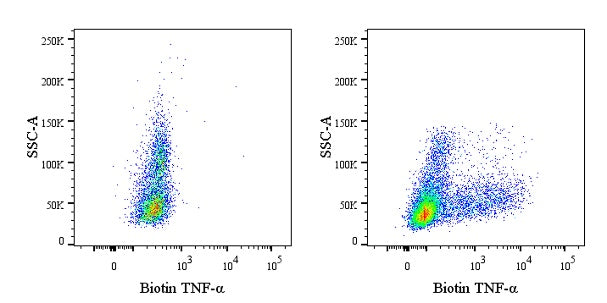
Flow cytometric analysis of TNF-α expression in stimulated Human PBMCs (human peripheral blood mononuclear cells). Human PBMCs were cultured 6hr with 50ng/ml PMA and 1 μg/ml Ionomycin in the presence of 1 μg/ml BFA (right panel) or untreated (left panel). The PBMCs were harvested and fixed with 4% PFA and permeabilized with Intracellular Fixation & Permeabilization Buffer Set. The cells were then stained with Biotin Mouse Anti-Human TNF-α Antibody at 2 μl/test followed by Sav-PE. Flow cytometry and data analysis were performed using BD FACSymphony™ A1 and FlowJo™ software.
Biotin Mouse Anti-Human TNF-α Antibody (MAb11)
Biotin Mouse Anti-Human TNF-α Antibody (MAb11)
Price:
Regular price
$125 USD
Regular price
Sale price
$125 USD
Unit price
per
For shipping services or bulk orders, you may request a quotation.
Secure checkout with

View full details
Product Details
Product Details
Product Specification
| Host | Mouse |
| Antigen | TNF alpha |
| Location | Secreted |
| Accession | P01375 |
| Clone Number | MAb11 |
| Antibody Type | Mouse mAb |
| Isotype Control | S0B5431 |
| Application | ICFCM |
| Reactivity | Hu |
| Positive Sample | Human PBMCs stimulated with PMA and BFA |
| Purification | Protein A |
| Concentration | 0.1 mg/ml |
| Conjugation | Biotin |
| Physical Appearance | Liquid |
| Storage Buffer | PBS pH7.4, 0.09% sodium azide |
| Stability & Storage | 12 months from date of receipt / reconstitution, 2 to 8 °C as supplied |
Dilution
| application | dilution | species |
| ICFCM | 2μl per million cells in 100μl volume | Hu |
Background
Tumor necrosis factor alpha (TNF-α) is a pleiotropic, 17-kDa homotrimeric cytokine synthesized chiefly by activated macrophages but also by T cells, NK cells, fibroblasts, and adipocytes; it signals through two distinct receptors, TNFR1 and TNFR2, to orchestrate a vast array of biological processes including activation of NF-κB and MAPK pathways that drive pro-inflammatory gene expression, induction of fever, chemokine secretion for leukocyte recruitment, enhancement of cytotoxic CD8+ T cell responses, and promotion of apoptosis or necroptosis via caspase-8 or RIPK1/RIPK3 signaling, while also mediating cachexia and insulin resistance in chronic inflammation, and its dysregulated overproduction is a central driver of rheumatoid arthritis, inflammatory bowel disease, psoriasis, sepsis, and neurodegeneration, making it a prime therapeutic target for monoclonal antibodies such as infliximab, adalimumab, and certolizumab pegol.
Picture
Picture
FC