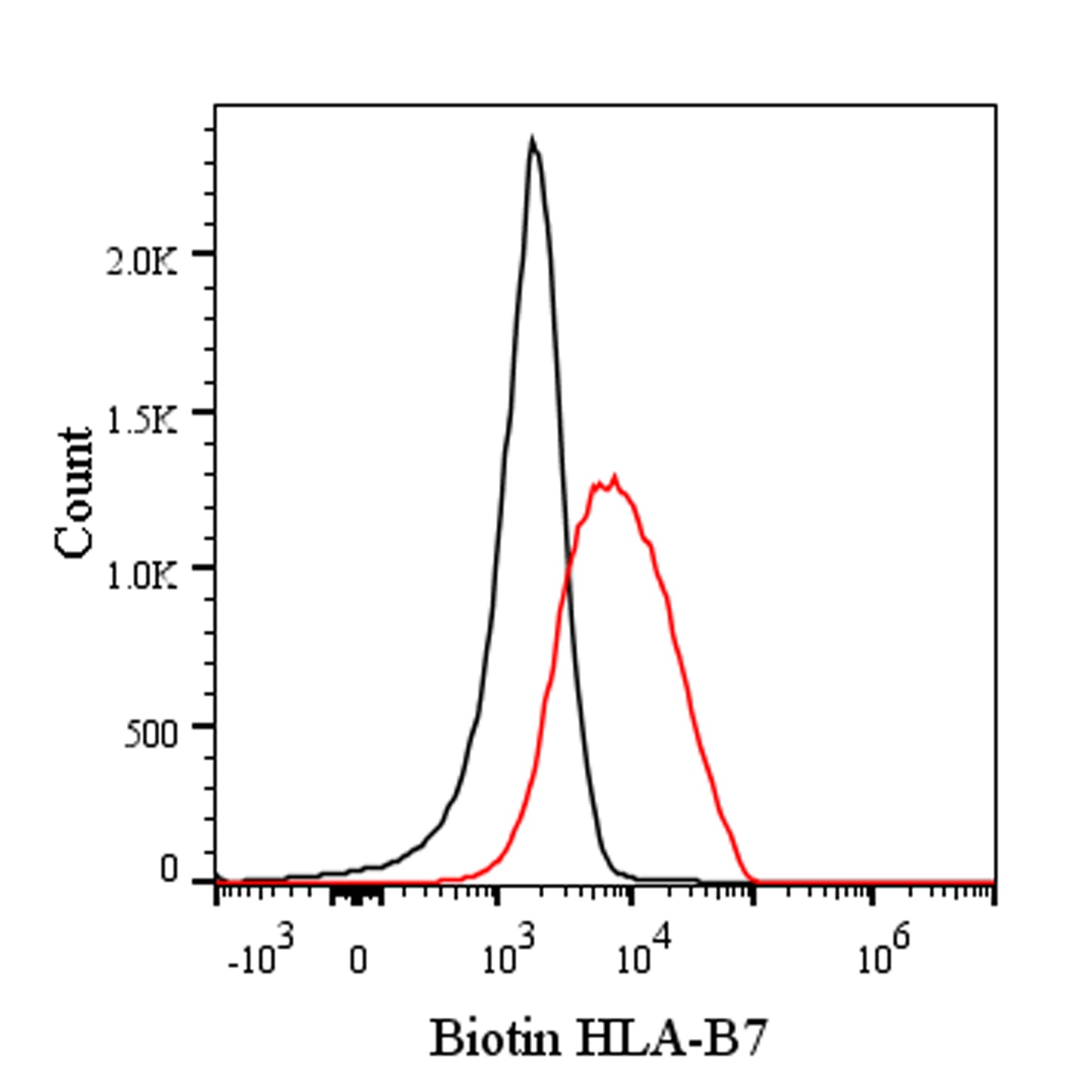
Flow cytometric analysis of Human HLA-B7 expression on Jurkat (human T cell leukemia T lymphocyte). Jurkat were stained with Biotin Mouse IgG1, k Isotype Control (black line histogram) or Biotin Mouse Anti-Human HLA-B7 Antibody (red line histogram) at 1.25 μl/test followed by Sav-iFluor 488. Flow cytometry and data analysis were performed using BD FACSymphony™ A1 and FlowJo™ software.
Biotin Mouse Anti-Human HLA-B7 Antibody (BB7.1)
Biotin Mouse Anti-Human HLA-B7 Antibody (BB7.1)
Price:
Regular price
$150 USD
Regular price
Sale price
$150 USD
Unit price
per
For shipping services or bulk orders, you may request a quotation.
Secure checkout with

View full details
Product Details
Product Details
Product Specification
| Host | Mouse |
| Antigen | HLA-B7 |
| Synonyms | HLA class I histocompatibility antigen, B alpha chain; HLAB; HLA-B |
| Location | Cell membrane, Endoplasmic reticulum membrane |
| Accession | P01889 |
| Clone Number | BB7.1 |
| Antibody Type | Mouse mAb |
| Isotype | IgG1,k |
| Application | FCM |
| Reactivity | Hu |
| Positive Sample | Jurkat |
| Purification | Protein G |
| Concentration | 0.2 mg/ml |
| Conjugation | Biotin |
| Physical Appearance | Liquid |
| Storage Buffer | PBS pH7.4, 0.03% Proclin 300 |
| Stability & Storage | 12 months from date of receipt / reconstitution, 2 to 8 °C as supplied |
Dilution
| application | dilution | species |
| FCM | 5μl per million cells in 100μl volume | Hu |
Background
HLA-B7, also known as HLA-B*07:02, is a specific allele of the human leukocyte antigen B (HLA-B) gene located on the short arm of chromosome 6, encoding a major histocompatibility complex (MHC) class I cell surface receptor that plays a pivotal role in the adaptive immune system by presenting endogenous peptide fragments to CD8+ cytotoxic T cells for immune surveillance. This highly polymorphic protein consists of a heavy chain non-covalently associated with beta-2 microglobulin, forming a groove that binds and displays intracellular peptides derived from normal cellular metabolism or pathogenic infections, thereby enabling the immune system to distinguish self from non-self. Clinically, HLA-B7 is significant not only for its involvement in transplant rejection scenarios due to alloimmune responses but also for its well-documented associations with various autoimmune disorders, such as multiple sclerosis and psoriasis, as well as its potential influence on susceptibility to certain viral infections and cancer progression, making it a critical marker in immunogenetics, personalized medicine, and vaccine development research.
Picture
Picture
FC